Clear Sky Science · en
Housing structure shapes dengue transmission dynamics in a rapidly urbanizing Malaysian district
Why the Place You Live Matters for Dengue
Dengue fever is often blamed on mosquitoes and rainy weather, but this study from Kuala Selangor, Malaysia, shows that the shape and style of our homes play a powerful role too. By tracking more than 5,000 confirmed dengue cases over five years and mapping where people lived, the researchers reveal how different types of housing can either spark explosive outbreaks or quietly keep the virus circulating all year long.
A Growing Town on the Edge of City and Countryside
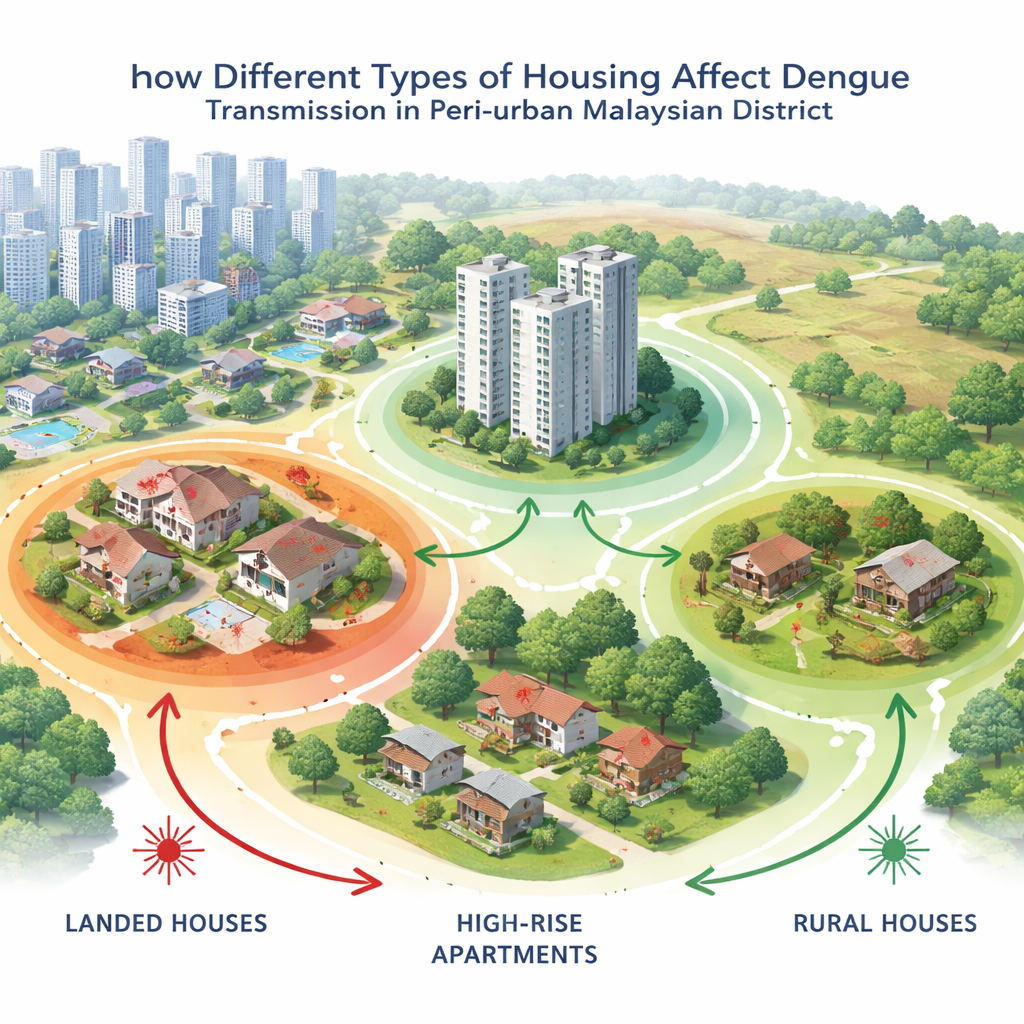
Kuala Selangor is a rapidly changing district where new housing estates, high-rise blocks, and traditional villages sit side by side. This mix of building styles makes it an ideal place to ask a simple but overlooked question: which kinds of homes see the most dengue, and when? The team combined national health records, local housing data, satellite maps, and even drone images to pinpoint each patient’s home and classify it into five groups: landed houses with yards, high-rise apartments, traditional rural houses, institutional quarters such as hostels or government housing, and a small "other" category. They then examined how case numbers rose and fell over time and where clusters repeatedly formed on the map.
Yard Homes as Outbreak Engines
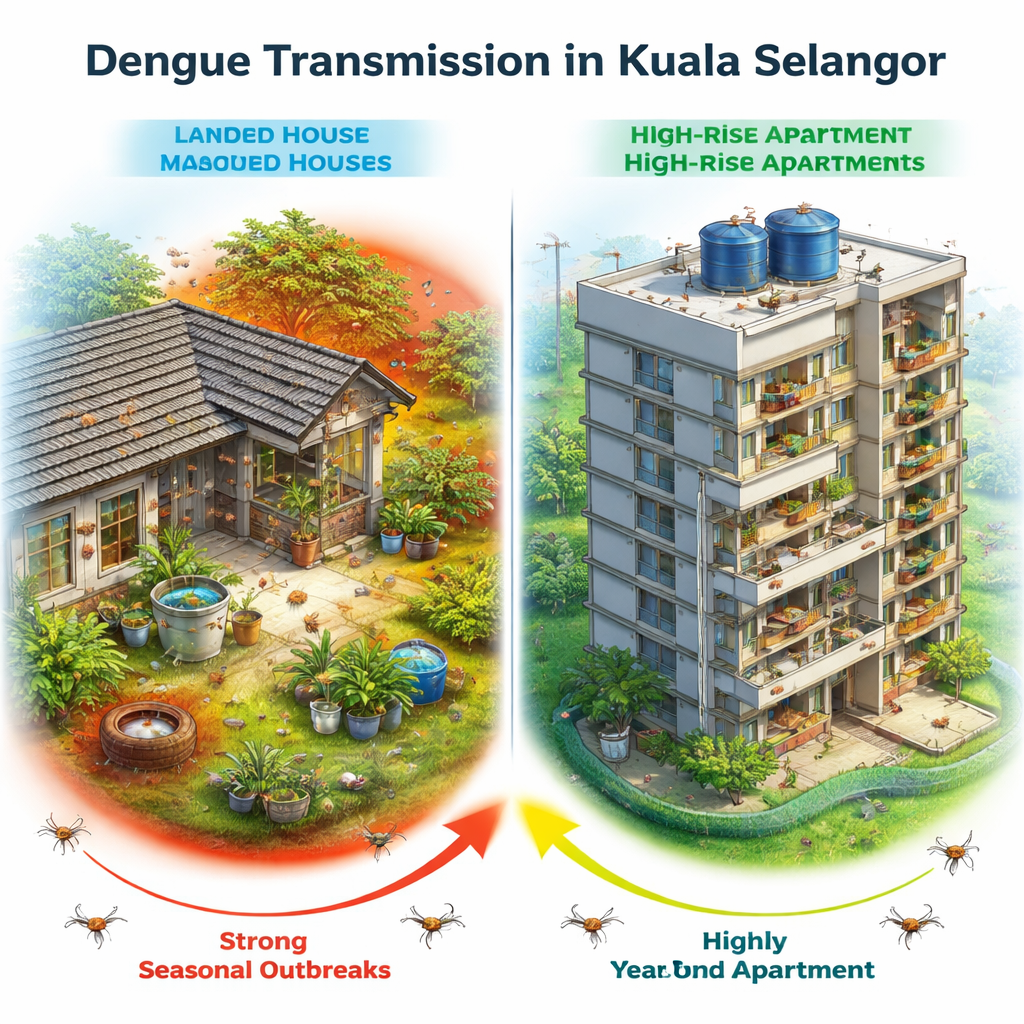
The results were striking. Landed properties—terrace houses, semi-detached homes, and stand-alone houses with individual compounds—accounted for about three quarters of all dengue cases. These homes drove the big, predictable spikes in illness that hit between weeks 20 and 35 of the year, lining up with Malaysia’s southwest monsoon. Heavy rain, roof gutters, garden pots, and other outdoor containers create countless puddles where Aedes mosquitoes can breed. When these populations surge, so do infections. The maps showed that the most stubborn hotspots appeared in peri-urban landed estates in the central and southern parts of the district, where moderate housing density, vegetation, and mixed land use combine to favor mosquito survival.
Apartment Blocks as Silent Reservoirs
High-rise apartments told a different story. They made up only around one sixth of total cases, but dengue never truly disappeared from these buildings. Instead of sharp peaks, apartments showed a steady trickle of infections across almost every week of the year. The researchers suggest that indoor and semi-indoor features—such as rooftop water tanks, corridor drains, shared facilities, and balcony plants—offer sheltered water sources that are less affected by dry spells. In effect, high-rise housing appears to act as a quiet reservoir: it keeps dengue smoldering during low season and may help re-seed outbreaks in nearby landed neighborhoods once the rains return.
Traditional Villages and Special Housing on the Sidelines
Traditional rural homes, institutional quarters, and mixed or unclassified housing types played only a minor role in the overall picture. These places saw occasional short-lived spikes in cases but did not sustain ongoing clusters year after year. This pattern suggests that many of these infections may be tied to local flare-ups, imported cases, or temporary lapses in environmental management, rather than the kind of entrenched, structural risk seen in large landed estates or densely occupied high-rise complexes.
Turning Maps into Targeted Action
By tying dengue patterns so clearly to housing type, the study offers a roadmap for smarter, more focused control efforts. Instead of treating all neighborhoods the same, the authors argue for housing-specific tactics within Malaysia’s Integrated Vector Management framework. In landed areas, that means organizing pre-monsoon clean-up campaigns, fixing roof gutters, clearing outdoor containers, and managing construction sites and yards before mosquito numbers explode. In high-rise buildings, the priority shifts to routine checks of rooftop tanks and corridor drains, better maintenance of shared spaces, and educating residents about indoor breeding spots. For health authorities and urban planners, the message is straightforward: how and where we build homes can help determine whether dengue flares up, fades out, or lingers year-round—and tailoring prevention to those built environments may be one of the most effective ways to keep communities safe.
Citation: Dom, N.C., Hisyam, A.N.S., Saeman, M.N. et al. Housing structure shapes dengue transmission dynamics in a rapidly urbanizing Malaysian district. Sci Rep 16, 6840 (2026). https://doi.org/10.1038/s41598-026-35904-9
Keywords: dengue, housing, urbanization, mosquito, Malaysia