Clear Sky Science · en
Isolation, characterisation and potential applications of a novel bacteriophage targeting beta-lactam-resistant Staphylococcus saprophyticus
Why tiny viruses might help with stubborn infections
Urinary tract infections are among the most common bacterial illnesses worldwide, and many are now caused by germs that shrug off standard antibiotics. One such culprit, Staphylococcus saprophyticus, lives harmlessly on our skin and in the genital area but can move into the urinary tract and cause painful, recurring infections, especially in women. This study explores an unusual ally against this microbe: a newly discovered virus that infects bacteria, called a bacteriophage, which can kill drug‑resistant S. saprophyticus and strip away its protective slime layers and odour‑causing colonies on skin and fabrics.
A hidden troublemaker in everyday life
Staphylococcus saprophyticus is a normal resident of the human body, colonising the gut, urethra, cervix and skin. Yet it is also the second most frequent cause of urinary tract infections in women and can affect older men as well. It forms sticky biofilms—dense bacterial communities glued to surfaces—that make it harder for antibiotics to work and help the microbe cling to bladder and urethral cells. Many strains now resist several important beta‑lactam antibiotics, including some that were designed to withstand bacterial penicillin‑breaking enzymes. Beyond UTIs, this organism has been linked to food spoilage, skin and eye infections, body odour and even fertility problems in men, making it a wider hygiene and health concern.
Finding a virus that hunts resistant bacteria
To look for a natural enemy of this bacterium, the researchers first isolated a stubborn, beta‑lactam‑resistant S. saprophyticus strain from smelly socks. They then screened sewage samples—a rich source of bacterial viruses—and identified a phage they named ØPh_SS01 that specifically attacks this strain. Under the electron microscope, the phage showed a classic head‑and‑tail structure typical of many bacterial viruses. Laboratory tests revealed that ØPh_SS01 can also infect several related staphylococcal species and one Bacillus species, giving it a moderately broad host range that could be useful for tackling multiple troublesome skin and environmental bacteria while remaining far more targeted than standard antibiotics.
A durable and effective bacterial killer
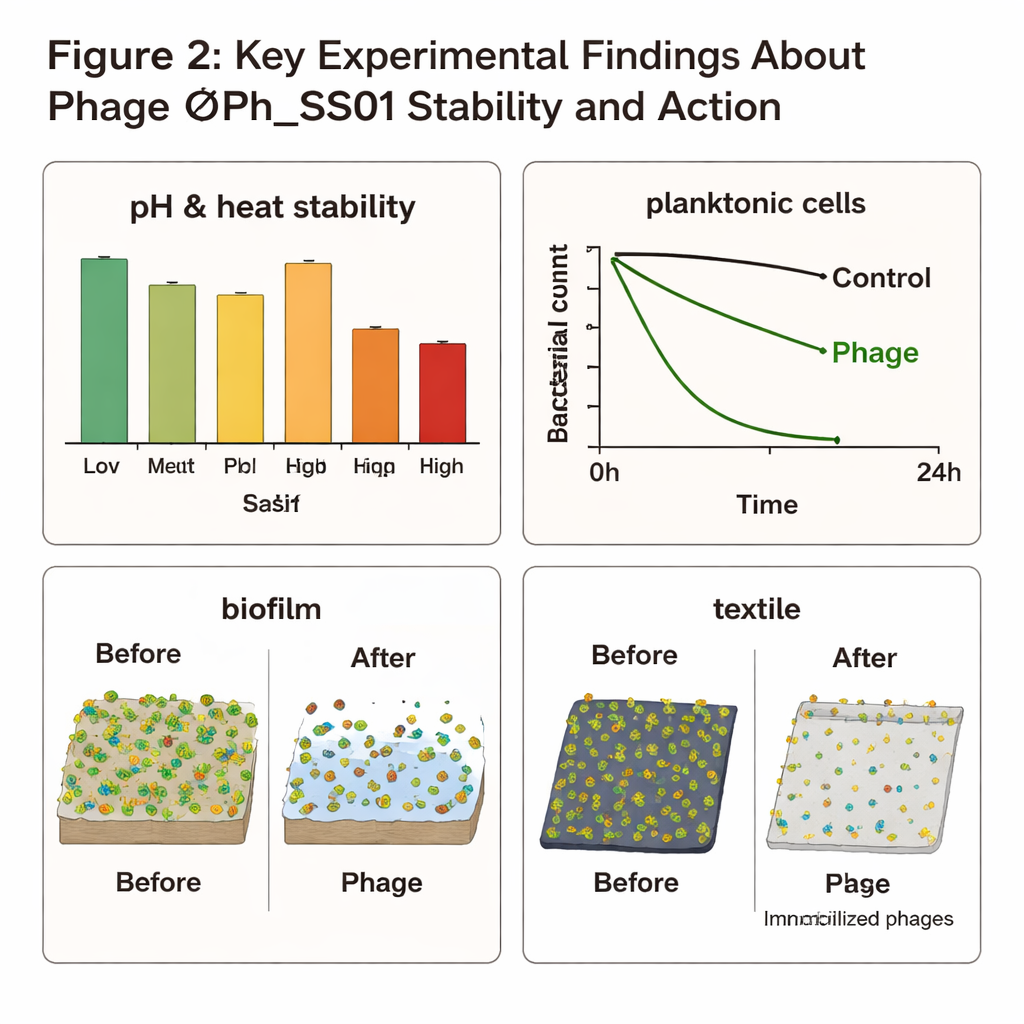
ØPh_SS01 proved surprisingly hardy. It stayed active across a broad range of acidity, temperatures from fridge‑cold to body heat and high salt levels, and it tolerated organic solvent treatment used to purify it. In liquid culture, adding the phage to S. saprophyticus led to about a seven‑log (ten‑million‑fold) drop in bacterial numbers within 24 hours. It also worked well at stopping and breaking down biofilms: at a generous phage dose, it prevented roughly three‑quarters of biofilm formation and removed about two‑thirds of already formed biofilm. Tests on human skin‑like cells and bladder‑derived cells showed that the phage did not noticeably harm mammalian cells, supporting its safety for potential use on or in the body.
From lab bench to textiles and hygiene
The team also explored how this phage might be used in real‑world settings. When ØPh_SS01 was immobilised on cotton textile pieces and then exposed to S. saprophyticus, the number of live bacteria on the fabric fell by roughly seven orders of magnitude over time, and in many samples bacteria became undetectable. This proof‑of‑concept suggests that phage‑coated materials—such as socks, underwear, sanitary pads, or wound dressings—could actively reduce bacterial load and associated odour or infection risk, rather than merely absorbing moisture. Genomic analysis showed that ØPh_SS01 is a previously unreported member of the Caudoviricetes class with a 47‑kilobase double‑stranded DNA genome and genes consistent with a temperate lifestyle, meaning it can either destroy bacteria outright or integrate quietly into their DNA.
What this means for everyday health
For non‑specialists, the take‑home message is that carefully chosen “good” viruses can be used as precision tools against “bad” bacteria that no longer respond to common antibiotics. This new phage, ØPh_SS01, can dramatically reduce a UTI‑associated, drug‑resistant bacterium in lab tests, chip away at its biofilms, and function when bound to fabrics without harming human cells. Although more work is needed to convert a temperate phage into a purely bacteria‑killing therapy and to test it in animals and people, the study points toward future soaps, sprays, dressings and clothing that are actively self‑disinfecting—helping to prevent infections and reduce our dependence on increasingly unreliable antibiotics.
Citation: Gopika, O., Sarat, N., Manikandan, M. et al. Isolation, characterisation and potential applications of a novel bacteriophage targeting beta-lactam-resistant Staphylococcus saprophyticus. Sci Rep 16, 7460 (2026). https://doi.org/10.1038/s41598-026-35899-3
Keywords: urinary tract infections, bacteriophage therapy, Staphylococcus saprophyticus, antibiotic resistance, biofilm control