Clear Sky Science · en
Comparison of kinetic adaptations in gait initiation following exergaming and balance training in athletes with chronic ankle instability
Why Pausing Before a Step Matters
For most of us, taking the first step is effortless. But for athletes with chronic ankle instability—those ankles that keep "giving way" after repeated sprains—that first step can be risky. The brief moment when the body shifts from standing still to moving forward demands precise balance and control. This study explores whether a playful, video game–style form of rehab called exergaming can fine‑tune that crucial first step better than traditional balance exercises.
When a Simple Step Becomes a Challenge
Ankle sprains are among the most common sports injuries, and many athletes go on to develop chronic ankle instability. They live with pain, a sense that the ankle is unreliable, and a higher risk of new sprains and early joint wear. A key problem is impaired postural control—the body’s ability to keep its center of mass over the feet, especially when movement begins. The act of starting to walk, known as gait initiation, is a perfect stress test: the body must briefly tip itself off balance to move forward and to one side, then catch itself on a single leg. In people with unstable ankles, the tiny shifts of pressure under the feet during this sequence tend to be smaller and slower, signaling cautious, less efficient movement.
Gaming Your Way to Better Balance
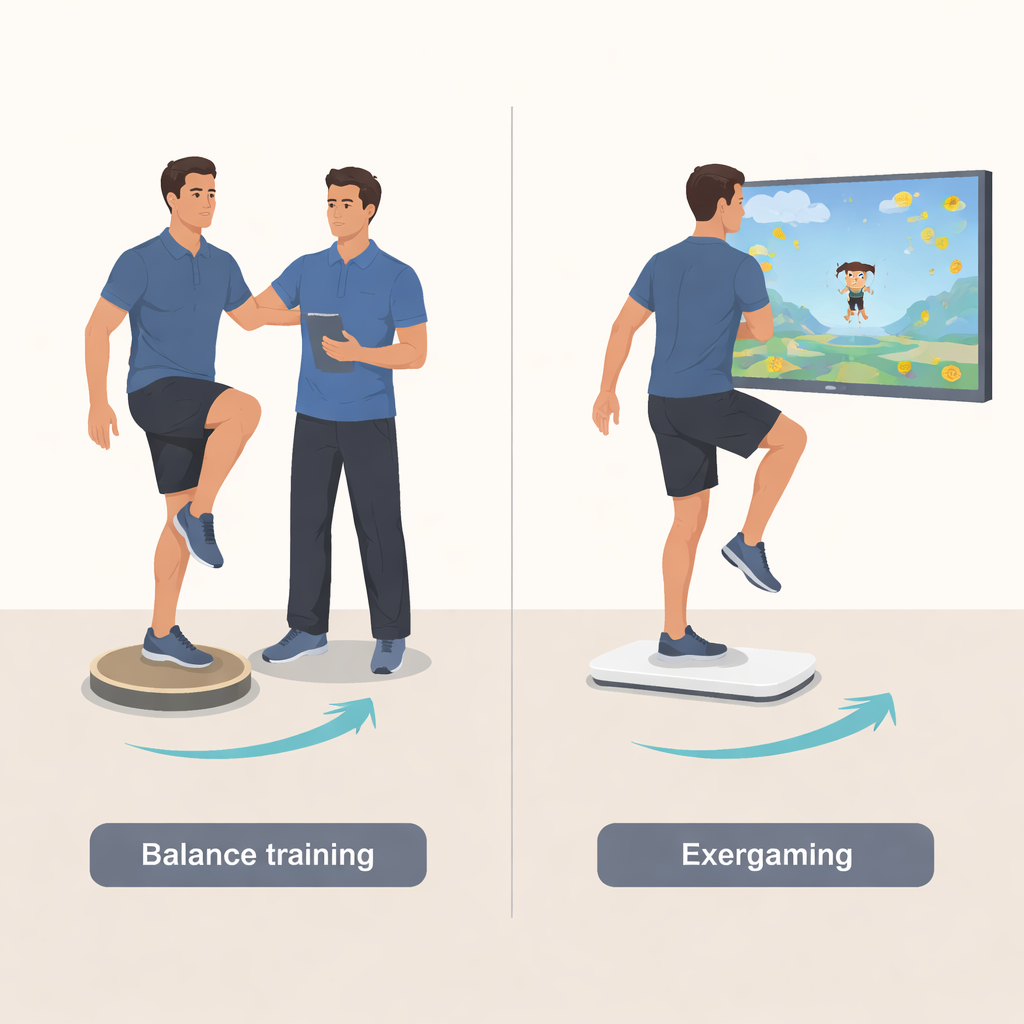
To see whether exergaming could help, researchers recruited 34 recreational athletes with chronic ankle instability and randomly assigned them to two groups. One group performed classic balance training: single‑leg stands, hopping to stable landings, and ball‑kicking drills on firm and unstable surfaces, all supervised by a therapist. The other group trained on a Wii Balance Board, playing ten different games that required shifting weight in multiple directions, maintaining one‑leg balance, and reacting quickly to visual challenges. Both groups trained three times a week for four weeks, with each 60‑minute session carefully progressed in difficulty.
Measuring the Invisible Shifts Underfoot
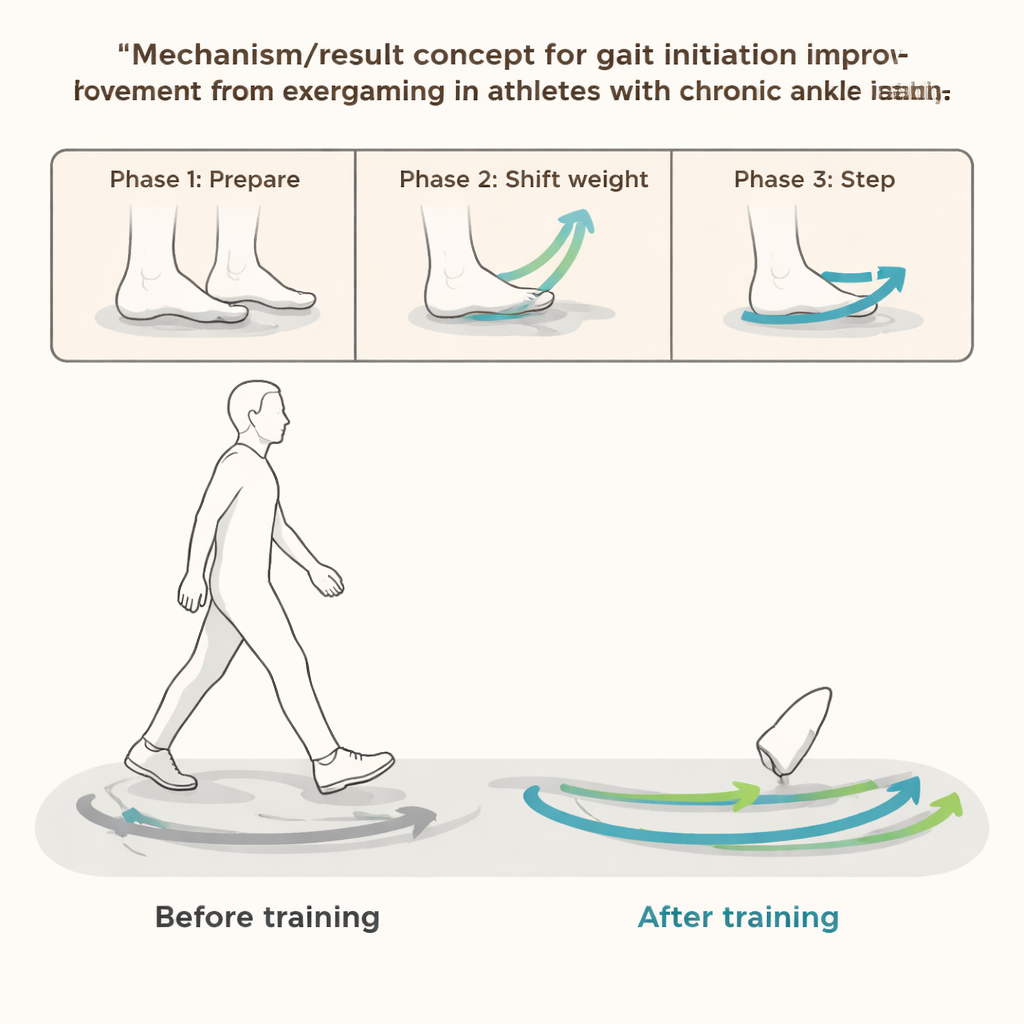
The scientists focused on how the center of pressure—the point where the body’s weight is effectively applied to the ground—moved during three parts of the first step: the anticipatory phase (preparing to move), the weight‑transition phase (shifting the body forward), and the locomotor phase (actually stepping). Using a force plate under the feet, they measured how far and how fast this pressure point moved forward–backward and side‑to‑side before training, after four weeks, and again one month later. These patterns reveal how confidently and efficiently the brain and muscles prepare for, and control, movement.
What Improved—and What Didn’t
After training, the exergaming group showed a clear advantage in the very first part of the step. During the anticipatory phase, their forward‑backward pressure shifts became faster than those of the balance‑training group, suggesting more decisive preparation to move. However, this edge faded by the one‑month follow‑up, hinting that the nervous system benefits may be short‑lived without ongoing practice. In the later phases of the step, both groups improved in similar ways. They shifted their weight forward more effectively and reduced excessive sideways drift toward the stepping leg, indicating better forward drive and lateral stability. These gains were partially to fully maintained after a month. When all measures were combined, exergaming offered only a small but statistically reliable overall advantage.
What This Means for Injured Athletes
In plain terms, video game–based rehab seems especially good at sharpening the brain’s "get ready to move" signal—the split‑second adjustments before the first step that protect an already vulnerable ankle. Traditional balance exercises, meanwhile, are just as effective at improving how the body shifts and controls weight once movement is underway. Because the exergaming boost in early preparation did not last, athletes may need continued or booster sessions, or a mix of exergaming and classic drills, to cement these benefits. Still, by making rehab more engaging while targeting critical moments in movement, exergaming offers a promising tool for helping athletes with unstable ankles step back into sport more safely.
Citation: Sarkhosh, S.S., Khanmohammadi, R. Comparison of kinetic adaptations in gait initiation following exergaming and balance training in athletes with chronic ankle instability. Sci Rep 16, 6287 (2026). https://doi.org/10.1038/s41598-026-35898-4
Keywords: chronic ankle instability, exergaming, balance training, gait initiation, sports rehabilitation