Clear Sky Science · en
Lanthanide–carbamazepine complexes: synthesis, spectroscopic characterization, DFT Insights, molecular docking, and biological evaluation
Why this epilepsy drug is getting a high-tech makeover
Carbamazepine is a long‑standing medicine used to treat epilepsy and mood disorders, but it has limits: it dissolves poorly in water, can persist as a pollutant in rivers, and was not designed with modern cancer or infection treatments in mind. In this study, researchers gave carbamazepine a chemical “upgrade” by attaching it to special metals called lanthanides and then testing whether these new compounds could act as powerful, targeted agents against microbes and cancer cells.
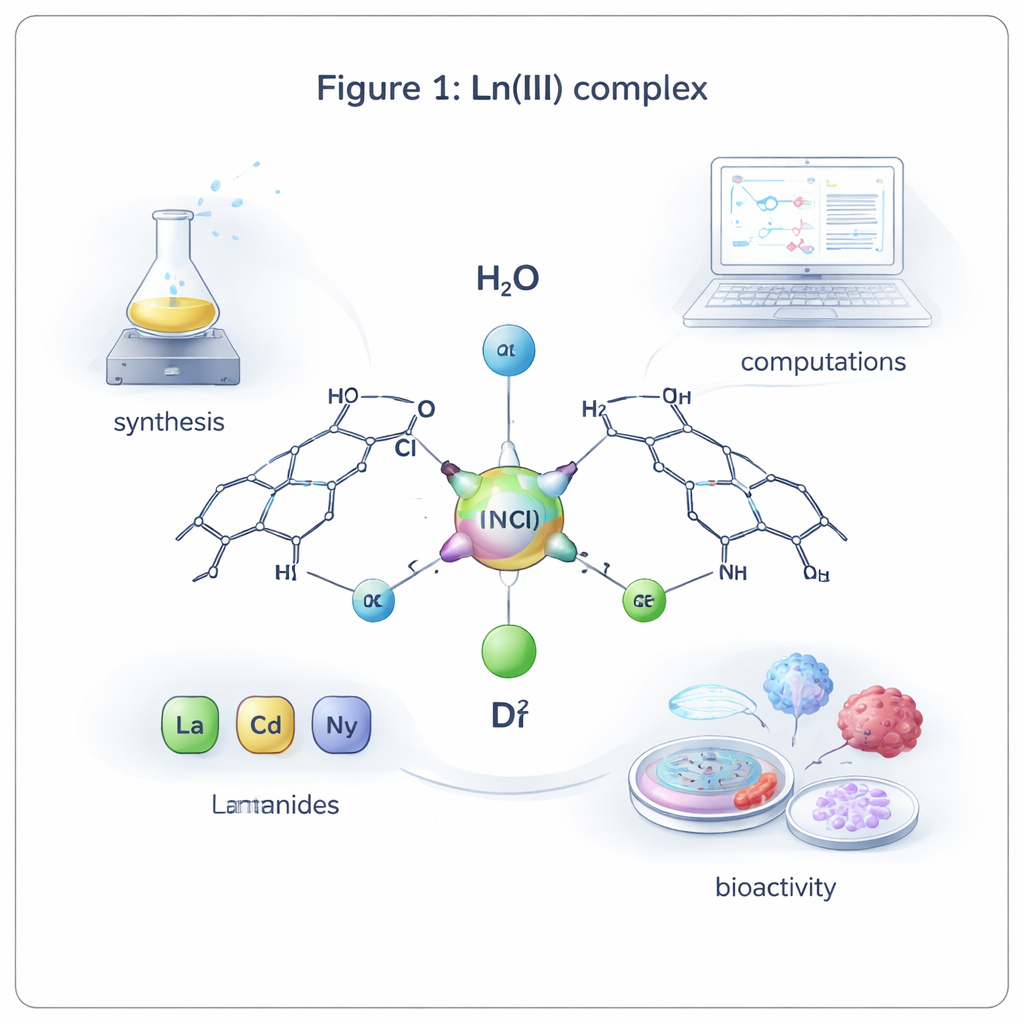
Building new molecules from a familiar pill
The team focused on four lanthanide metals—lanthanum, cerium, neodymium, and dysprosium—chosen for their useful magnetic and optical properties and growing medical applications. They reacted each metal with carbamazepine in a warm alcohol solution, forming four closely related metal–drug complexes in a 1:2 ratio (one metal ion bound to two carbamazepine molecules). Careful laboratory measurements showed that each complex has a similar overall formula and behaves as an electrolyte, meaning parts of the molecule can separate into charged pieces in solution, a feature that can affect how it travels in the body.
Peering into shape and structure
To understand what they had made, the scientists used a toolkit of spectroscopic and structural methods, including infrared and nuclear magnetic resonance spectroscopy, X‑ray diffraction, and thermal analysis. These tests all pointed to the same picture: in the new compounds, carbamazepine grips the metal through two atoms in its amide group—one nitrogen and one oxygen—so that each metal ends up surrounded by six partners in a slightly distorted octahedral shape. Computer calculations based on density functional theory backed up this geometry and showed that, once bound to the metal, the electronic properties of carbamazepine change in ways that can make the complexes more reactive and more stable than the free drug, a promising combination for medical use.
From test tubes to microbes and cancer cells
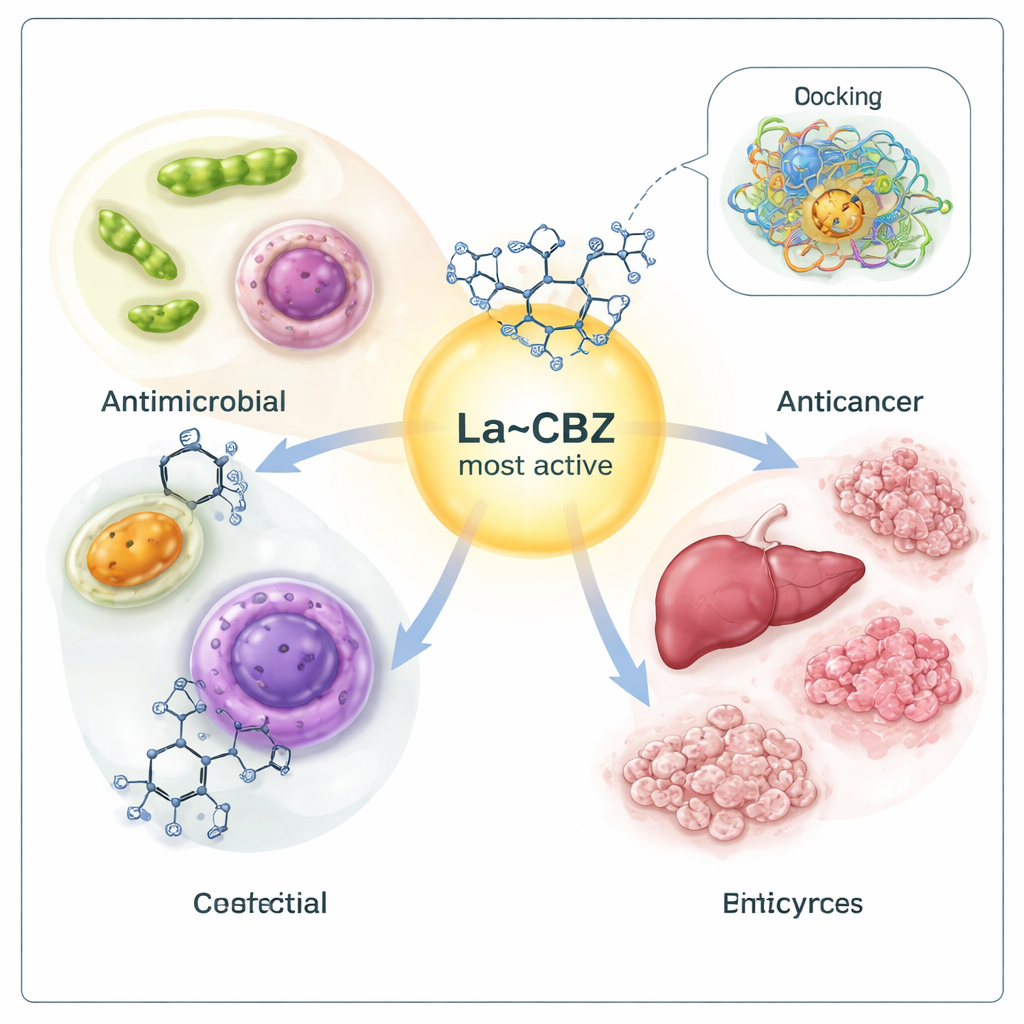
The next question was biological: do these designer molecules actually do anything useful to living cells? In petri‑dish tests, the complexes were challenged with several disease‑causing bacteria and fungi. The plain carbamazepine molecule showed little to no effect, but all four metal complexes inhibited at least some microbes, with the lanthanum version giving the largest clear “kill zones,” even rivaling or surpassing a standard antifungal drug against one mold species. The researchers then exposed human liver (Hep‑G2) and breast (MCF‑7) cancer cell lines to the same compounds. Again, the metal–drug complexes outperformed carbamazepine alone, damaging or killing cancer cells at far lower concentrations. Among them, the lanthanum complex stood out, showing the strongest tumor‑killing action while remaining within a range comparable to a widely used chemotherapy agent.
How the molecules may lock onto disease targets
To explore why the lanthanum complex was so potent, the team turned to molecular docking simulations—computer models that show how a small molecule might fit into the nooks and crannies of a protein. They examined bacterial proteins and key enzymes linked to liver and breast cancers. The simulations suggested that the lanthanum–carbamazepine complex nestled most snugly into these protein binding pockets, creating strong interactions that could disrupt normal function. In energy terms, lower (more negative) docking energies indicated tighter binding, and the lanthanum complex consistently gave the most favorable values, aligning with its superior performance in lab tests.
What this could mean for future medicines
Overall, this work shows that a well‑known epilepsy drug can be transformed into a new class of metal‑based compounds with promising antimicrobial and anticancer behavior. By reshaping carbamazepine around lanthanide centers, the researchers created stable, crystalline complexes that interact more strongly with biological targets than the original drug. While these findings are still at an early, preclinical stage, they point toward the possibility of using such metal–drug hybrids as future chemotherapy or anti‑infection agents, and perhaps even as imaging or delivery tools that exploit the unique optical and magnetic traits of lanthanides.
Citation: Mohamed, N.S., Mohamed, M.M.A., Shehata, M.R. et al. Lanthanide–carbamazepine complexes: synthesis, spectroscopic characterization, DFT Insights, molecular docking, and biological evaluation. Sci Rep 16, 6340 (2026). https://doi.org/10.1038/s41598-026-35893-9
Keywords: carbamazepine, lanthanide complexes, metal-based drugs, anticancer agents, antimicrobial activity