Clear Sky Science · en
Application validation and high-yield mechanism analysis of the desorption superposition effect method in Fukang block 8 based on well FS-24
Unlocking cleaner energy from coal
Natural gas trapped in coal seams, known as coalbed methane, is a cleaner fuel than coal itself. China has vast coalbed methane resources, but many wells yield disappointingly little gas. This study asks a practical question with global relevance: how can engineers make multiple thin coal layers work together so that a single well delivers far more methane, more quickly and more reliably?
Why coal seams hide so much gas
Coal is like a giant sponge filled with microscopic pores. Methane sticks to the internal surfaces of this sponge rather than floating freely, which means gas only comes out when pressure in the coal is lowered and the methane “lets go” of the coal surface. In many shallow coal fields, the pressure is low, the rock is tight, and the seams are irregularly fractured. Even when there is plenty of gas in place, it trickles out slowly, leaving operators in the frustrating situation of “reserves without production.”
Turning a physical process into a roadmap
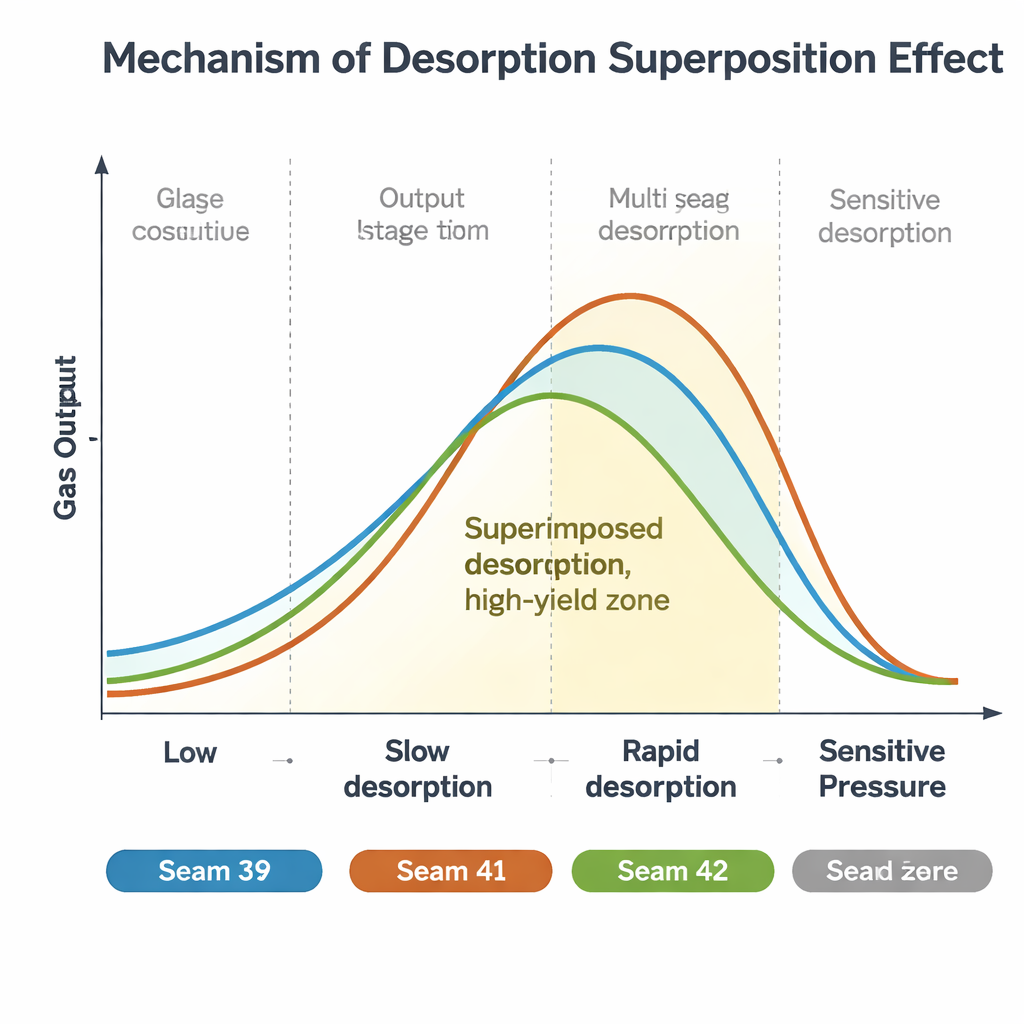
The authors build on a classic theory that describes how gases cling to and leave solid surfaces. Using this framework, they convert the complex behavior of methane release into a simple set of numbers: how much gas desorbs from coal for each small drop in pressure. By examining the curvature, or bending, of these desorption curves, they define three key pressure points that split the gas-release process into four stages: a low-efficiency stage with almost no useful gas, a slow stage, a rapid stage, and a highly sensitive stage where a small pressure drop releases a large amount of methane. This quantitative “mechanism–model–standard” system lets engineers read the pressure history of a well like a map, seeing exactly when it enters its most productive phases.
Making multiple coal layers work together
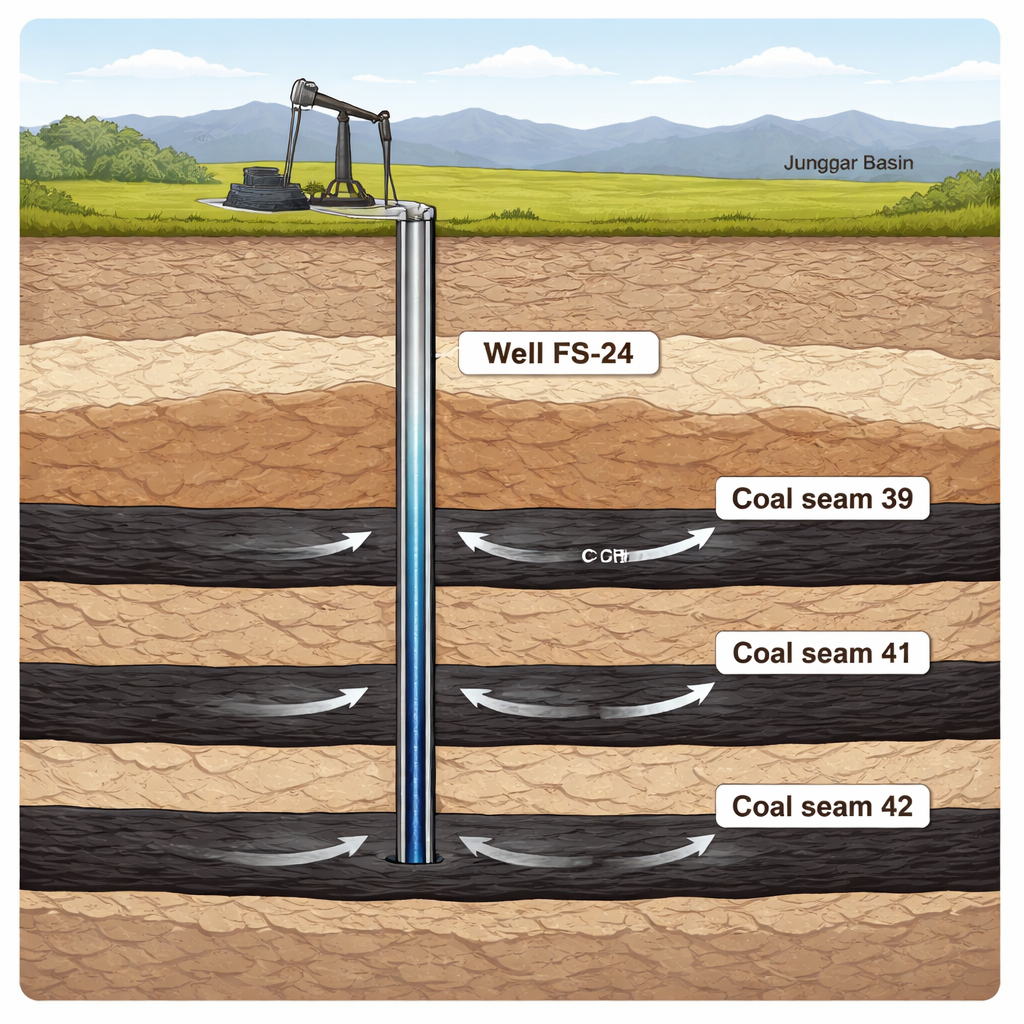
In China’s Fukang District 8, the FS-24 well taps three major coal seams stacked at different depths. The team studied each seam’s gas content, coal properties, and the pressure at which it starts releasing methane. They then tracked how the liquid level in the well moves downward during pumping. As water is removed, pressure around the well falls and different seams begin to desorb gas at different times. The key question is whether the most efficient desorption stages of the seams occur separately or overlap in time and space. If they overlap, the gas output from each seam can add together, creating a “superposition effect” where total production is much higher than from any seam alone.
Finding the sweet spot for maximum output
For FS-24, the analysis shows a favorable sequence: coal seam 39 begins desorbing first, followed by seams 41 and 42. When the dynamic water level settles between about 699 and 795 meters depth, all three seams are desorbing at once and, crucially, they are already in their rapid and sensitive stages. In this window, the combined volume of gas that can be drawn toward the well under ideal control reaches roughly 2.07 billion cubic meters, with an average potential production on the order of 5,600 cubic meters per day. The thickest seam, number 42, contributes more than half of this potential, while the thinner seams still boost total output significantly. This overlap of high-efficiency stages across multiple seams is what the authors define and measure as the desorption superposition effect.
What this means for future gas production
To non-specialists, the takeaway is straightforward: by understanding exactly when and how each coal layer releases gas as pressure drops, engineers can tune pumping schedules and target fluid levels to make several seams “breathe out” methane together. Instead of trial-and-error fieldwork, they gain a predictive tool that shows when a well is entering or leaving its prime productive window. The study demonstrates, with real data from FS-24, that carefully timed, multi-seam production can turn previously underperforming reservoirs into high-yield gas sources, offering a more efficient and cleaner way to use coal-bearing formations in the transition to lower-carbon energy systems.
Citation: Wenjie, L., Fengnian, W., Chenglong, Q. et al. Application validation and high-yield mechanism analysis of the desorption superposition effect method in Fukang block 8 based on well FS-24. Sci Rep 16, 5623 (2026). https://doi.org/10.1038/s41598-026-35890-y
Keywords: coalbed methane, gas desorption, multi-seam production, clean energy, unconventional gas