Clear Sky Science · en
Emotion recognition from faces and bodies in Parkinson’s disease and its relationship to MRI-based brain volumetry
Why Emotions Matter in Parkinson’s
Parkinson’s disease is best known for tremors and slowed movement, but many people with Parkinson’s and their families notice something less obvious yet deeply important: social interactions can become harder. Understanding how others feel—from a smile, a frown, or a tense posture—is essential for conversation, empathy, and relationships. This study explores how people with Parkinson’s read emotions not only from faces, but also from body language, and how these abilities relate to subtle brain changes seen on MRI scans.
Looking Beyond the Face
Most earlier research on emotions in Parkinson’s has focused on facial expressions or tone of voice. Yet in everyday life, we also rely heavily on the way people stand, move, and gesture. Body posture can signal joy, fear, anger, or sadness even when a face is hard to see—for example, across a room or in dim light. The researchers wanted to know whether people with Parkinson’s struggle more with reading emotions from faces or from bodies, and how these differences might influence daily social life.
How the Study Was Done
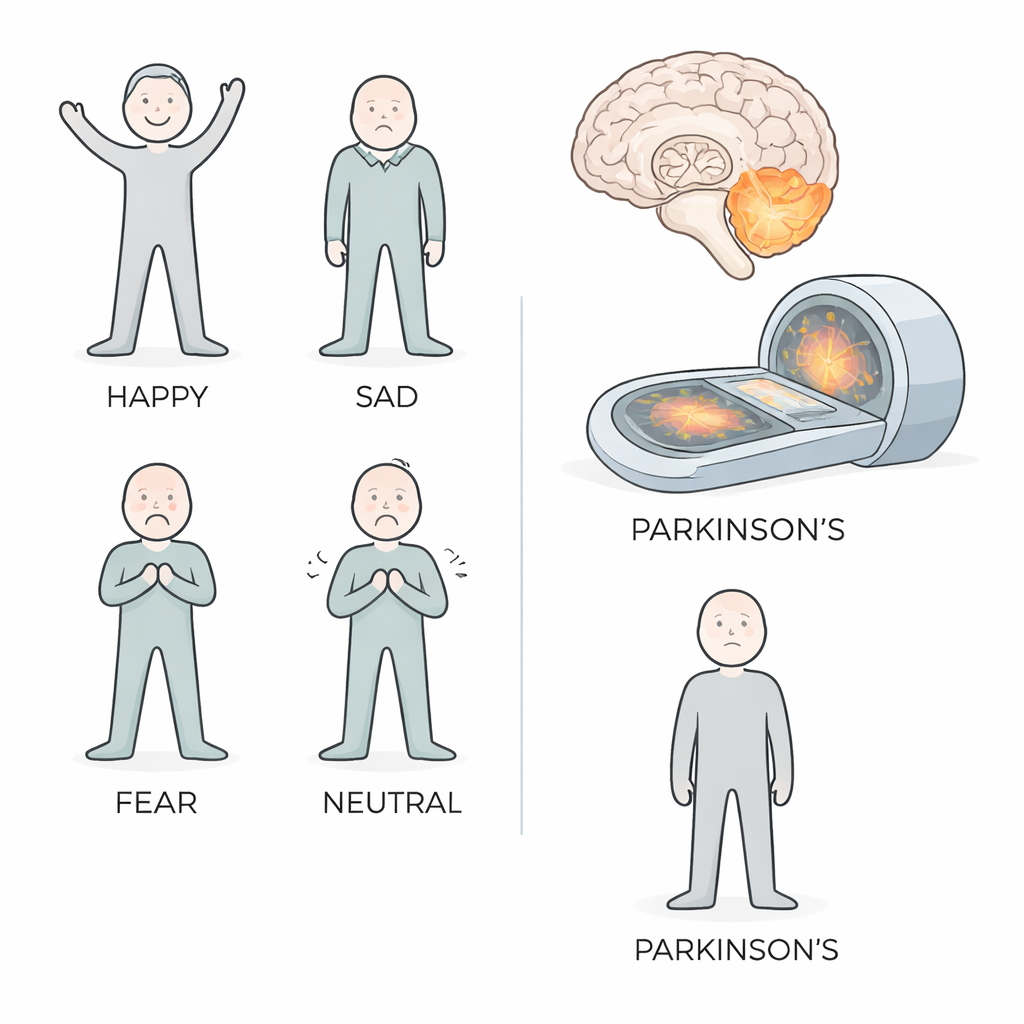
The team tested 25 people with mild to moderate Parkinson’s and 24 healthy adults of similar age. Everyone completed two tablet-based tests. In the face test, participants viewed photographs of people showing happiness, sadness, anger, fear, or a neutral expression and chose which emotion they saw. In the body test, the faces were hidden, and only posture and gesture were visible, but the same set of emotions had to be identified. All participants also took standard thinking and memory tests, while only the Parkinson’s group had detailed ratings of their motor symptoms and underwent high-resolution brain MRI to measure the volume of key brain regions.
What the Researchers Found
Both groups found it easier overall to recognize emotions from body postures than from faces. However, when the two groups were compared, people with Parkinson’s showed a specific disadvantage for reading emotions from bodies. Their performance on facial emotion recognition was similar to that of healthy participants, but their accuracy dropped more noticeably when only body language was available. Within the Parkinson’s group, difficulties in reading body emotions were linked to worse motor slowing (bradykinesia) and slightly poorer scores on thinking tests, especially those tapping planning and mental flexibility.
Links Between Brain Structure and Emotion Reading
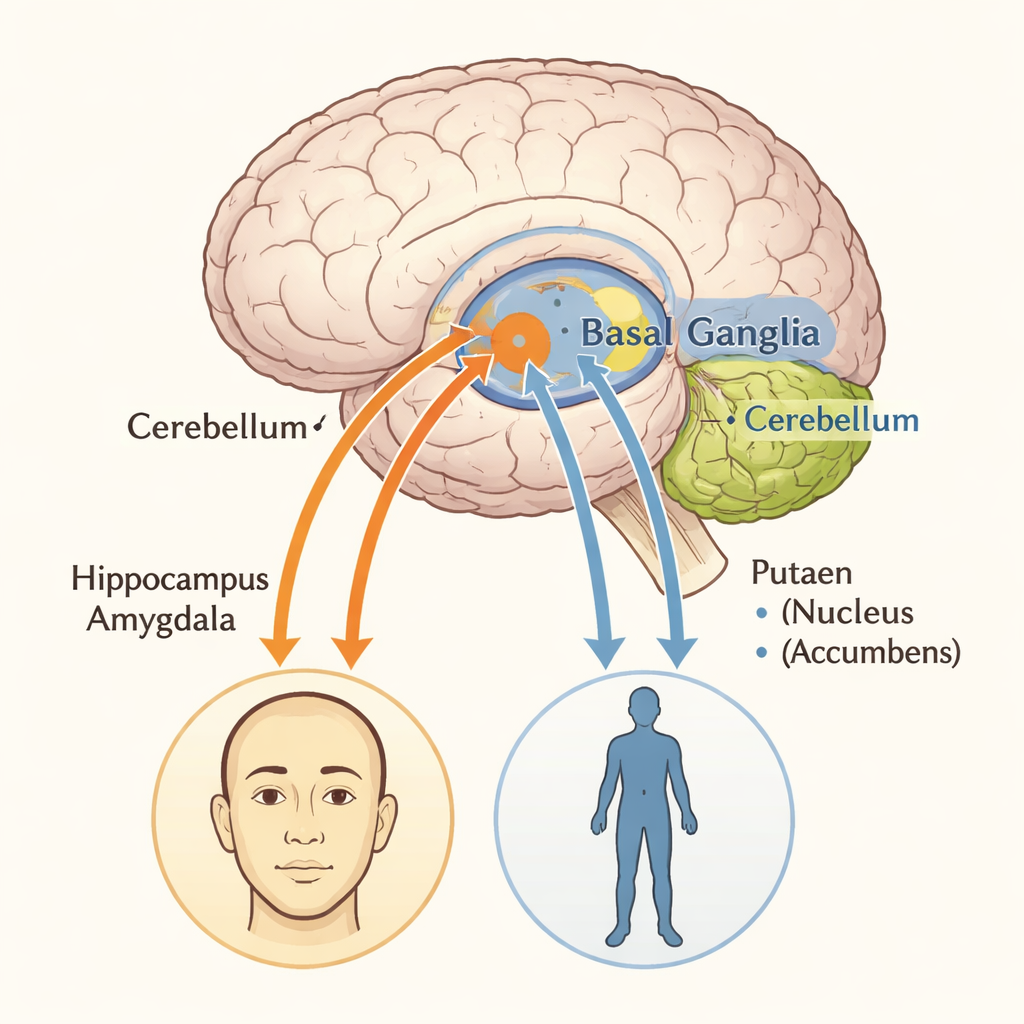
MRI scans revealed that better emotion recognition in Parkinson’s was tied to larger volumes in several brain regions that help support feeling and understanding emotions. For both faces and bodies, stronger performance was associated with healthier tissue in the hippocampus (important for memory and context), the nucleus accumbens (involved in motivation and reward), and the white matter of the cerebellum, a structure traditionally linked to movement but increasingly recognized for its role in social and emotional processing. Facial emotion recognition showed an extra link to the cerebellar cortex, while recognizing emotions from body posture was additionally related to the size of the right putamen and right amygdala, regions involved in movement, sensory integration, and emotional salience.
What It Means for People Living with Parkinson’s
The findings suggest that Parkinson’s can affect how people read emotions in a way that depends on the type of cue: body language appears more vulnerable than facial expressions. Because body cues are often more ambiguous and rely heavily on movement, they may be especially challenging when motor systems and related brain networks are disrupted. The study supports the idea that the motor system does more than move our bodies—it also helps us "simulate" and understand the feelings of others. For families and clinicians, this means that apparent social withdrawal or misunderstandings may sometimes reflect hidden difficulties in reading emotions, rather than lack of interest. Recognizing and addressing these subtle changes could improve communication, relationships, and quality of life for people with Parkinson’s disease.
Citation: Brandoburova, P., Bolekova, V., Hajduk, M. et al. Emotion recognition from faces and bodies in Parkinson’s disease and its relationship to MRI-based brain volumetry. Sci Rep 16, 5841 (2026). https://doi.org/10.1038/s41598-026-35889-5
Keywords: Parkinson’s disease, emotion recognition, body language, social cognition, brain imaging