Clear Sky Science · en
A low-profile compact dual-sense quad-port circularly polarized MIMO antenna for 5G mmWave networks
Why tiny 5G antennas matter
As our phones, cars, and connected gadgets push toward ever-faster 5G connections, especially at millimeter-wave (mmWave) frequencies, they rely on tiny antennas that can squeeze into cramped devices while still sending and receiving lots of data reliably. This paper reports a new compact antenna “tile” that fits four antennas in a very small space, yet still delivers strong, stable 5G signals with built‑in resilience to interference and signal fading—features that could help future devices stream more data with fewer dropouts.
A small antenna for very fast signals
The authors focus on 5G mmWave bands around 28–31 GHz, where signals can carry huge data rates but are easily blocked and weakened. To fight this, engineers use multiple-input multiple-output (MIMO) antennas: several antennas working together to shape and combine signals. The team designed a single, flat antenna element that operates efficiently in two nearby frequency bands. By carefully shaping the metal pattern on a thin circuit board and using a special feed line, this element converts ordinary linear signals into circular ones—where the electric field spins like a corkscrew as it travels. This circular polarization helps signals stay robust when devices rotate or tilt, or when reflections flip the signal’s orientation.
Shaping the ground for better performance
A key innovation is hidden on the underside of the antenna: a “window-shaped” modified ground structure. The ground plane—the metal sheet that normally just serves as a reference surface—is carved and extended in stages to guide the return currents more intelligently. The researchers tested several versions, gradually adding cuts and stubs until they found a pattern that both widened the useful frequency range and produced clean circular polarization. Simulations showed that the final ground shape supported two distinct operating bands with good matching to the electronics, high gain (around 5–6 dBic), and radiation efficiency above 80%, meaning most of the input power is turned into useful radio waves rather than wasted as heat.
Four antennas working together
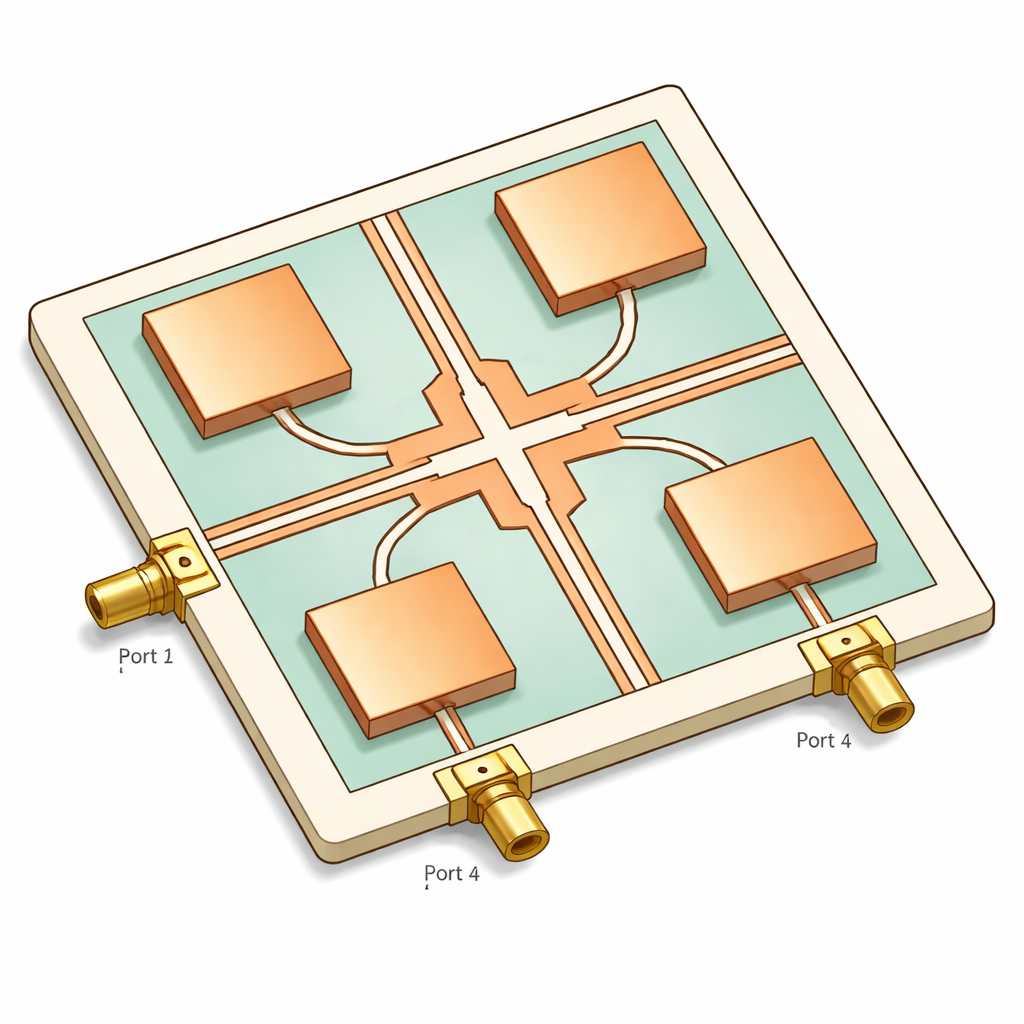
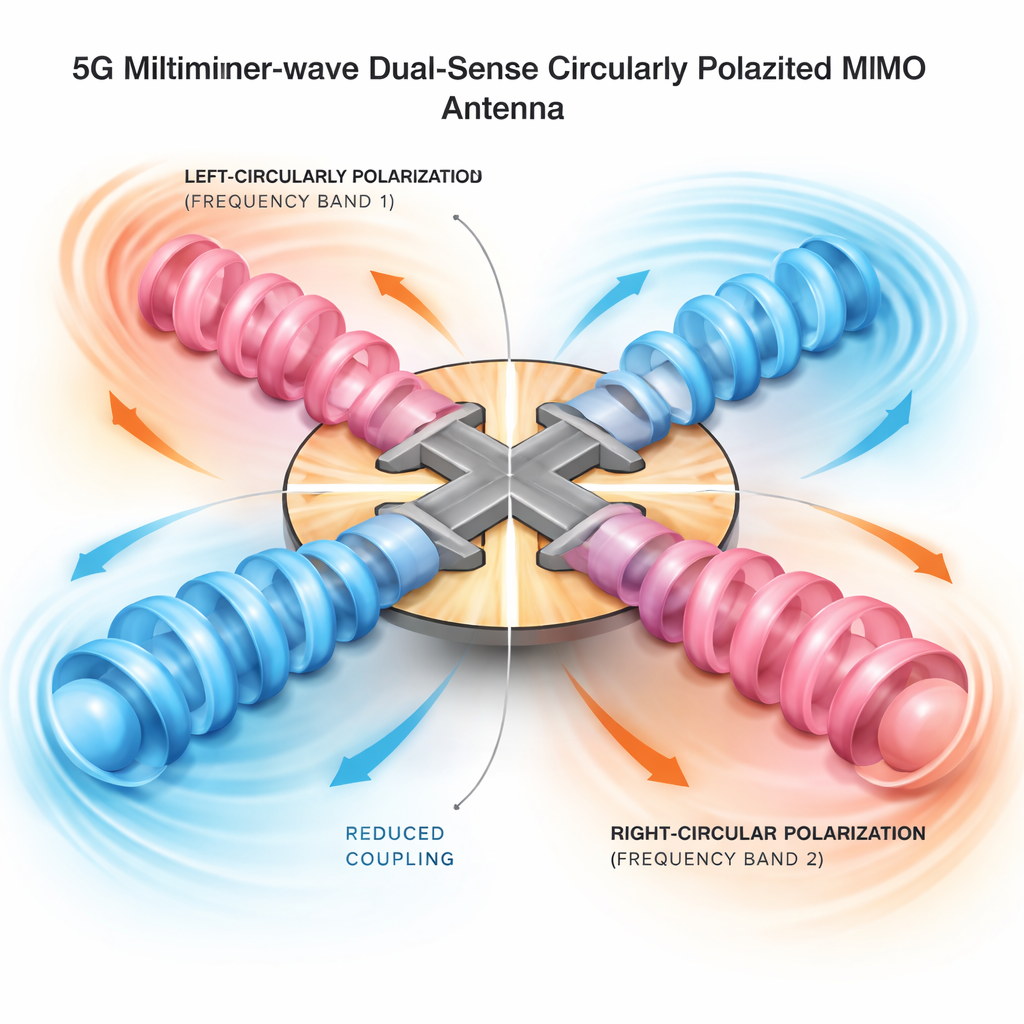
Building on the single element, the team created a four-port MIMO antenna by placing four identical radiators at right angles around a shared ground plane. At the center, they added a cross-shaped copper structure that acts like a traffic controller for surface currents. This cross behaves much like a filter and reflector, blocking unwanted waves that would otherwise leak from one antenna to another—a problem known as mutual coupling. With the cross in place, the antennas achieve isolation better than about 21 dB in one band and 18 dB in the other, meaning each element largely “minds its own business” instead of corrupting its neighbors. In the lower band the array radiates left‑hand circular polarization, while in the upper band it radiates right‑hand circular polarization, giving it dual “spin” senses in a single compact part.
Putting the design to the test
The authors did not stop at simulations: they built a prototype on a low-cost circuit board material and measured it with precision lab equipment. The real‑world results closely matched the computer models. Across the two target bands, the antenna showed strong gain, high radiation and total efficiency, and stable circular polarization. Just as important for 5G, the MIMO metrics were excellent: the envelope correlation coefficient—a measure of how similarly the antenna elements respond to the radio environment—was extremely low, meaning the elements provide truly independent signal paths. Diversity gain, mean effective gain, and channel capacity loss all fell within preferred limits, indicating that the array can support high data rates with minimal performance penalties in complex, multipath urban settings.
What this means for future 5G devices
In simple terms, the paper demonstrates a very small, flat antenna module that can send and receive two flavors of spinning 5G signals from four tightly packed ports, while keeping interference between them low and efficiency high. Because it uses a single circuit layer, avoids complicated vertical connections, and relies on clever shaping of metal patterns rather than bulky 3D structures, it is well suited for smartphones, in‑vehicle units, and Internet‑of‑Things devices that must fit advanced radios into tiny spaces. If adopted, such antenna tiles could help future 5G mmWave products deliver faster, more reliable connections without growing in size.
Citation: Hayat, B., Khan, A., Ahmad, S. et al. A low-profile compact dual-sense quad-port circularly polarized MIMO antenna for 5G mmWave networks. Sci Rep 16, 5619 (2026). https://doi.org/10.1038/s41598-026-35885-9
Keywords: 5G mmWave, MIMO antenna, circular polarization, compact antenna design, wireless communication