Clear Sky Science · en
Flexural performance of RC beams strengthened with CFF and SCCFL sheets under cyclic loading
Stronger bridges and buildings for a shaking world
Many of the concrete bridges and buildings we rely on every day are quietly wearing out under traffic, wind, and even mild earthquakes. Tearing them down and rebuilding is expensive and disruptive, so engineers are searching for smart ways to give aging structures a second life. This study explores how thin sheets of carbon fiber—some of them coated with silicone—can be glued to the underside of reinforced concrete beams to make them stronger and more durable when they are pushed and pulled over and over again, much like real structures in service.
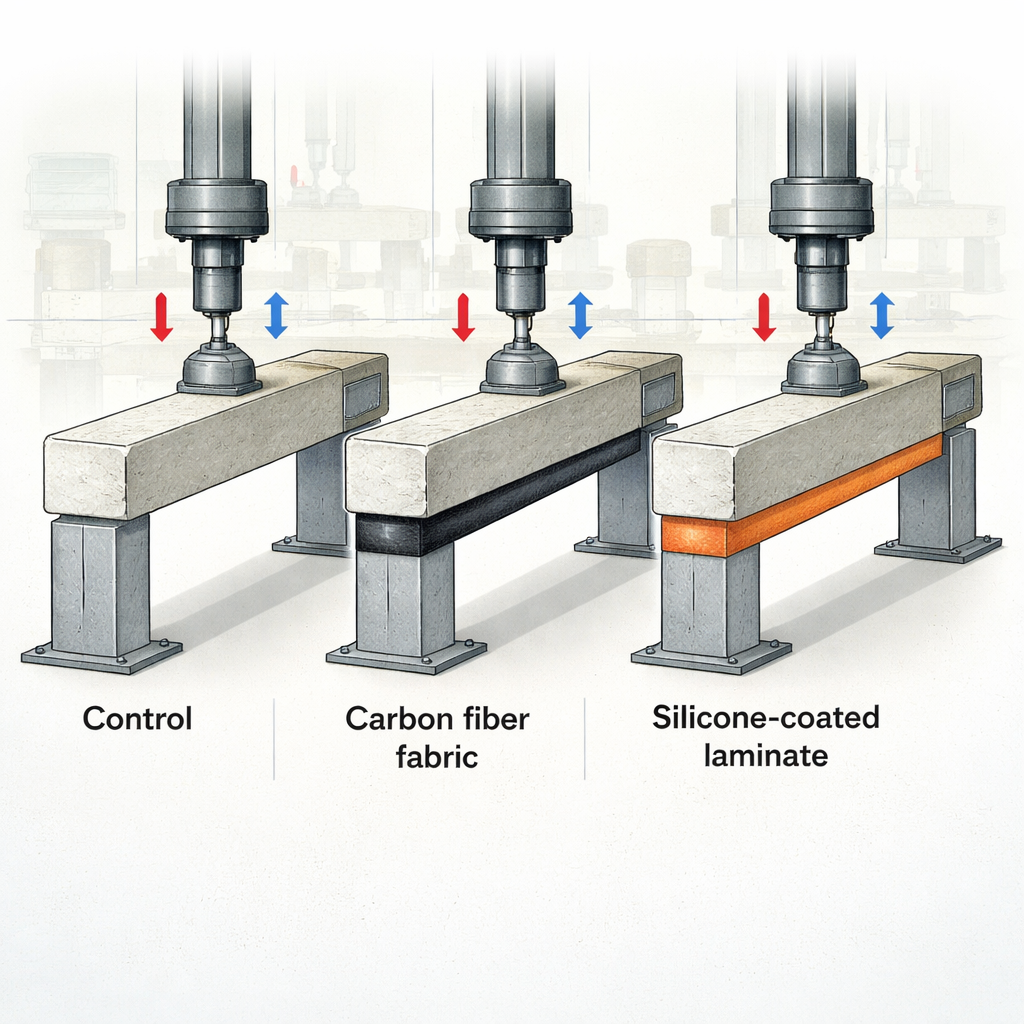
Giving tired concrete a high-tech “bandage”
Modern concrete beams usually contain steel bars hidden inside to carry tension, but over time these bars can corrode or the beams can crack under repeated heavy loads. Instead of adding bulky new supports, engineers can now bond flexible carbon fiber sheets to the outside surface of a beam, much like applying a strong medical bandage. Carbon fiber is extremely light yet stronger than steel in tension, and it does not rust. In this work, the researchers compared two such materials: a conventional carbon fiber fabric and a newer silicone-coated carbon fiber laminate. The silicone coating is designed to improve how well the carbon sticks to the concrete and to protect it from the environment.
How the team tested the strengthened beams
The researchers cast fifteen concrete beams similar in size to those used in small bridges or building floors. Three beams were left as-is to act as controls. The others were strengthened by gluing either one or two layers of carbon fiber fabric or silicone-coated laminate to the underside—the side that stretches when the beam bends. All beams were then placed in a test frame and loaded repeatedly at two points along their length. The load was slowly increased and decreased in cycles, while instruments measured how much the beams bent, how cracks spread, how stiff they remained, and how much energy they absorbed before suffering serious damage.
What happened under repeated loading
The strengthened beams clearly outperformed the plain concrete ones. Beams with a single layer of carbon fiber fabric carried about one-third more load than the control beams, and those with two fabric layers did even better. The silicone-coated laminates were more impressive still: one layer allowed the beams to withstand roughly two-thirds more load than the controls, and two layers nearly doubled the load capacity. These upgraded beams also bent less under the same load, showed smaller and more tightly spaced cracks, and delayed the first appearance of visible cracking from about 1.5 kilonewtons in the control beams to above 4.5 kilonewtons for beams with silicone-coated laminates. Measurements of the looping load–deflection curves revealed that the coated laminates helped the beams dissipate more energy in each cycle, a sign of better performance under shaking or traffic.
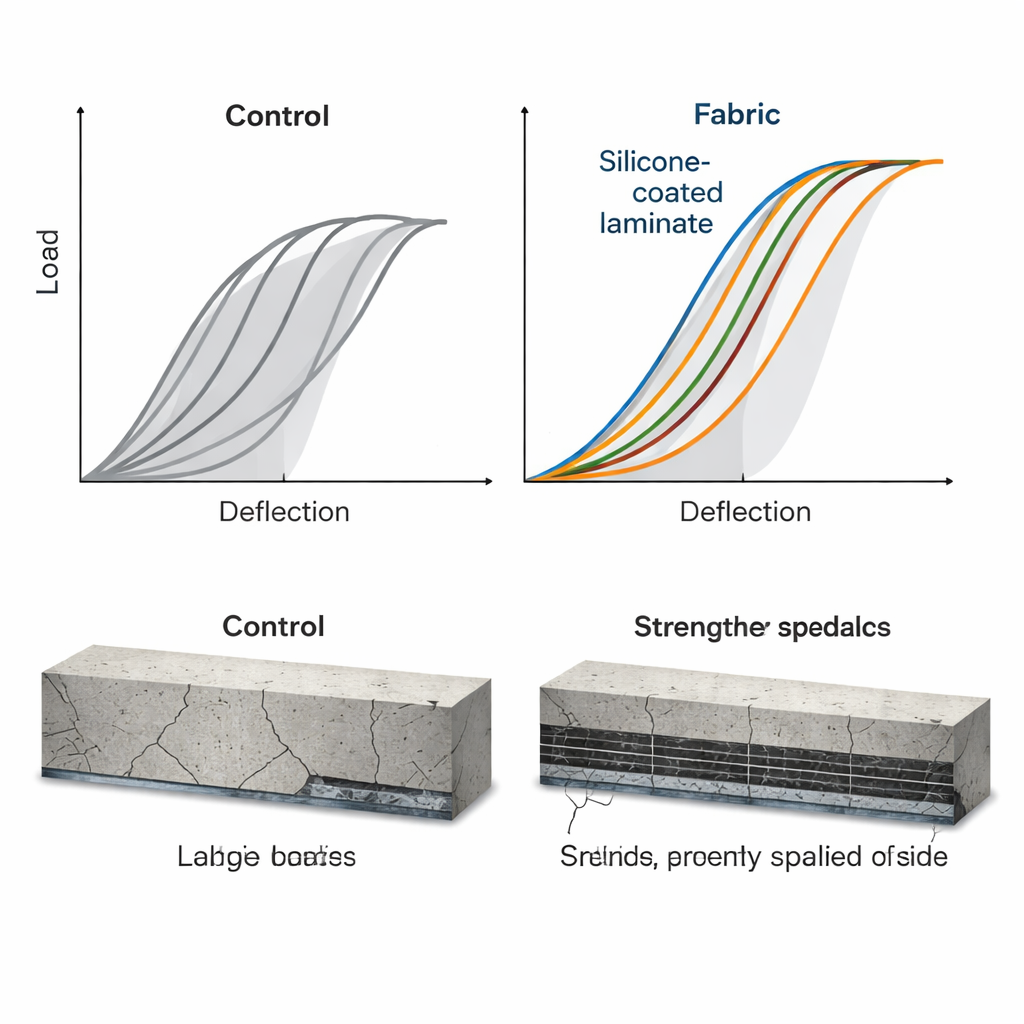
Why silicone-coated carbon fiber stood out
Beyond simple strength, the way the beams eventually failed also mattered. Control beams fractured through large bending cracks and crushing of the concrete at the top. Beams with regular carbon fiber fabric tended to fail when the fabric started to peel away from the concrete, a weak link at the interface. In contrast, the silicone-coated laminates stayed bonded more firmly. When those beams finally failed, it was usually through gradual concrete crushing or tearing of the laminate after many load cycles, not sudden debonding. This behavior indicates that the silicone layer improves the grip between the carbon and the concrete, helping the strengthened beams retain their stiffness and energy-absorbing ability for longer under repeated loading.
What this means for everyday structures
For non-specialists, the message is straightforward: carefully applied carbon fiber “wraps” can significantly extend the life and safety of existing concrete structures, and silicone-coated laminates appear to be the most effective option tested here. By nearly doubling the bending strength in some cases, delaying cracking, and reducing stiffness loss over many loading cycles, these thin sheets offer a practical way to retrofit older bridges and buildings so they can better withstand traffic, wind, and earthquakes without major reconstruction. As cities face aging infrastructure and growing demands, such strengthening methods could help keep critical structures in service longer and more safely.
Citation: Sujitha, V.S., Sriram, A.G., Raja, S. et al. Flexural performance of RC beams strengthened with CFF and SCCFL sheets under cyclic loading. Sci Rep 16, 6491 (2026). https://doi.org/10.1038/s41598-026-35884-w
Keywords: carbon fiber strengthening, reinforced concrete beams, fatigue and cyclic loading, structural retrofitting, infrastructure durability