Clear Sky Science · en
The ERP characteristics in the process of hazard identification
Why spotting danger quickly really matters
On busy construction sites, factory floors, or even highways, people face hazards that can turn deadly in seconds. Yet many dangers go unnoticed until it is too late. This study asks a simple but urgent question: can we look directly at the brain to measure how good someone is at spotting hazards—how fast and how accurately—so that training and job assignments in high‑risk work can be made safer and smarter?
How the brain helps us see danger
When we glance at a scene and decide whether something is dangerous, the brain springs into action long before we are aware of it. Electrical activity ripples across different regions as we scan, judge, and respond. The researchers used a method called electroencephalography (EEG) to pick up these faint signals from the scalp while people performed a hazard recognition task. By focusing on brief, time‑locked bursts of brain activity—known as event‑related potentials—as well as ongoing brain rhythms, they set out to connect specific patterns in the brain with how well people recognize hazards at work.
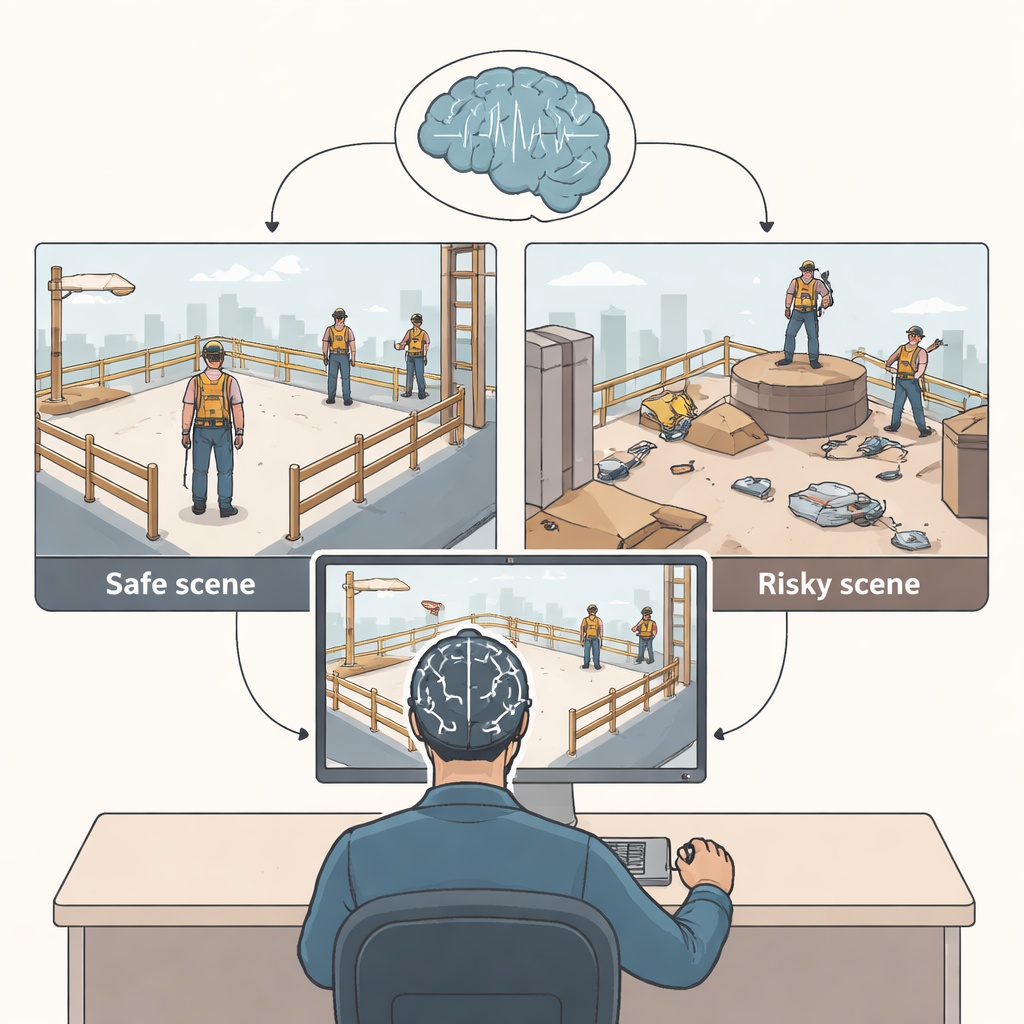
Testing real‑world risks in the lab
The team recruited 30 adults with construction experience and showed them photographs from real building sites. Some images showed well‑protected, orderly scenes; others contained clear dangers, such as missing guardrails or unstable materials. On each trial, participants had to press one key if they saw a hazard and another if the scene appeared safe. The researchers recorded not only whether the answers were right, but also how many images each person could judge per second, yielding two simple scores: hazard identification accuracy and hazard identification speed. At the same time, a 32‑channel EEG system tracked their brain activity from 200 milliseconds before each image appeared to 800 milliseconds afterward.
Brain signatures of sharp and slow performance
To uncover what separates sharp hazard spotters from weaker ones, the researchers compared the top and bottom performers. People who were less accurate showed larger early brain responses about one‑tenth to one‑fifth of a second after a picture appeared. These signals suggest that they had to recruit more mental effort just to interpret what they were seeing, and yet still made more mistakes. They also showed stronger beta‑band rhythms, which have been linked to stress and emotional strain. In contrast, highly accurate participants displayed stronger theta and alpha rhythms in key brain regions, patterns associated with efficient control and focused processing. When the team instead grouped people by how fast they worked, those who responded slowly showed bigger waves not only in the early stages but also later, around 300 milliseconds, when the brain is updating what it believes about the scene. This pattern hints that slower workers may wrestle longer with uncertainty, investing more attention but taking more time.
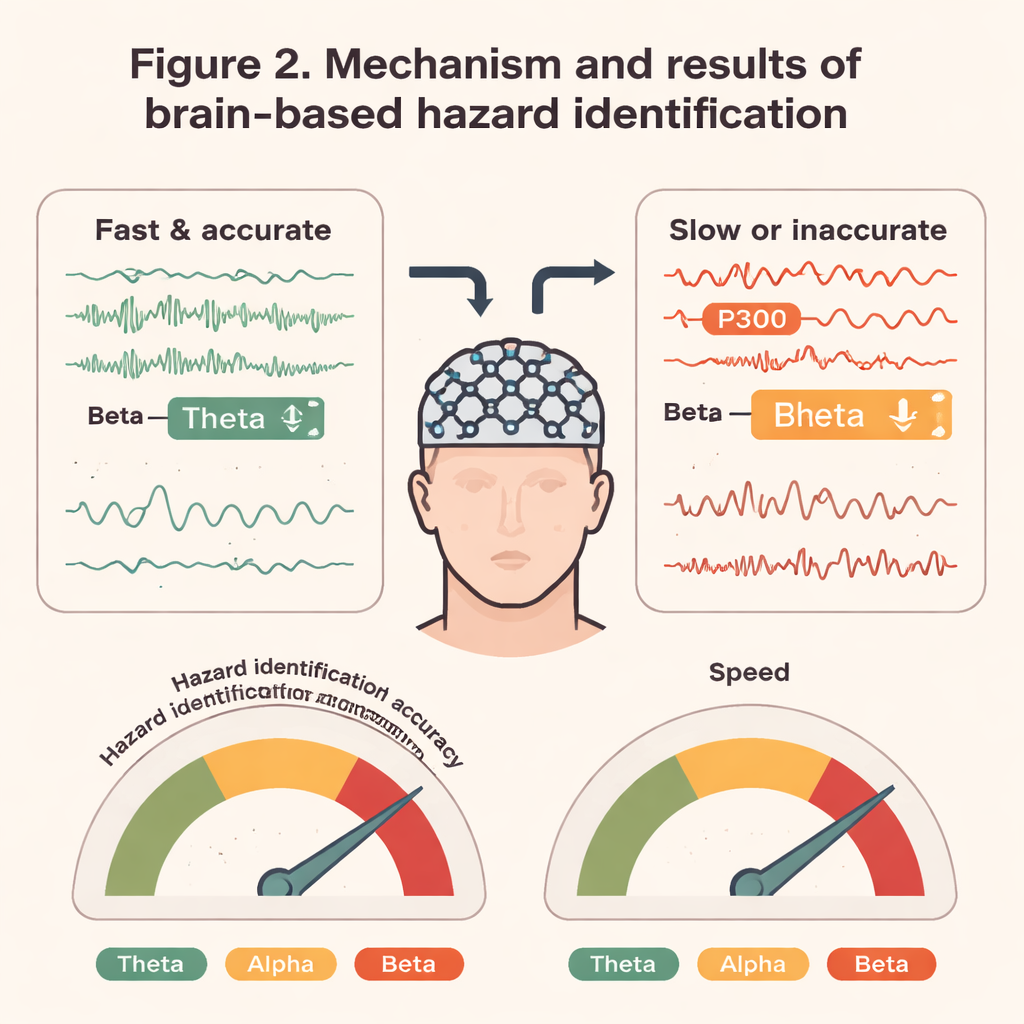
Turning brainwaves into practical scores
The most powerful findings came when the scientists tried to turn these brain patterns into simple cut‑off values. They found that average theta power in the central frontal region could serve as a marker of hazard identification accuracy: lower theta values went hand‑in‑hand with poorer performance, while higher theta indicated more reliable judgments. Likewise, the size of the P300 wave—a positive surge around 300 milliseconds—in the visual areas at the back of the head tracked how quickly people could identify hazards. Smaller P300 peaks were linked with faster responses, while larger peaks were tied to slower, more effortful decisions. Using these thresholds, the team could classify people as fast or slow, and as more or less accurate, with about 86 percent accuracy in an independent group tested with the same task and equipment.
What this means for everyday safety
For a layperson, the takeaway is straightforward: the brain leaves a measurable fingerprint when we look for danger, and that fingerprint can reveal who spots hazards quickly and who struggles. By turning subtle EEG features into practical scores, this work points toward future tools that could help employers in construction, transport, or emergency response tailor training, monitor safety‑critical skills, and assign the riskiest tasks to those whose brains are best prepared for them. While these brain‑based thresholds still need testing in larger and more varied groups—and will have to be recalibrated for different equipment—the study offers an early blueprint for using neural signals to make hazardous work a little less deadly.
Citation: Zhang, S., Tang, S., Ye, S. et al. The ERP characteristics in the process of hazard identification. Sci Rep 16, 5849 (2026). https://doi.org/10.1038/s41598-026-35883-x
Keywords: hazard identification, workplace safety, brainwaves, EEG, construction risk