Clear Sky Science · en
Impact of two different hesperidin forms loaded on nanoscale modified borate bioglass scaffolds on rat critical-sized calvarial defects
Helping Broken Bones Heal Themselves
Large gaps in bone—after accidents, tumors, or major dental work—often cannot heal on their own. Today’s standard fixes, such as transplanting bone from another part of the body, can be painful and limited. This study explores a different path: using a tiny glass-like scaffold combined with a natural compound from citrus fruits to coax the body into rebuilding bone more effectively.
A Tiny Glass Framework for New Bone
The researchers worked with special “bioglass” scaffolds made from borate, a glass that slowly dissolves inside the body while encouraging bone cells to grow. These scaffolds are full of pores, like a sponge, so cells, nutrients, and blood vessels can move in. When placed into a round defect in the skull bone of rats, the scaffold acts as a temporary framework, giving the body something to build on while the glass gradually converts into bone-like mineral.
Boosting Healing with Citrus-Derived Hesperidin
To make this framework more powerful, the team added hesperidin, a plant compound found in oranges and other citrus fruits. Hesperidin is known for its antioxidant and anti-inflammatory effects and has been linked to better bone formation. The twist in this study was to compare two physical forms of the same substance: a traditional micro-sized powder and an ultra-small nano-sized version. Both were loaded into the nanoscale-modified bioglass scaffolds, and the researchers asked a simple question: does shrinking the hesperidin particles make a real difference to bone repair?
Testing Bone Repair in Rat Skull Defects
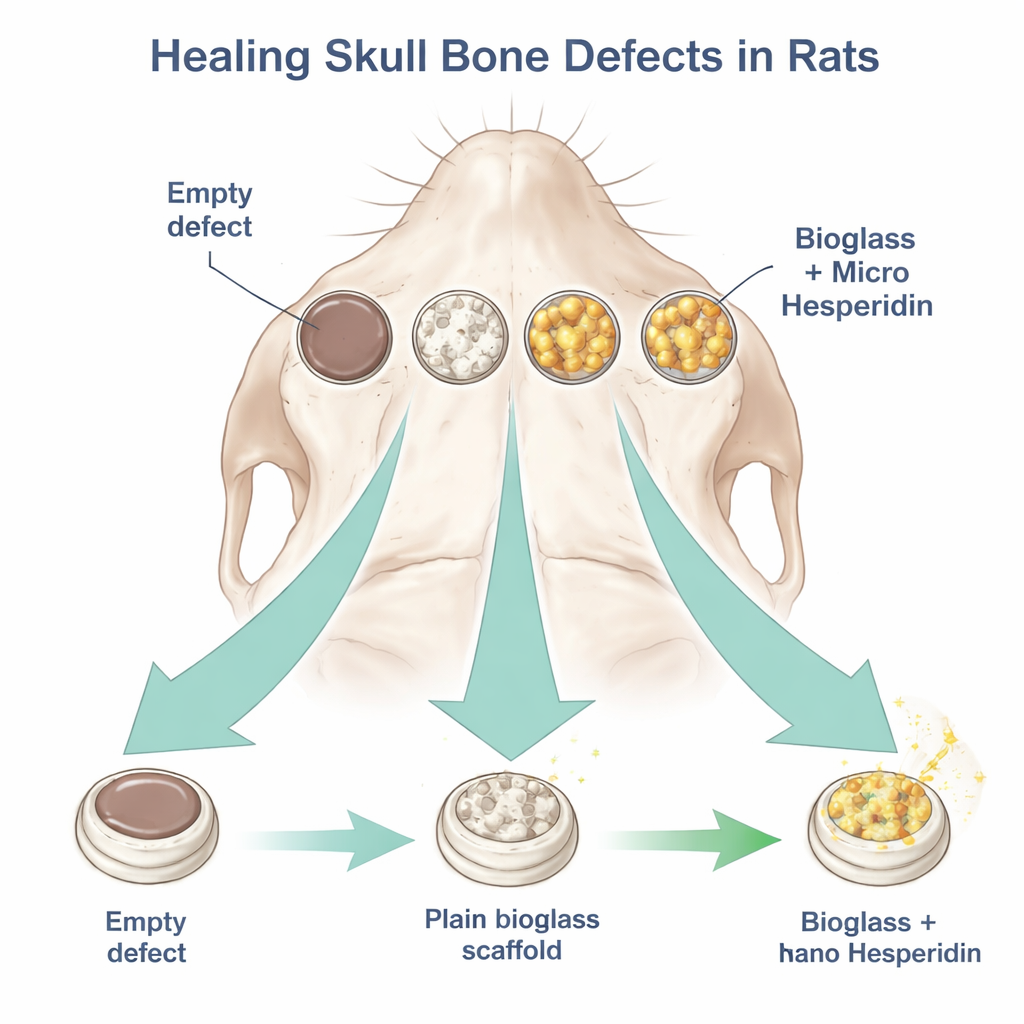
Fifty-six rats received two standardized circular defects in the flat bones of the skull—gaps large enough that they would not heal naturally. Each defect was assigned to one of four treatments: left empty, filled with plain bioglass scaffold, filled with bioglass plus micro hesperidin, or filled with bioglass plus nano hesperidin. Over two and six weeks, the team monitored healing using cone-beam CT scans, which measure how dense the new tissue becomes, along with microscope studies of tissue slices to look for new bone, collagen (the main bone matrix protein), and osteopontin, a marker that switches on when new bone is being laid down.
What the Scans and Microscopes Revealed
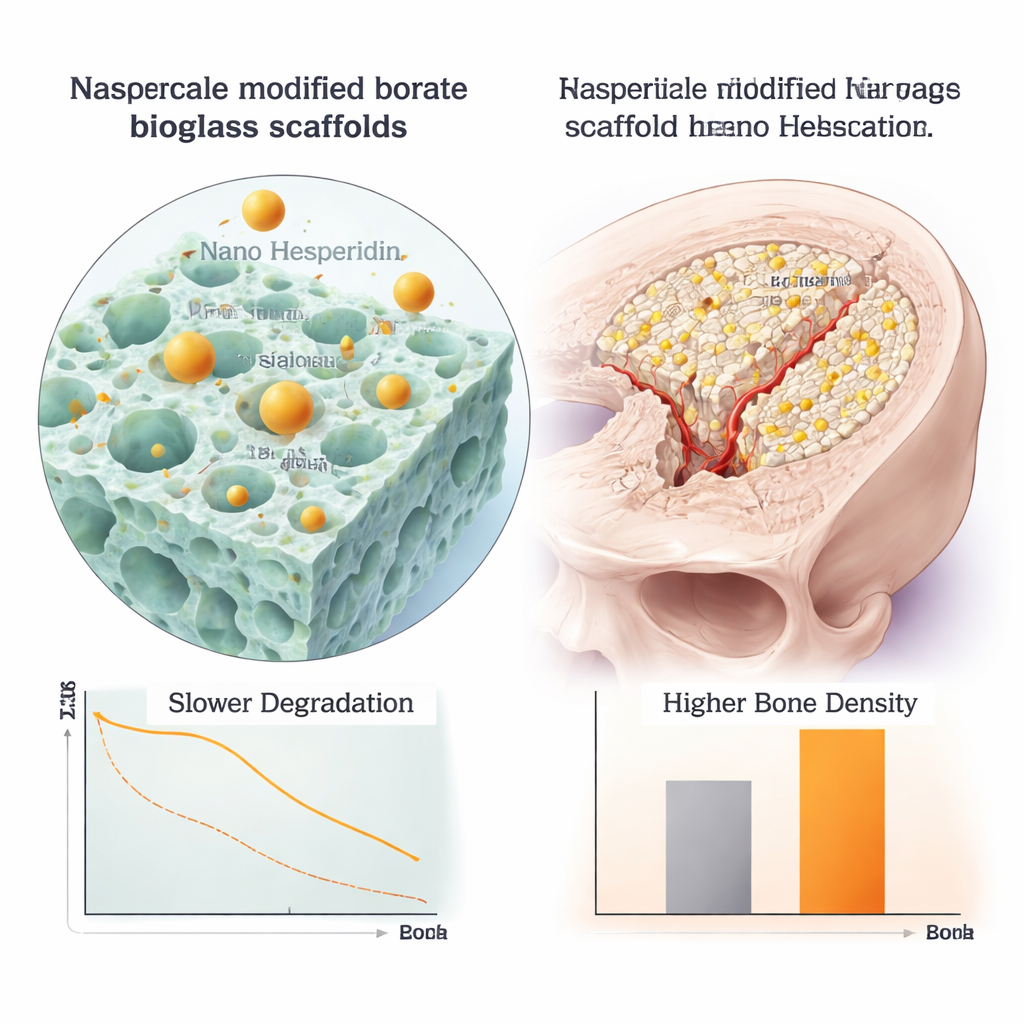
The empty defects showed very little healing: mostly thin scar-like tissue and minimal new bone even after six weeks. Plain bioglass scaffolds did better, with moderate bone growth creeping in from the edges as the glass dissolved. Adding micro-sized hesperidin further improved results, producing more mineralized tissue, stronger collagen networks, and higher osteopontin activity. But the standout performer was the nano hesperidin scaffold. These defects showed the greatest closure on scans, the densest collagen and bone matrix, and the strongest osteopontin signal. Laboratory tests also revealed that scaffolds with nano hesperidin degraded more slowly and developed a more complete bone-like mineral coating, suggesting steadier ion release and a more stable platform for cells.
Why the Nano Form Works Better
Because nano-sized particles have a much larger surface area relative to their volume, the nano hesperidin could spread more uniformly through the scaffold and interact closely with both the glass network and nearby cells. This likely improved its release pattern and made it easier for bone-forming cells to take up the compound. At the same time, the nano hesperidin seemed to subtly strengthen the glass structure, slowing its breakdown so that it continued to support the defect while new bone and blood vessels moved in. The result was a better balance: the scaffold lasted long enough to guide healing but still dissolved to be replaced by natural bone.
What This Could Mean for Future Treatments
For non-specialists, the main message is that both the recipe of a bone scaffold and the size of the drug particles inside it can dramatically change how well damaged bone heals. In this animal model, pairing a degradable borate bioglass scaffold with nano-sized hesperidin led to the strongest and fastest bone regeneration among all tested options. While more work is needed before use in people, the findings suggest that smart combinations of bioactive glass and plant-derived nano-compounds could one day offer safer, more effective alternatives to traditional bone grafts.
Citation: Alqiran, N.A., Abdelghany, A.M., Fouad, S. et al. Impact of two different hesperidin forms loaded on nanoscale modified borate bioglass scaffolds on rat critical-sized calvarial defects. Sci Rep 16, 4777 (2026). https://doi.org/10.1038/s41598-026-35881-z
Keywords: bone regeneration, bioglass scaffold, hesperidin, nanoparticles, cranial defects