Clear Sky Science · en
Personalized skill transfer optimization in swimming training through multi-agent reinforcement learning driven digital twin environments
Smarter Coaching for Every Swimmer
Swimming is one of the most technical sports: tiny changes in body position, timing, or breathing can decide a race. Yet most swimmers still rely on a coach’s eyes and a stopwatch. This paper explores how pairing swimmers with a virtual copy of themselves and an artificial‑intelligence “coach” could radically change how people learn to swim—making training more personalized, efficient, and data‑driven for everyone from novices to competitive athletes.
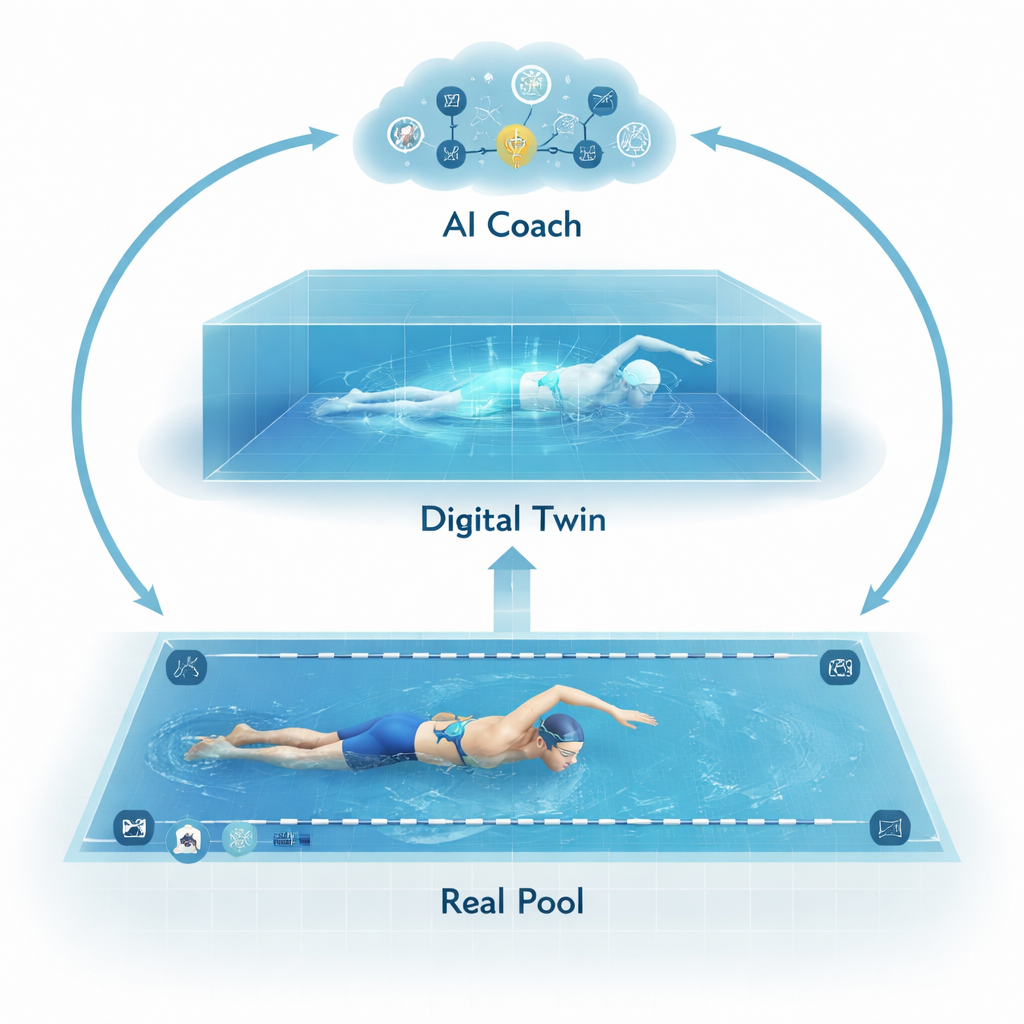
A Virtual Twin in the Pool
At the heart of the work is a detailed digital twin of the swimming environment. This twin is a virtual replica of the pool and the swimmer that runs in real time alongside actual training. Underwater cameras, wearable motion sensors, and pressure sensors collect data about how the swimmer moves and how water flows around the body. That information continually updates the virtual swimmer, which simulates water drag, body position, and joint motion with high precision. Because the twin lives in software, coaches and researchers can safely test “what if” scenarios—like changing stroke timing or body angle—without tiring or risking the athlete.
Many AI Coaches Working Together
Instead of a single, monolithic AI, the system uses a team of specialized software agents trained with a technique called reinforcement learning. Each agent focuses on a different aspect of training: one analyzes technique, another designs training sets, a third monitors real‑time performance, a fourth manages how skills transfer between strokes, and a fifth controls the virtual environment. These agents practice inside the digital twin, trying different training decisions and receiving rewards when swimmers go faster, move more efficiently, or maintain better form. Over time, the agents learn how to coordinate with each other, sharing information and converging on strategies that work best for different swimmers and situations.
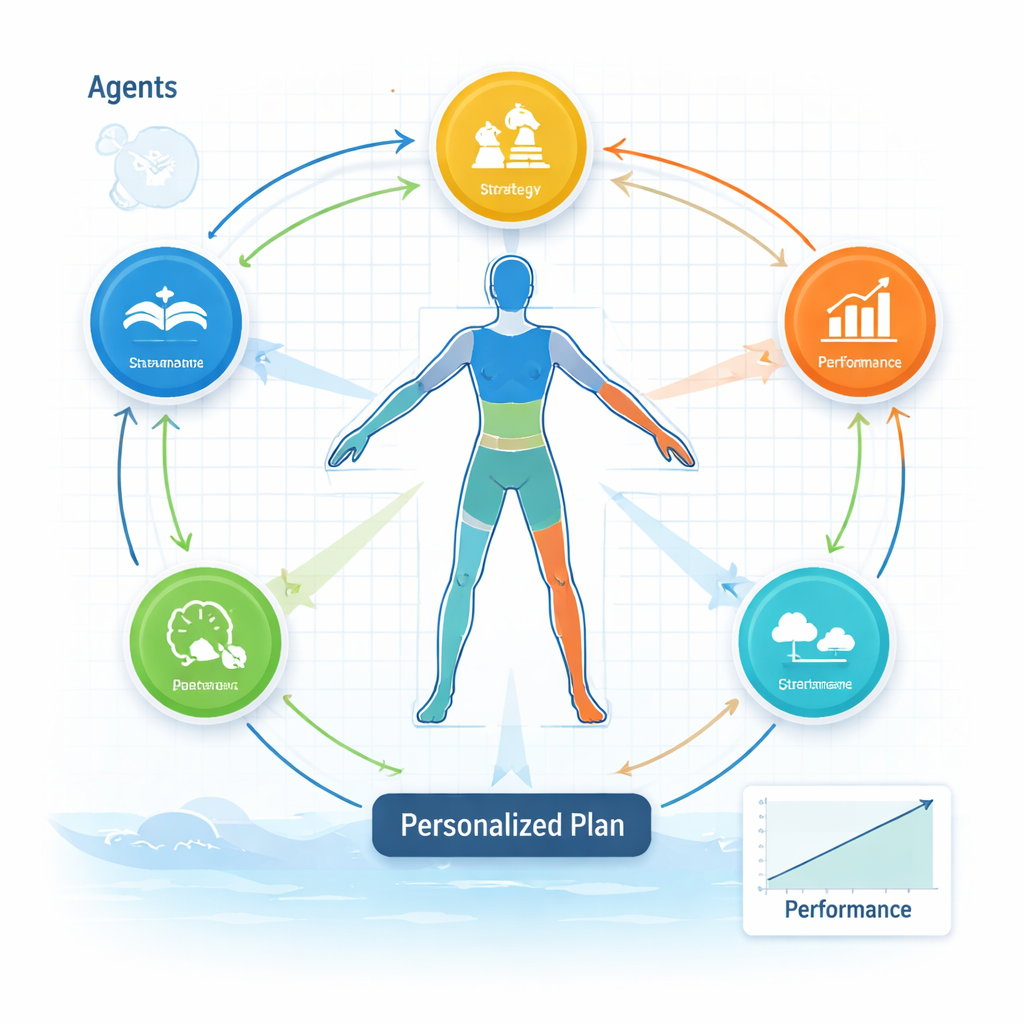
Learning How to Learn—and to Share Skills
A key innovation is the use of meta‑learning, sometimes described as “learning to learn.” Rather than starting from scratch with every new swimmer, the system studies patterns across many virtual swimmers and tasks. It learns a strong starting point that can be quickly adapted to a new person with only a small amount of data. This also enables skill transfer: progress made while mastering, say, freestyle can help speed up learning backstroke, especially when the strokes share similar body mechanics. The framework includes privacy‑preserving methods so that sensitive motion data can stay on local devices while only high‑level model updates are shared.
Faster Gains and Longer‑Lasting Skills
The researchers tested their approach extensively in simulation. Compared with standard AI training methods and traditional rule‑based coaching strategies, the multi‑agent meta‑learning system reached high performance levels about 34% faster and ended up 22% better on a combined measure of technique quality, speed, and consistency. Skill acquisition was about 2.7 times quicker, and most of the gains remained even after simulated “time off,” with nearly 90% of performance retained over several months. The system adapted well to different athlete profiles, from novices to advanced swimmers, though it worked best once basic technique was in place and showed limits for entirely new beginners or elite athletes already near their physical ceiling.
What This Could Mean for Swimmers
In simple terms, this research points toward an AI‑assisted training partner that watches every stroke, tests thousands of variations in a safe virtual pool, and then returns to the swimmer with a made‑to‑measure plan. While the current results come from high‑fidelity simulations rather than large‑scale trials in real pools, the framework suggests that future swimming programs could move beyond generalized sets toward continuously adapting workouts. If brought into practice, such systems could help swimmers learn correct technique faster, avoid wasted effort, reduce injury risk, and hold onto skills longer—much like having an expert coach and a personal wind‑tunnel lab following them to every lane.
Citation: Wu, Z. Personalized skill transfer optimization in swimming training through multi-agent reinforcement learning driven digital twin environments. Sci Rep 16, 5134 (2026). https://doi.org/10.1038/s41598-026-35877-9
Keywords: swimming training, digital twin, sports AI, skill transfer, personalized coaching