Clear Sky Science · en
First detection of Usutu virus in wild birds in Denmark, 2024
Why dying backyard birds matter
Across Denmark in the summer of 2024, people began noticing something unsettling: blackbirds that looked weak, confused, or already dead in their gardens and local parks. What seemed at first like an unlucky season for a familiar songbird turned out to be the first known outbreak in Denmark of Usutu virus, a mosquito-borne infection that mainly targets birds but can occasionally sicken people. Understanding what happened to these birds offers a window into how changing climate and thriving mosquitoes can help new viruses move into northern Europe—and what that might mean for wildlife and human health.
Unusual deaths trigger a closer look
More than a thousand citizens contacted bird and veterinary authorities to report frail or dead blackbirds. Three of these birds were first tested for two mosquito-borne viruses known in Europe: West Nile virus and Usutu virus. While all were negative for West Nile, they carried high levels of Usutu virus in their brains. This discovery launched a nationwide call for the public to send in dead birds for examination, turning ordinary birdwatchers and homeowners into crucial eyes and ears for disease surveillance. 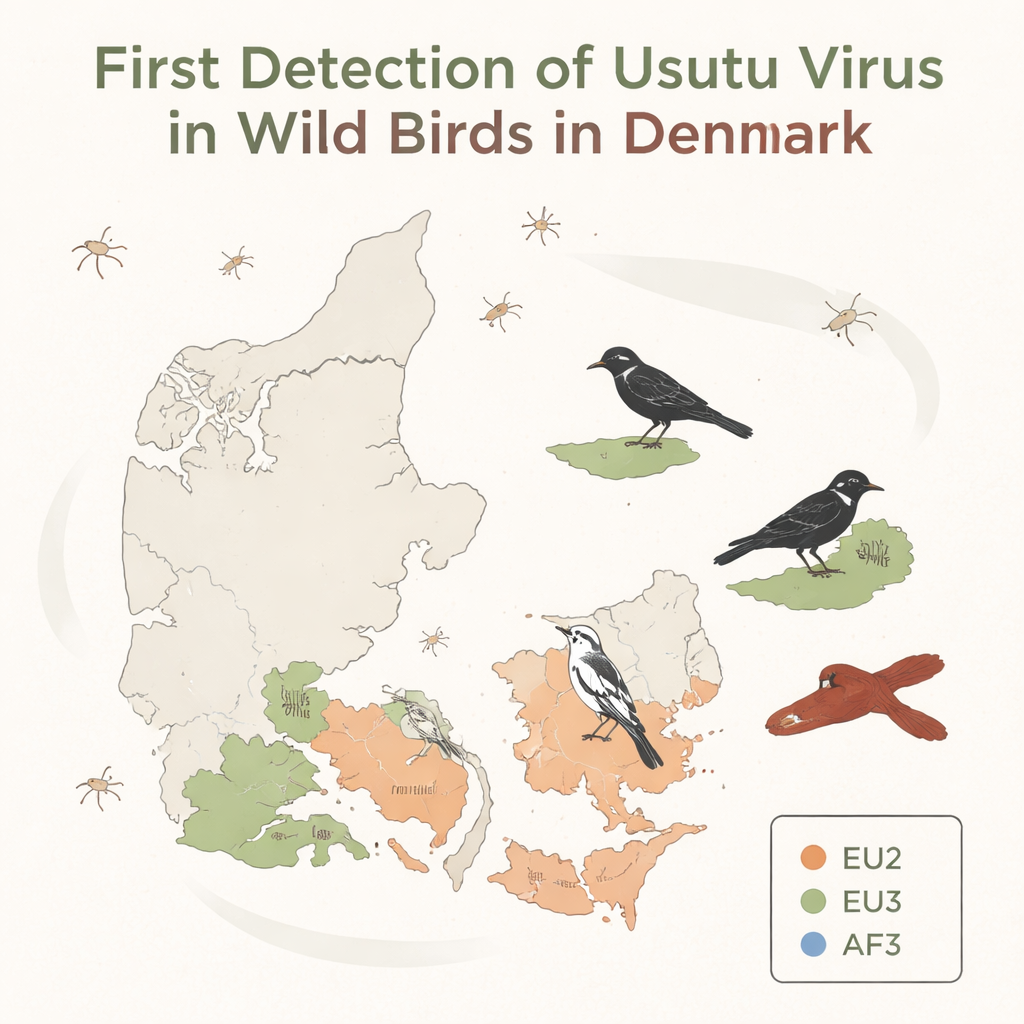
What the testing revealed
From September to the end of 2024, 149 birds from across Denmark were examined, including 85 blackbirds. Brain samples from every bird were checked for both viruses. None carried West Nile, but 56 of the 85 blackbirds—about two-thirds—tested positive for Usutu virus, often with very high amounts of viral genetic material. Two great spotted woodpeckers and one red kite also tested positive, though at much lower levels. The infected blackbirds came from most regions of the country, with the highest numbers in the south, suggesting the virus had become widely established rather than being confined to a single small hotspot.
How sick were the birds?
Veterinary pathologists carefully examined the dead birds. Many infected blackbirds were strikingly thin, with ruffled or incomplete feathers and empty stomachs, signs that they had been unwell for some time. A common finding was an enlarged spleen and bleeding or congestion inside the skull—changes that fit what has been seen in Usutu outbreaks in other European countries. Reports from the public often mentioned birds that were unusually weak or showed trouble with balance and coordination, hinting at damage to the nervous system. Tests of liver, kidney, and simple throat and cloacal swabs showed virus levels similar to those in the brain, confirming that the infection spread throughout the body and that routine swabs can be useful tools for monitoring this virus.
Where the virus came from
To trace the virus’s origins, researchers sequenced the complete genetic code of Usutu virus from 20 blackbirds. They found three distinct genetic lineages—called Europe 2, Europe 3, and Africa 3—circulating in Denmark at the same time. These lineages closely matched strains previously detected in countries such as Germany, Italy, Hungary, Austria, the United Kingdom, Belgium, and others. Because these lineages are common elsewhere in Europe, and because mosquitoes typically do not travel far from where they hatch, the team concludes that Usutu virus most likely arrived via infected migratory birds rather than by windblown mosquitoes. The presence of three lineages strongly suggests multiple introductions rather than a single event. 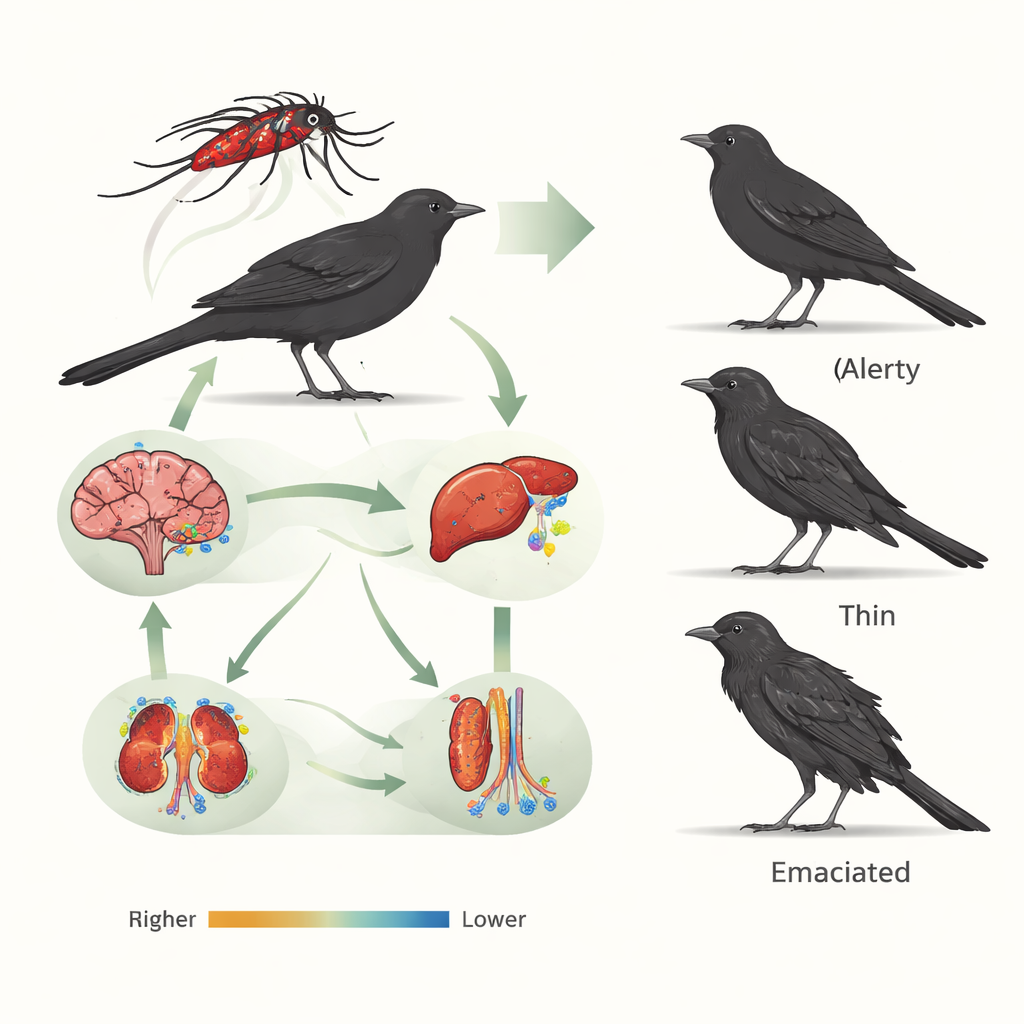
Climate, mosquitoes, and future risks
The year 2024 was both unusually warm and unusually wet in Denmark—ideal conditions for mosquitoes. National monitoring recorded record-high numbers of Culex mosquitoes, the main carriers of Usutu virus. Warmer temperatures not only boost mosquito populations but also speed up virus replication inside them, allowing infected mosquitoes to spread virus more quickly. Similar weather patterns have preceded Usutu outbreaks in other European countries, and in several places Usutu has appeared before West Nile virus, which can cause more serious illness in humans and horses. Because Usutu infections in people are usually mild and rare, the main immediate impact in Denmark is on wild birds, especially blackbirds. However, doctors are advised to be aware of the virus when older or immunocompromised patients present with unexplained neurological symptoms in mosquito season.
What it means for birds and people
The arrival of Usutu virus in Denmark has already caused a noticeable drop in the blackbird population, echoing patterns seen elsewhere in Europe. Fortunately, blackbirds are still common, and experience from other countries suggests that their numbers are likely to rebound over time. The bigger lesson from this study is that emerging mosquito-borne viruses can quietly establish themselves in northern Europe and only become obvious when many animals start dying. By combining systematic mosquito trapping, routine testing of birds, genetic analysis of viruses, and rapid reporting from the public, Denmark aims to stay ahead of both Usutu virus and possible future arrivals such as West Nile virus. For the average person, the story is a reminder that what happens to familiar garden birds can be an early warning sign for wider changes in climate, ecosystems, and infectious disease.
Citation: Gelskov, L.V., Johnston, C.M., Hammer, A.S.V. et al. First detection of Usutu virus in wild birds in Denmark, 2024. Sci Rep 16, 5156 (2026). https://doi.org/10.1038/s41598-026-35874-y
Keywords: Usutu virus, blackbirds, mosquito-borne disease, wildlife surveillance, Denmark