Clear Sky Science · en
Analysis of the impact of vertical deep hole blasting at the bottom of the hole on the lower ore body based on LS-dyna numerical simulation
Protecting Hidden Treasure Underground
Modern technology, from smartphones to wind turbines, depends on rare metals buried deep underground. As mines dig ever deeper to reach these strategic resources, they must blast rock without accidentally shattering the valuable ore that lies below. This study explores how to fire powerful explosives in an upper ore layer while keeping a deeper, rarer ore body safe—and pinpoints how much protective rock needs to be left in between.
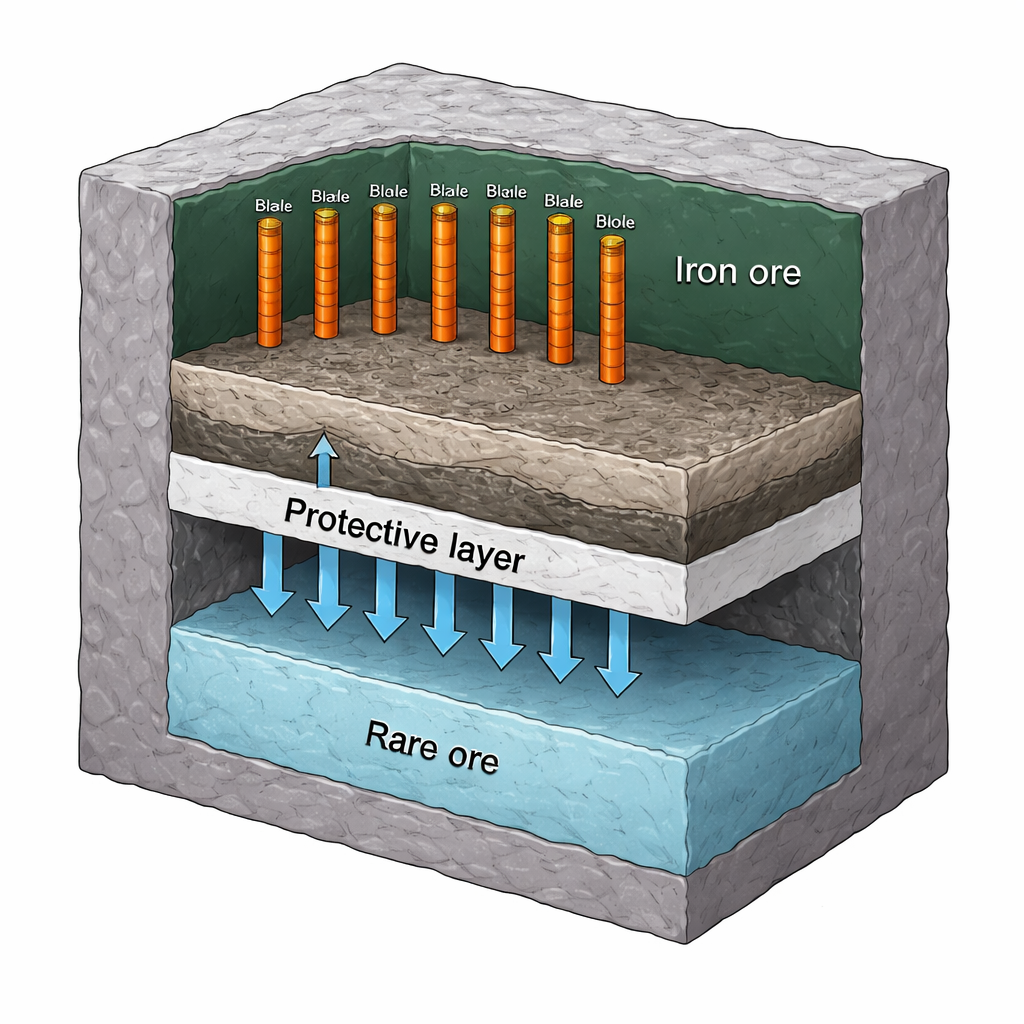
Why Blasting Puts Rare Metals at Risk
Many large mines are shifting from open pits at the surface to underground tunnels as shallow deposits run out and environmental rules tighten. A common technique uses long, vertical drill holes that are packed with explosives to break up iron-rich rock in stages. The problem is that the shock waves from these explosions do not stop neatly where the miners want them to. They can travel through the rock, across filled-in cavities, and into a lower layer that may contain rare metals such as tantalum, niobium, or indium. If this deeper ore body is cracked or loosened too much, the metal can be lost, diluted, or made unsafe to mine later.
Building a Virtual Mine in the Computer
Instead of testing every blasting plan inside a real mine—which would be risky, expensive, and hard to measure—the researchers built a detailed three-dimensional model on the ANSYS/LS-DYNA simulation platform. In this digital mine, they represented explosives, air, rock, and backfill material and allowed them to interact as they would during a real blast. The model included an upper iron ore body containing the blast holes, a horizontal protective layer of rock and backfill beneath it, and a lower rare earth ore body that must remain intact. By changing only the thickness of the protective layer—from 0.5 meters to 3.0 meters in six steps—they could watch how the strength and spread of the blast waves changed and how much the lower ore body moved or cracked.
Watching Shock Waves Travel and Fade
The simulations showed how the blast unfolds over thousandths of a second. Within 1 to 3 milliseconds, the explosive shock surges outward from the drill holes; by about 3 milliseconds it reaches the boundary between the iron ore and the rare earth ore. Around 7 milliseconds, the wave piles up at this boundary, forming a zone of high pressure. After 14 milliseconds, the energy has spread deeper and weakened. The key finding is that the thicker the protective layer, the more the blast wave is delayed and the more its strength drops before it can reach the rare ore. When the protective layer is only 0.5 or 1.0 meter thick, the peak pressure in the rare ore exceeds the rock’s known strength, and the simulated movement of the rock surface is large enough to count as serious, irreversible damage.
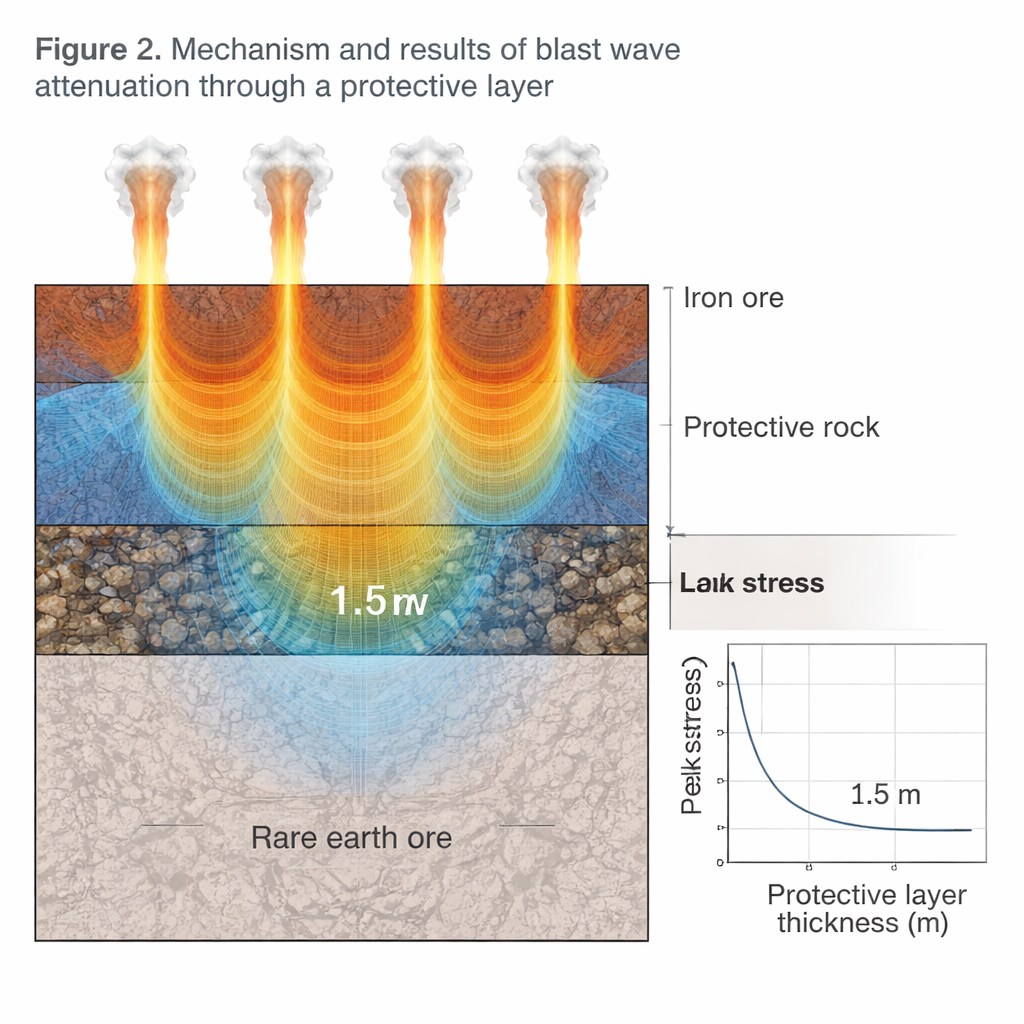
Finding the Safe Buffer Zone
When the protective layer is increased to 1.5 meters or more, the picture changes. The peak pressure arriving at the rare ore stays below its crushing strength, and the tiny movements of the rock surface fall into a range that engineers classify as only slight damage. By tracing stress values along carefully chosen paths through the model, the team could draw a clear curve linking protective layer thickness to blast intensity. This analysis showed a strong, consistent trend: each extra bit of thickness sharply cuts the stress, and 1.5 meters marks a tipping point where the deeper ore shifts from being at risk of failure to being effectively shielded.
What This Means for Future Mining
For the specific mine studied—and for similar operations that blast iron-rich rock above sensitive rare earth deposits—the work delivers a practical rule of thumb: leave at least 1.5 meters of solid protective material between the blast zone and the underlying rare ore. That buffer is enough to keep the deeper ore largely intact while still allowing efficient extraction of the upper layer. By showing how digital simulations can capture these rapid, violent events and turn them into simple design numbers, the study offers a roadmap for mines worldwide to recover essential metals more safely and with less waste.
Citation: Wang, S., Yang, J., Lu, R. et al. Analysis of the impact of vertical deep hole blasting at the bottom of the hole on the lower ore body based on LS-dyna numerical simulation. Sci Rep 16, 6395 (2026). https://doi.org/10.1038/s41598-026-35872-0
Keywords: underground mining, blasting safety, rare earth ore, numerical simulation, protective rock layer