Clear Sky Science · en
A customized MobileNetV2-based lightweight CNN for monkeypox detection and classification
Why a Phone-Friendly Mpox Test Matters
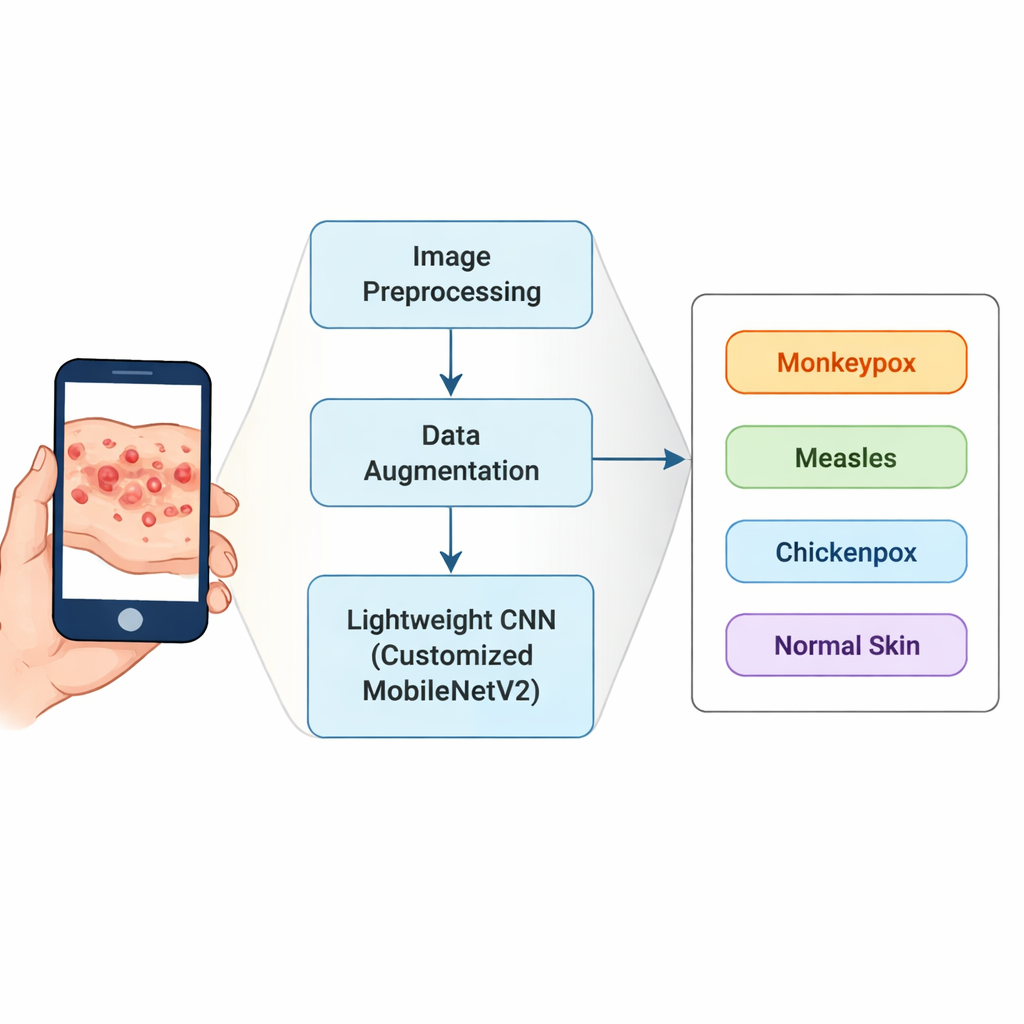
Imagine snapping a photo of a strange rash with your phone and getting a fast, reliable hint about whether it might be monkeypox (Mpox) or something less serious, like chickenpox or measles. This paper explores a compact form of artificial intelligence that can do just that. By shrinking a powerful image-recognition system into a model small enough for smartphones and other simple devices, the researchers aim to bring early Mpox screening to clinics and communities that lack advanced laboratories.
The Challenge of Spotting Mpox Early
Mpox is a viral disease that spreads through close contact and has symptoms that can look confusingly similar to other skin conditions. People may develop fever, body aches, and distinctive rashes, but these signs overlap with diseases like measles, chickenpox, and ordinary skin irritations. Traditional tests, such as laboratory-based PCR, are accurate but slow, expensive, and often unavailable in remote areas. That gap leaves many health workers and patients guessing, delaying isolation and treatment and giving the virus more time to spread.
Teaching Computers to Read Skin Images
Modern image-based artificial intelligence offers a way to turn everyday cameras into simple diagnostic helpers. The authors build on a popular “lightweight” neural network called MobileNetV2, originally designed to run on devices with limited computing power. They use a public dataset of 770 skin photographs divided into four groups: Mpox, measles, chickenpox, and normal skin. To make the most of this relatively small collection, they carefully prepare the images, resizing them to a common format and applying subtle changes such as rotations, flips, and zooms. These tricks, known as data augmentation, help the model learn to recognize patterns without memorizing specific photos.
A Smarter, Slimmer Brain for the Task
Instead of building a new system from scratch, the researchers “fine-tune” an existing MobileNetV2 model that has already learned general visual features from large image collections. They keep most of its layers fixed and only retrain the last 20 layers so they specialize in Mpox-related rashes. On top of this backbone, they add a lightweight decision-making head that includes a global averaging step and dropout—techniques that help the model focus on the most important parts of the image while avoiding overconfidence in noise or background. They also adjust the way the model learns from mistakes so that all four disease groups are treated fairly, even though some have fewer examples.
How Well the Tiny Model Performs
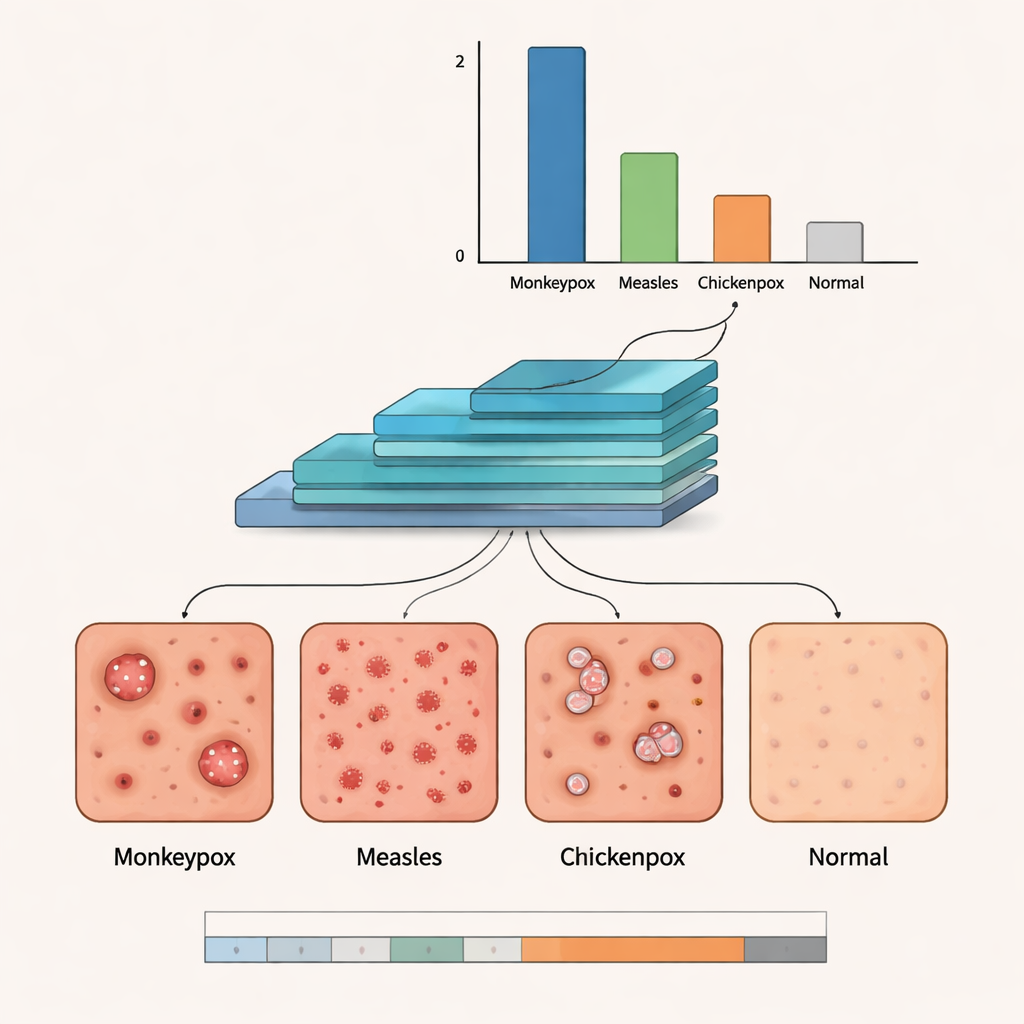
After training, the customized MobileNetV2—called CMBNV2—achieves striking results. It correctly identifies the right class for 99% of the test images and reaches similarly high scores for precision, recall, and a combined measure known as the F1-score. In simple terms, it rarely misses true Mpox cases and seldom raises false alarms. The entire model is only about 8.63 megabytes in size, uses modest memory, and requires relatively few calculations, making it suitable for real-time use on typical smartphones or other small devices. Comparisons with heavier, more complex networks and other compact designs show that this tuned version of MobileNetV2 is both faster and more accurate on the Mpox dataset.
What This Could Mean for Everyday Health
For non-specialists, the main takeaway is that a carefully designed, phone-friendly AI can reliably distinguish Mpox from look-alike skin conditions using a simple photo. While it is not a replacement for a doctor or a lab test, such a tool could act as an early warning system, especially where medical resources are scarce. By guiding people toward timely testing and isolation, and giving health workers quick support in the field, models like CMBNV2 could become a practical line of defense against future Mpox outbreaks and, eventually, other skin diseases as well.
Citation: Askale, G.T., Yibel, A.B., Munie, A.T. et al. A customized MobileNetV2-based lightweight CNN for monkeypox detection and classification. Sci Rep 16, 5028 (2026). https://doi.org/10.1038/s41598-026-35871-1
Keywords: monkeypox, skin lesions, deep learning, mobile health, image classification