Clear Sky Science · en
Predicting multiphase flow and tracer transport for an underground chemical explosive test
Why underground blasts matter to the rest of us
Underground nuclear tests are banned, but the world still needs ways to tell if someone breaks the rules. One powerful clue is radioactive gas that can leak from an underground blast and drift into the atmosphere, where it can be measured far away. This study looks at how gases race through dry underground rock in the first hours and days after a buried explosion, using a large chemical blast as a safe stand-in. By combining detailed field measurements with advanced computer models, the researchers show how pressure from the explosion can rapidly push gases into surrounding rock—knowledge that helps improve future monitoring and lowers environmental risk.
A test blast in the desert
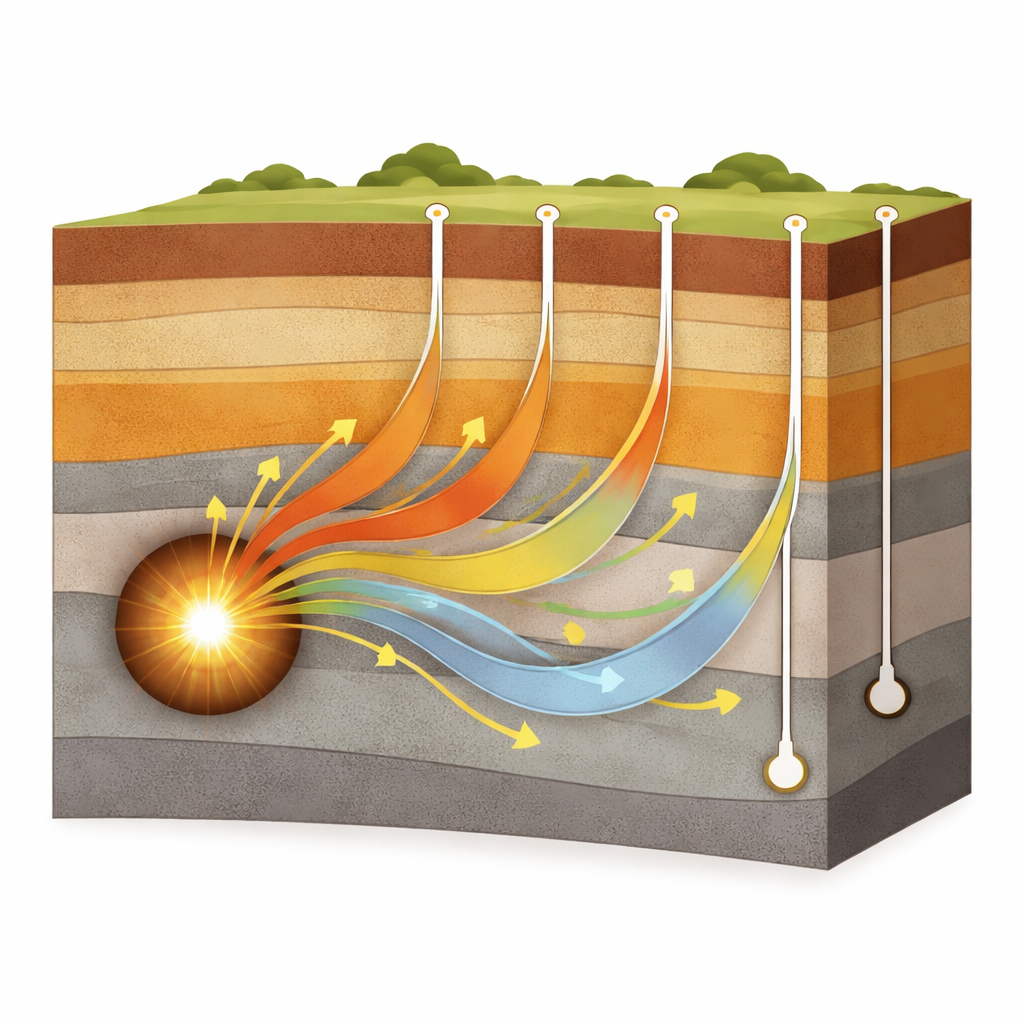
The work centers on a recent experiment at the Nevada National Security Site, inside a tunnel complex carved into volcanic rock hundreds of meters above the water table. Instead of a nuclear device, scientists detonated a chemical explosive deep underground to create a small cavity and a powerful pressure wave. Before the shot, they drilled several narrow boreholes around the planned cavity and carefully measured the rock’s properties—such as how easily gas and water move through it. After the explosion, these boreholes acted like tiny windows into the subsurface, allowing instruments to track pressure changes and the arrival of different gases over time.
Following the gas after the blast
When the explosive detonates, it creates a hot, highly pressurized pocket of gas in the cavity. That sudden overpressure forces air, water vapor, and tracer gases—such as a specially chosen radioactive xenon isotope and combustion byproducts like carbon dioxide and methane—into the surrounding rock. The team used a specialized computer code to simulate how gas and water move together through the tiny pores in the rock, taking into account high temperatures, steep pressure differences, and the way tracers can dissolve into pore water. They represented the tunnel environment in a simplified two-dimensional radial model: layers of volcanic rock around a central cavity, with gas pushing outward and some of it escaping through the boundaries of the model.
How well the predictions matched reality
Crucially, the model was built and calibrated using only data available before the explosion, mimicking how scientists must work when evaluating an unknown test. Even with this constraint and a simplified geometry, the simulations predicted the timing and size of tracer gas arrivals at the closer boreholes to within about an order of magnitude. In other words, they got the right general picture of how quickly and how much gas would arrive nearby. However, the model tended to underestimate gas concentrations at more distant, shallower boreholes and sometimes predicted gas arrivals too early. These mismatches highlighted how sensitive gas movement is to small-scale variations in rock permeability and water content that are difficult to capture in advance.
What the rock itself is hiding
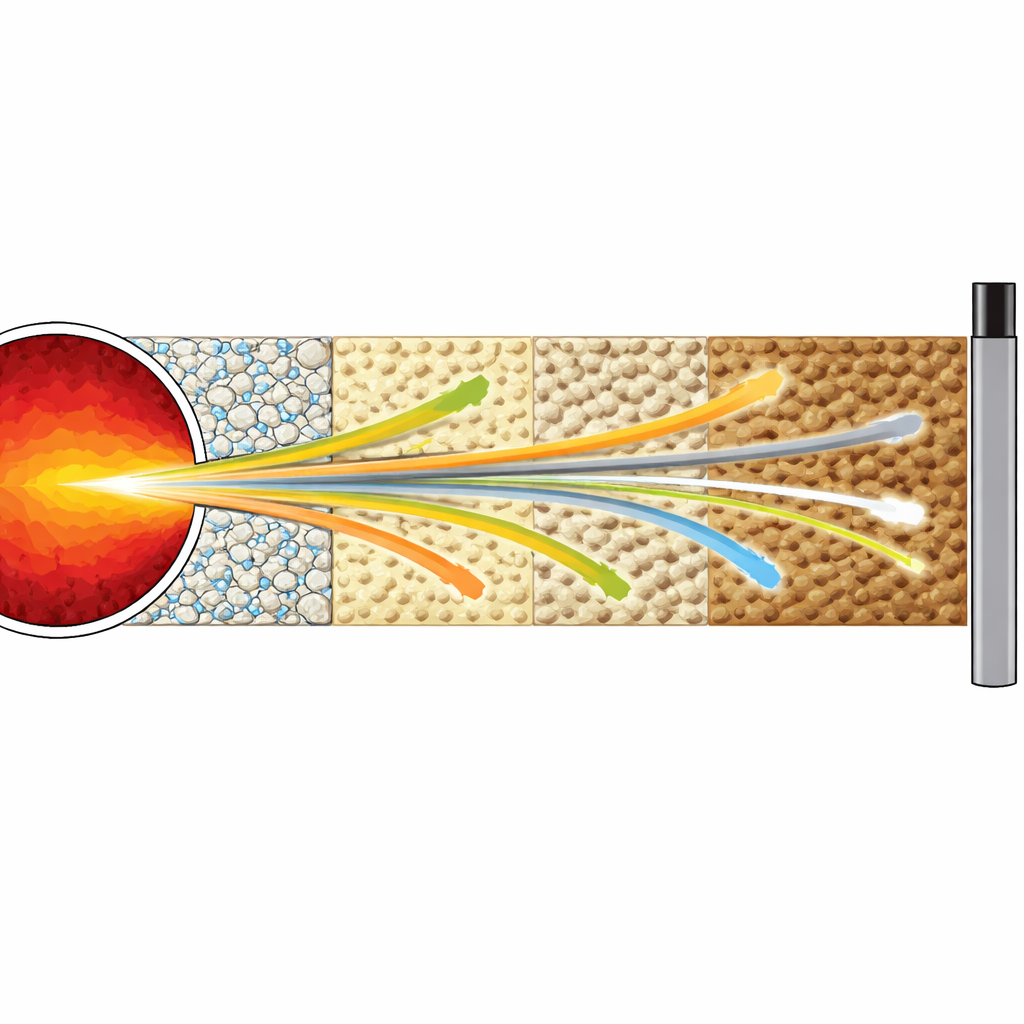
The study showed that not all rock layers behave the same. Some units have pores and microfractures that allow gases to move more freely, while others are tighter or contain minerals, such as zeolites, that can strongly grab certain gases. Follow-up analyses using post-explosion pressure data suggested that one upper rock layer was more permeable than pre-shot tests had indicated, which helped explain why actual gas concentrations were higher there than predicted. Other discrepancies likely stem from processes the model did not yet include, such as strong adsorption of xenon and carbon dioxide onto zeolitic minerals or fine-scale variations in water saturation that can either block or channel gas flow.
What this means for detection and safety
For non-specialists, the key message is that early gas movement after an underground explosion is fast, complex, and strongly shaped by the local rock. This work demonstrates that, with careful site characterization and sophisticated modeling, scientists can make useful advance predictions about when and where gases will emerge—predictions accurate enough to guide where sensors should be placed and how future tests should be designed. Beyond nuclear monitoring, the same insights apply to understanding how any pressurized gas, from industrial leaks to natural emissions, might move through dry, unsaturated rock. Step by step, this kind of field-tested modeling improves our ability to detect hidden explosions and to manage the environmental risks of contaminants released underground.
Citation: Ortiz, J.P., Lucero, D.D., Rougier, E. et al. Predicting multiphase flow and tracer transport for an underground chemical explosive test. Sci Rep 16, 9431 (2026). https://doi.org/10.1038/s41598-026-35868-w
Keywords: underground explosions, radionuclide gas transport, subsurface monitoring, nonproliferation, vadose zone flow