Clear Sky Science · en
Influence of variety, toppling stage, and storage duration on postharvest quality and shelf life of onion(Allium cepa L.) in Bahir Dar Zuria district
Why onions on the shelf matter to all of us
Onions are a kitchen staple, but in parts of Ethiopia, a large share of the harvest rots or sprouts before it ever reaches the frying pan. This study from Northwest Ethiopia asks a practical question with big consequences for farmers and consumers alike: which onion types and field practices before harvest give bulbs that keep longer in simple village storage? The answers could mean more stable incomes for smallholders, less food waste, and more affordable onions in local markets.
Where the onions were grown and stored
The research took place in the Bahir Dar Zuria district, a major onion-growing area near Lake Tana. Farmers there mostly rely on open-pollinated varieties, especially one called Bombay Red, which are cheap to seed but notorious for poor keeping quality. Researchers compared this local favorite with three hybrid varieties—Red Coach, Russet, and Jambar—grown under irrigation using standard fertilizer and plant spacing. After harvest, the bulbs were stored for up to three months in a simple, well-ventilated “diffused light” store: essentially wooden racks in a shaded room where air can circulate and temperatures follow the local climate.
Simple field practices with big effects
The team focused on two preharvest practices farmers already use in different ways: “toppling,” which means bending the onion leaves at the neck to start drying the bulbs, and irrigation close to harvest. They tested four treatments: early toppling when about 70% of plants had bent necks, either with or without a last irrigation; later toppling at 90% neck fall; and a control where plants were not toppled at all and were simply pulled at 70% neck fall. After a short curing period in the shade, bulbs from every treatment and variety were weighed and placed into storage so the researchers could track sprouting, decay, weight loss, sweetness (through dissolved solids), firmness, and how many bulbs stayed marketable over time.
Which onions lasted longest
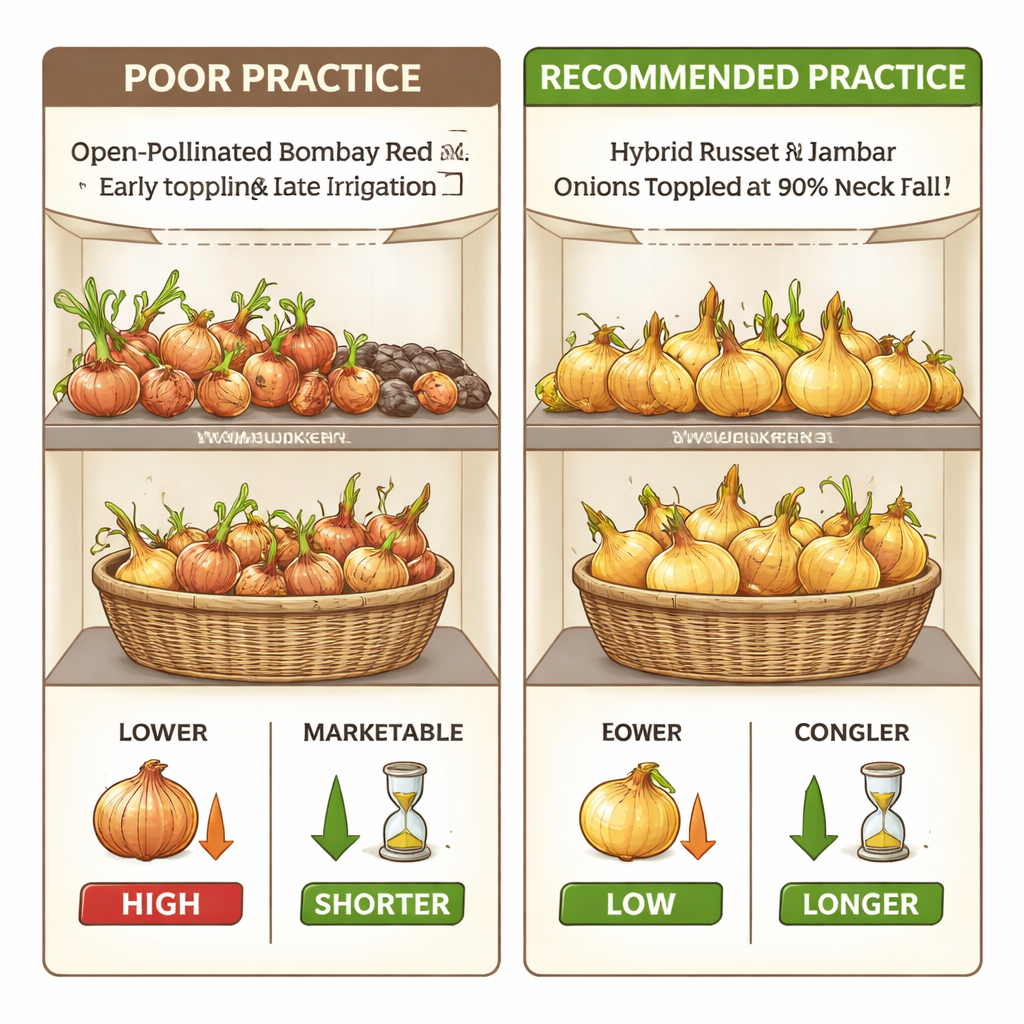
The differences in storage behavior were striking. Bombay Red was the worst performer: after three months it showed the highest levels of sprouting and decay and the greatest weight loss, leaving the fewest saleable bulbs. Red Coach did slightly better, but still lost quality faster than its hybrid cousins. Russet and Jambar stood out for their tougher skins, firmer bulbs, and slower sprouting. When these two hybrids were combined with toppling at 90% neck fall, they had the lowest weight loss (around half that of the worst treatment), the firmest bulbs, and the highest share of onions that remained fit for sale. In contrast, Bombay Red with early toppling plus late irrigation produced bulbs that sprouted and rotted quickly and became soft and shriveled.
Why timing and water make such a difference
The study shows that what happens in the field sets the stage for what happens in storage. Late irrigation leaves bulbs full of moisture and still physiologically “active,” so they breathe faster, burn through stored sugars, and are quick to sprout or succumb to fungi. Proper toppling near full maturity helps the neck dry and outer skins harden, creating a natural barrier that slows both water loss and infection. Varieties also differ genetically: hybrids like Russet and Jambar tend to have thicker outer scales, longer natural dormancy, and slower metabolism, all of which help them sit quietly on the shelf instead of trying to grow again in the store.
What this means for farmers and consumers
For farmers in Bahir Dar Zuria and similar regions, the message is clear and practical. Switching from Bombay Red to hybrid onions such as Jambar and Russet, and timing toppling close to full maturity (around 90% neck fall) without late irrigation, can sharply cut storage losses in low-cost diffused light stores. Under these conditions, onions can be safely held for at least a month with relatively little sprouting, decay, or weight loss. That means more of the harvest can be sold gradually at better prices, instead of being rushed to market or lost in storage. The authors recommend testing these approaches across more seasons and exploring growth regulators that might further extend shelf life, but their core finding is simple: better varieties and smarter preharvest care can turn a fragile crop into a more reliable source of income and food.
Citation: Assefa, F., Yeshiwas, Y., Alemayehu, M. et al. Influence of variety, toppling stage, and storage duration on postharvest quality and shelf life of onion(Allium cepa L.) in Bahir Dar Zuria district. Sci Rep 16, 5248 (2026). https://doi.org/10.1038/s41598-026-35867-x
Keywords: onion storage, postharvest losses, hybrid onion varieties, toppling and irrigation, Ethiopian smallholder farming