Clear Sky Science · en
Comparison of multi-stress resilience in wild and domesticated Cowpea
Why tougher cowpea plants matter
As climate change brings harsher droughts and more damaging insect outbreaks, smallholder farmers who rely on hardy crops like cowpea face growing uncertainty. This study asks a simple but crucial question: are the wild relatives of cowpea better at coping with multiple stresses than the high-yielding varieties grown in fields today—and can that hidden toughness help secure future harvests?
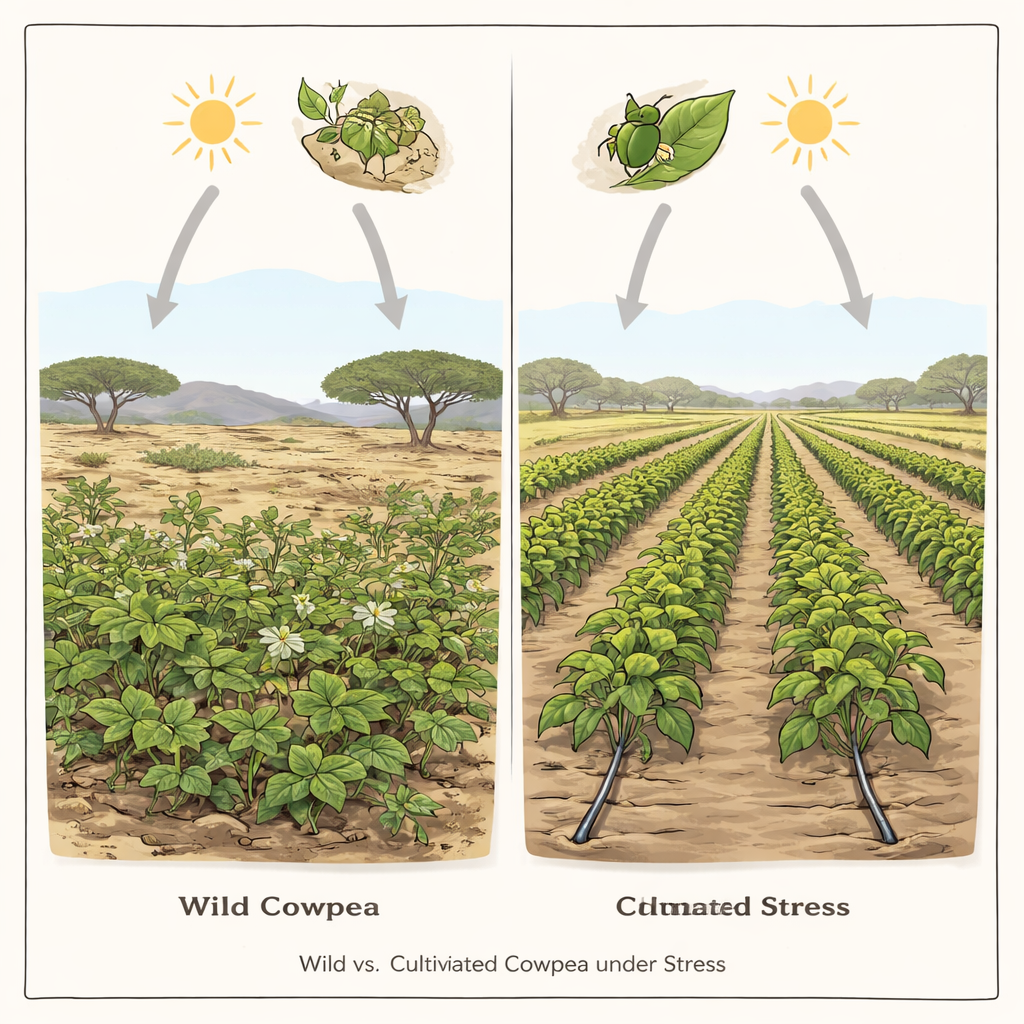
Wild cousins versus farm varieties
The researchers focused on cowpea (Vigna unguiculata), a key food and fodder legume in dry regions of Africa, Asia, and Latin America. Cowpea not only feeds people and livestock; it also enriches soils by fixing nitrogen, making it especially important in low-input farming systems. Over thousands of years, farmers have domesticated cowpea to produce more food and to grow in a predictable way. But in the process, some of the traits that helped its wild ancestors survive heat, drought, poor soils, and hungry insects may have been lost or weakened.
Putting plants through a stress test
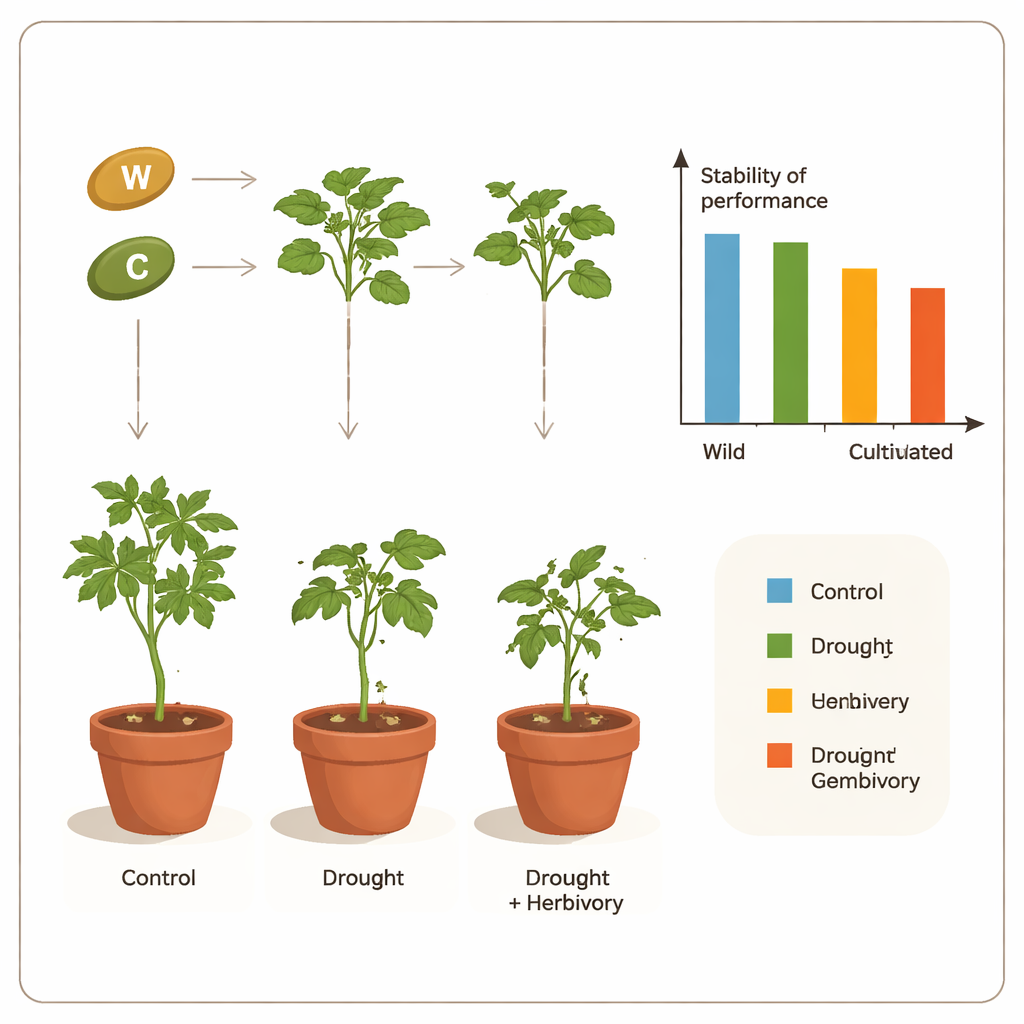
To compare toughness, the team grew fourteen genetically diverse cowpea lines—four cultivated varieties and ten wild relatives—under controlled greenhouse conditions. After an initial growth period, plants were divided into four groups: a well-watered control group, a drought group with limited watering, a herbivory group where stem clipping mimicked insect feeding, and a combined drought-plus-herbivory group. For each plant, they measured basic growth features that farmers care about, such as overall biomass, the length of the main stem, and the number of leaves and side shoots.
How plants fared under drought and damage
All plants, wild and cultivated, suffered when water was scarce or when “insect” damage was applied, and they did worst when both stresses were combined. Biomass, height, leaf number, and shoot number all declined sharply relative to the control plants. This reflects a key reality of farming under climate change: crops rarely experience just one problem at a time. Yet the important difference lay not only in how much plants shrank, but in how predictably they reacted. Wild cowpea lines generally started out growing better than cultivated ones and lost a smaller share of their performance under stress. Their responses were also more consistent from plant to plant and across different stress combinations.
Stability: a hidden form of resilience
To capture this idea of consistency, the authors looked at how variable each genotype’s responses were across stress treatments. Cultivated cowpea showed higher variability, meaning individual plants of the same variety could respond quite differently when hit by drought and simulated herbivory. Wild cowpea, in contrast, showed lower variability and more “stable” behavior under stress. This stability became especially clear for plants originating from areas with long dry seasons, suggesting that natural selection in tough environments favors reliable, not just strong, performance. Statistical models confirmed that domestication type and stress treatment interacted: cultivated types were more sensitive to combined stresses, while wild types maintained more even growth.
What this means for future food security
For farmers facing unpredictable weather, stability in yield can matter as much as high yield in a good year. This study shows that wild cowpea relatives hold valuable traits for multi-stress resilience: they are more likely to keep growing, and to do so in a predictable way, when confronted with both drought and insect damage. The authors argue that breeding programs and seed banks should pay closer attention to these wild lines, carefully measuring how they respond to realistic combinations of stresses. By crossing cultivated cowpea with its wild cousins, or even using some wild types directly in farming systems, breeders may be able to develop new legume varieties that are not only productive, but also reliably robust in the face of climate extremes.
Citation: De Meyer, E., Van Cauter, F., Vandelook, F. et al. Comparison of multi-stress resilience in wild and domesticated Cowpea. Sci Rep 16, 5109 (2026). https://doi.org/10.1038/s41598-026-35860-4
Keywords: cowpea, crop wild relatives, drought stress, insect herbivory, climate-resilient crops