Clear Sky Science · en
Genomic discrimination of the botanical groups conilon and robusta of Coffea canephora
A Tale of Two Coffees
For many coffee drinkers, a cup is simply labeled “robusta” or “conilon,” if it is labeled at all. Yet behind those names lies a hidden genetic story that shapes yield, flavor potential, disease resistance, and how well coffee plants cope with drought. This study peeks under the hood of Coffea canephora—the species behind most robusta coffee—to show how modern DNA tools can clearly tell these botanical groups apart and spot their hybrids, information that can ultimately influence what ends up in your mug.
Why Coffee Types Matter to Growers
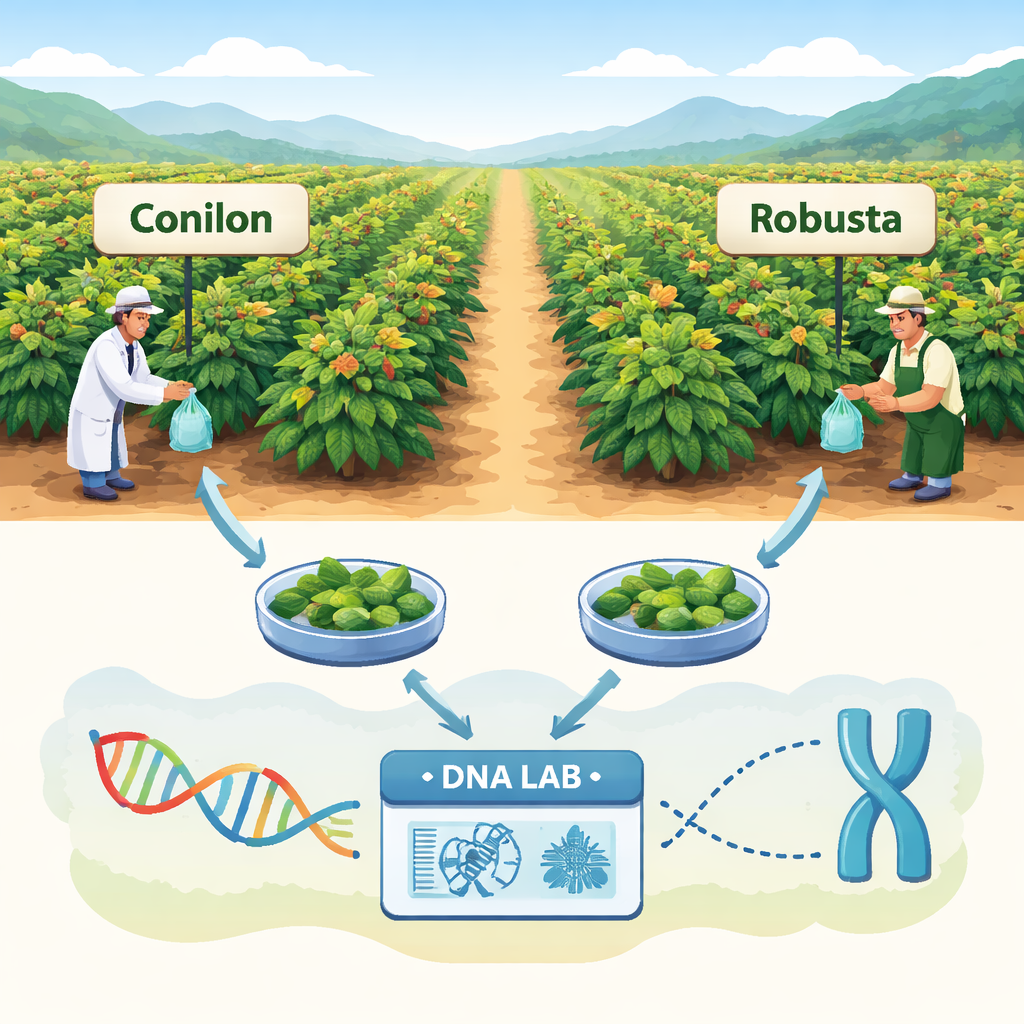
Coffea canephora is not a single, uniform crop. Two main botanical groups—Conilon and Robusta—are grown worldwide. Conilon plants tend to be shorter, with bushier growth and better tolerance to dry conditions, while Robusta plants are taller, with larger leaves, later ripening, and generally greater resistance to pests and diseases. Breeders like to cross these groups to combine their strengths and harness “hybrid vigor,” creating plants that are more productive and resilient. However, in practice it has been surprisingly difficult to say with confidence which plants belong to which group, and which are true hybrids, when relying only on visible traits like plant shape, leaf size, or fruit color.
From Leaves in the Field to DNA in the Lab
The research team worked with 121 plants from a major germplasm bank in Espírito Santo, Brazil, previously labeled as Conilon, Robusta, or hybrids based on 29 physical descriptors. They collected young leaves, extracted DNA, and used a high-throughput genotyping method called DArTseq to read thousands of tiny genetic differences known as single nucleotide polymorphisms, or SNPs. After strict filtering for quality, 1,551 SNP markers remained, spread across all 11 coffee chromosomes. These markers provided a kind of bar code for each plant, allowing the scientists to measure how genetically similar or different the plants were and to group them objectively.
Three Hidden Groups in the Coffee Genome
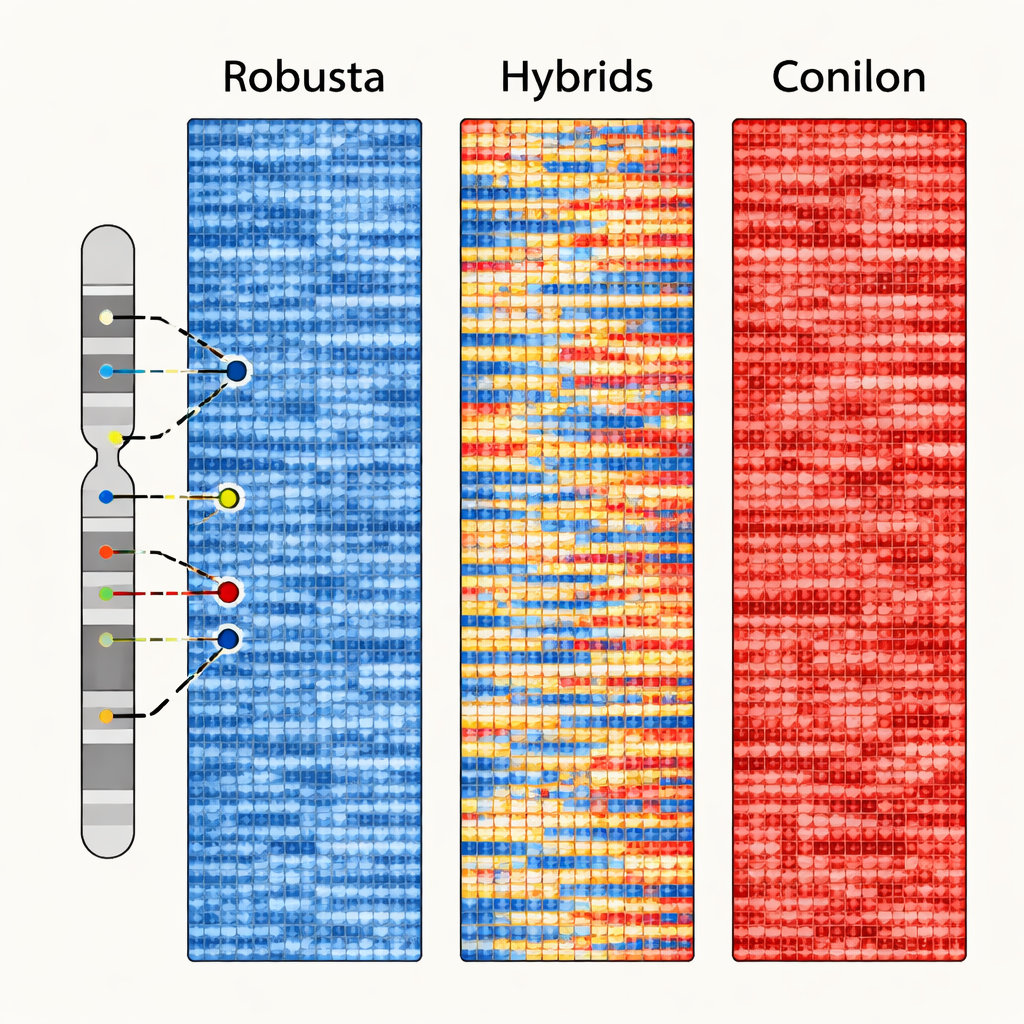
When the researchers clustered the plants purely by DNA, three clear genetic groups emerged. One group matched Robusta, while two groups together represented Conilon, with one of these containing especially diverse and hybrid-like individuals. Most Robusta plants fell neatly into the Robusta group, and most Conilon plants into the main Conilon group, confirming that the traditional visual classification works reasonably well for the pure types. But many plants labeled as “hybrids” by appearance actually grouped genetically with Conilon, and a smaller fraction grouped with Robusta or sat in the intermediate hybrid cluster. Statistical analysis showed that Robusta and Conilon are strongly differentiated at the DNA level, while the hybrid group carries a mix of genetic material from both, with a particularly high level of genetic diversity.
Building a Simple Genetic Fingerprint
Looking more closely at the SNP patterns, the team singled out markers where Conilon and Robusta consistently carry different genetic versions. Starting from 29 promising SNPs, they discovered that just 10 of them were enough to reliably distinguish Conilon, Robusta, and their hybrids. These markers sit in non-coding regions across nine chromosomes, meaning they can be used as neutral genetic “tags” without directly altering plant traits. To test how robust this miniature fingerprint really was, the scientists applied it to a much larger and more mixed set of 650 plants from farms and germplasm banks. The same handful of markers still cleanly separated the major groups and highlighted populations where genes from Conilon and Robusta are already blending in farmers’ fields.
What This Means for Coffee’s Future
For non-specialists, the key message is that a very small panel of DNA markers can now tell breeders, regulators, and farmers whether a coffee plant is Conilon, Robusta, or a hybrid—far more reliably than judging by eye. This helps protect genetic diversity, guides smarter crosses to combine drought tolerance with disease resistance, and can reduce the time and cost of variety testing. In the long run, such precise genetic tools make it easier to design stronger Coffea canephora varieties, helping secure robusta-style coffee supplies in a changing climate and keeping your morning cup both plentiful and affordable.
Citation: de Oliveira, R.G., de Almeida, F.A.N., Zaidan, I.R. et al. Genomic discrimination of the botanical groups conilon and robusta of Coffea canephora. Sci Rep 16, 5584 (2026). https://doi.org/10.1038/s41598-026-35855-1
Keywords: coffee genetics, robusta coffee, conilon coffee, DNA markers, plant breeding