Clear Sky Science · en
Taxonomic, functional and interspecific response of zooplankton to management practices in carp ponds
Why tiny pond life matters to your dinner plate
Carp ponds across Europe produce millions of fish each year, but beneath the surface, countless tiny animals called zooplankton quietly power this food production. These microscopic creatures feed on algae and in turn feed the carp. This study asks a deceptively simple question with big implications for both farmers and the environment: how does the way we feed carp—grains, pellets, or a mix—change these hidden communities, and what might that mean for pond health and sustainable aquaculture? 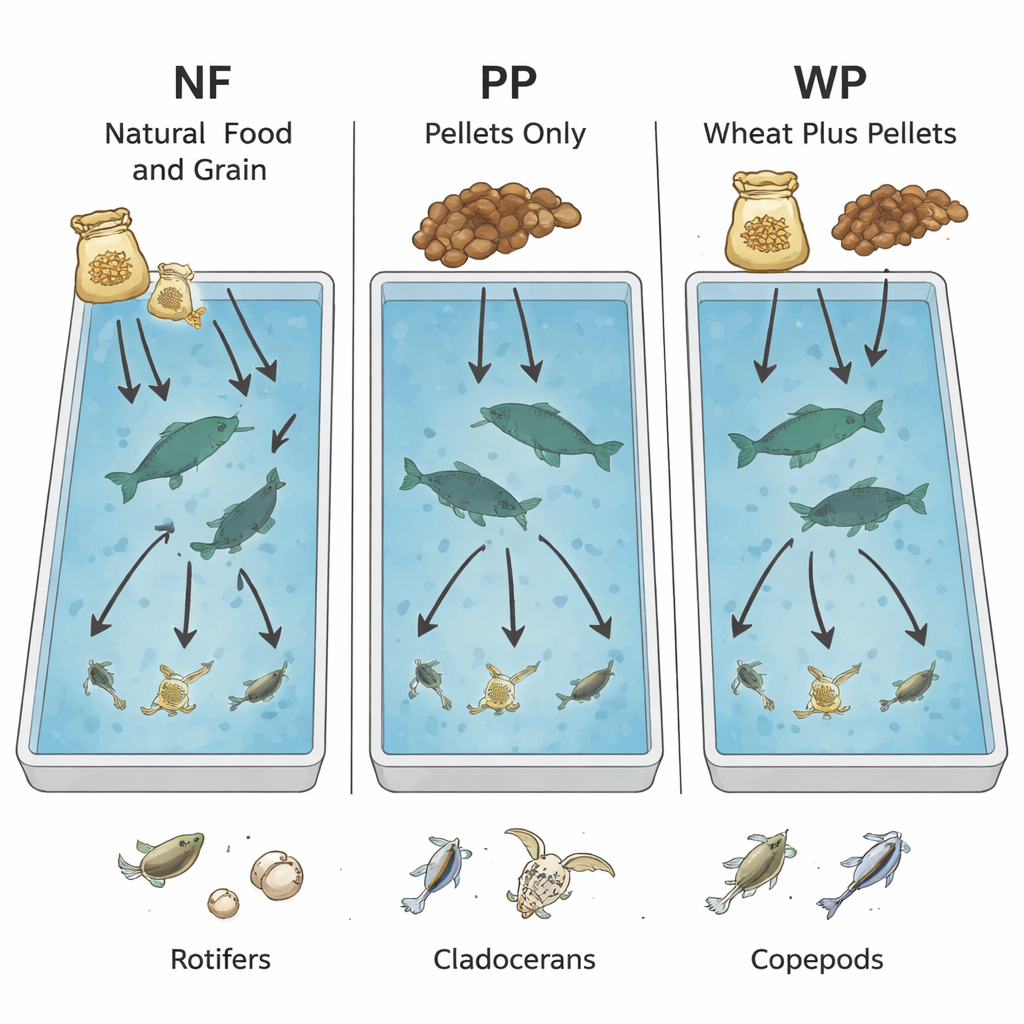
Three ways to feed a pond
The researchers worked in nine small carp ponds in the Czech Republic, all stocked with the same number and size of carp. What differed was the feeding regime. In one set of ponds (NF), carp relied on natural pond food in spring and received whole grains only in summer. A second set (PP) was fed formulated pellets throughout the growing season. A third (WP) used a mix of wheat and plant-based pellets. The team monitored the ponds from April to October, tracking water chemistry, algae, fish biomass, and the full zooplankton community, from tiny rotifers and protozoa to larger crustaceans like cladocerans and copepods.
Water stayed similar, but communities did not
Despite the contrasting diets, the ponds looked surprisingly alike when it came to basic water quality. Temperature, nutrients, and algae levels followed the seasons rather than feeding style: summer brought warmer water, more organic matter, higher nitrogen and phosphorus, and a surge in phytoplankton. Across all ponds, the number of zooplankton species and how evenly they were represented (a standard measure of diversity) also did not differ much. In other words, simply counting species would suggest the feeding regimes had little impact. Yet a closer look at which groups thrived, and how they interacted, told a different story.
Winners and losers among tiny grazers
Zooplankton in all ponds were dominated by small filter-feeding species that strain fine particles from the water, especially rotifers and young crustaceans. However, the balance between groups shifted with feeding style. In grain-based NF ponds, copepods—relatively large, mobile crustaceans and important plankton predators—were largely eliminated. Instead, larger filter-feeding cladocerans such as Bosmina and Daphnia and active rotifers like Asplanchna and Polyarthra flourished, especially as the season advanced. These species are fast breeders and efficient at clearing algae from the water. In ponds supplied with pellets all year (PP and WP), copepods remained abundant, but the community was dominated by small, mix-feeding rotifers and protozoa that can exploit a wide range of food, including bacteria and detritus. 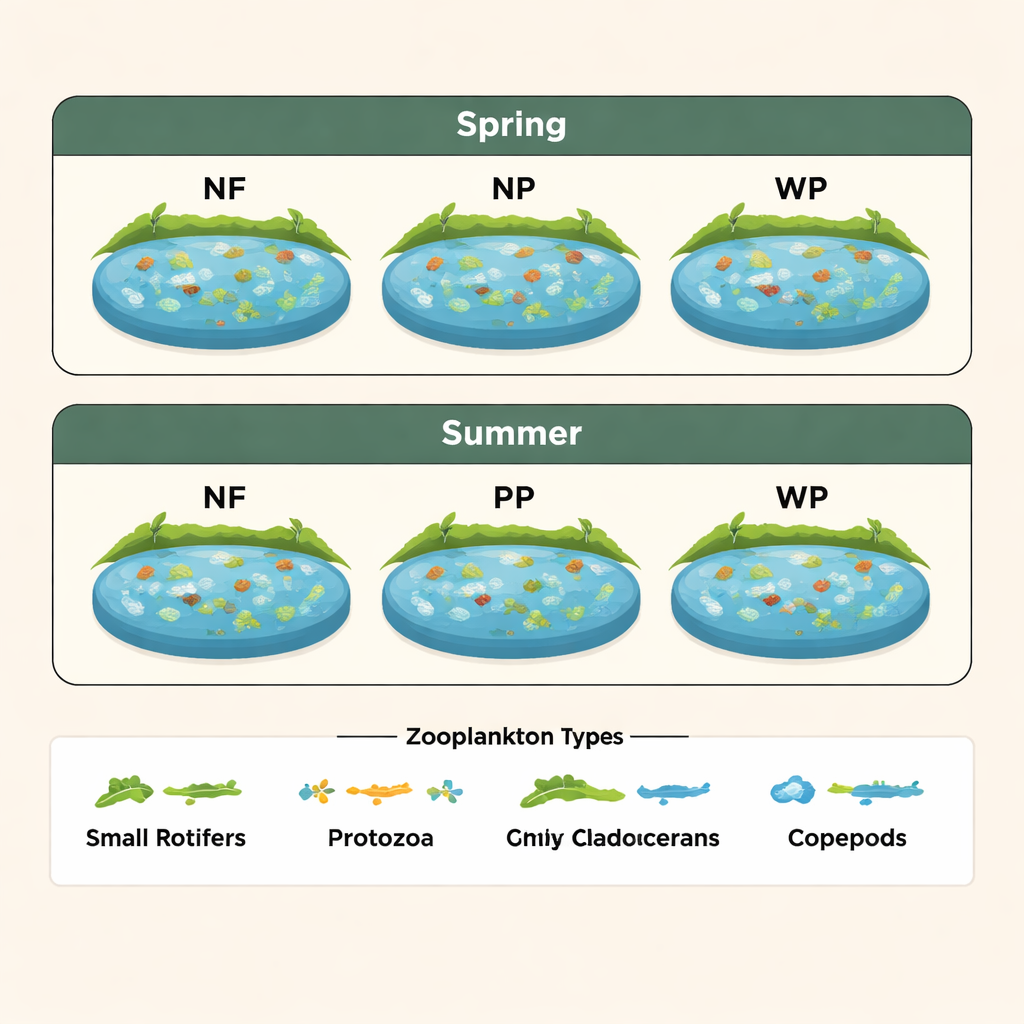
Changing the web of underwater relationships
Beyond which species were present, the study examined how strongly zooplankton groups were linked to one another. Using network-style analyses, the authors found that NF ponds supported a more dynamic and structured web of positive and negative associations. Two clear clusters emerged: one composed of larger filter feeders and active rotifers that tended to rise and fall together, and another of small rotifers that often showed negative links with crustaceans, suggesting competition for shared resources. In contrast, pellet-fed ponds showed weaker contrasts between cooperative and competitive ties and more homogenized communities, dominated by a few flexible, small-bodied forms. As summer progressed and ponds became warmer, murkier, and richer in algae, actively hunting or broadly feeding species became more important in all ponds, making the interaction network more complex but also less neatly clustered.
What this means for fish and farmers
For non-specialists, the key message is that how we feed carp does more than fatten fish; it reshapes the invisible engine of the pond. Year-round pellet feeding supports a stable but relatively uniform zooplankton community dominated by very small species, while a regime that leans more on natural food and seasonal grain encourages greater shifts in function, with larger filter feeders and more pronounced interactions among species. These differences can influence how efficiently energy and nutrients move from algae up to fish, and how ponds respond to nutrient inputs over time. By monitoring not just which zooplankton species are present, but what they do and how they relate to one another, managers can fine-tune feeding strategies that keep carp growing while helping ponds remain productive and ecologically resilient.
Citation: Goździejewska, A.M., Glińska-Lewczuk, K., Kruk, M. et al. Taxonomic, functional and interspecific response of zooplankton to management practices in carp ponds. Sci Rep 16, 5045 (2026). https://doi.org/10.1038/s41598-026-35854-2
Keywords: carp ponds, zooplankton, fish feeding, aquaculture, pond ecology