Clear Sky Science · en
Based on binary evolution operator-enhanced black-kite algorithm with natural replacement for engineering numerical optimization problems
Smarter Ways to Make Tough Choices
From designing safer cars to planning efficient wind farms, engineers constantly face puzzles with millions of possible answers. Checking every option is impossible, so they rely on clever shortcuts—computer algorithms that search for very good solutions without looking everywhere. This paper introduces one such shortcut, inspired by the hunting and migration behavior of a bird of prey called the black‑winged kite, and shows how a refined version of this idea can solve many demanding real‑world design problems faster and more reliably than existing methods.
Learning from a Hunting Bird
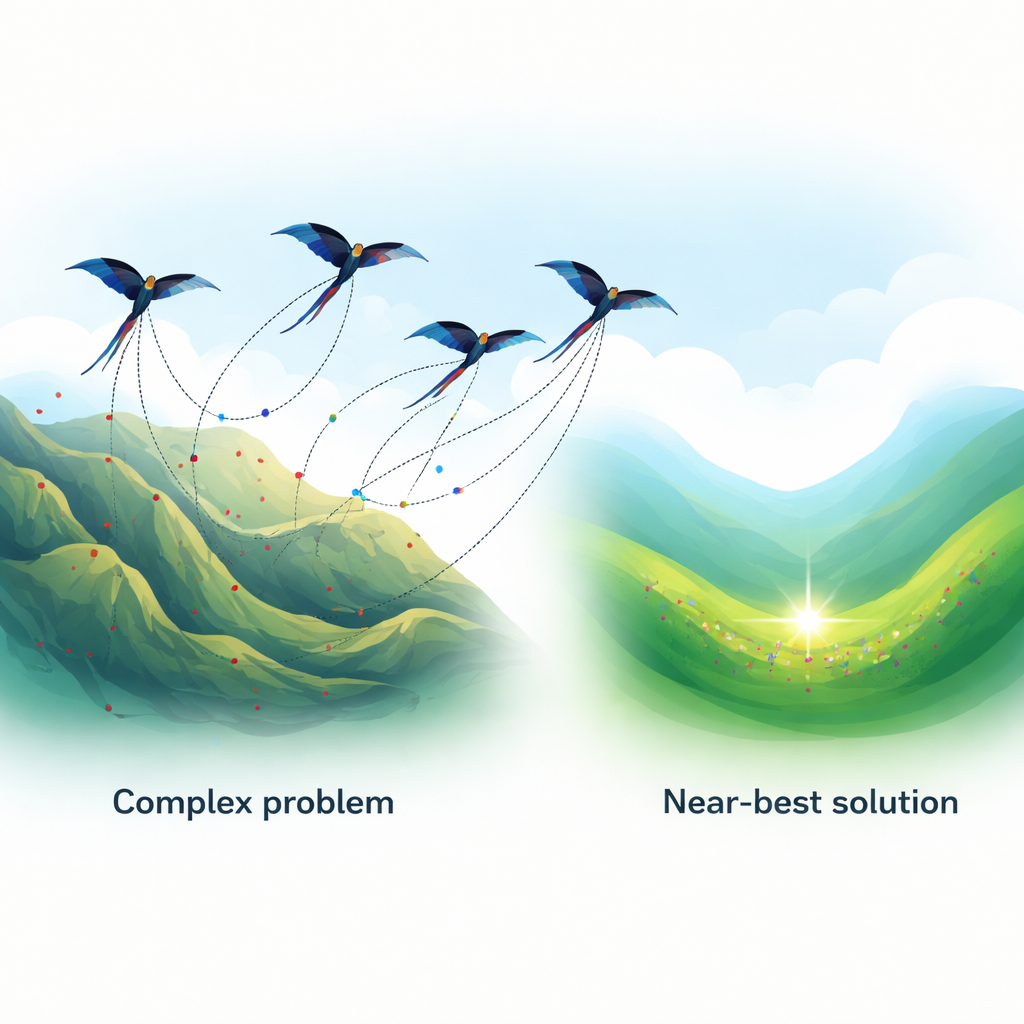
Modern “metaheuristic” algorithms often borrow ideas from nature: how ants find food, how wolves hunt, or how galaxies move. The original Black‑winged Kite Algorithm (BKA) fits this family. It imagines many virtual birds flying over a mathematical landscape, where height represents how good a design is. During an “attack” phase the birds explore broadly, and during “migration” they home in on promising areas. BKA has been used for practical tasks such as tuning batteries and helping with resource exploration. But like many similar methods, it can still get stuck on merely good solutions, miss better ones, or take a long time to settle on an answer when problems are very complex.
Adding Controlled Chaos and Smarter Mixing
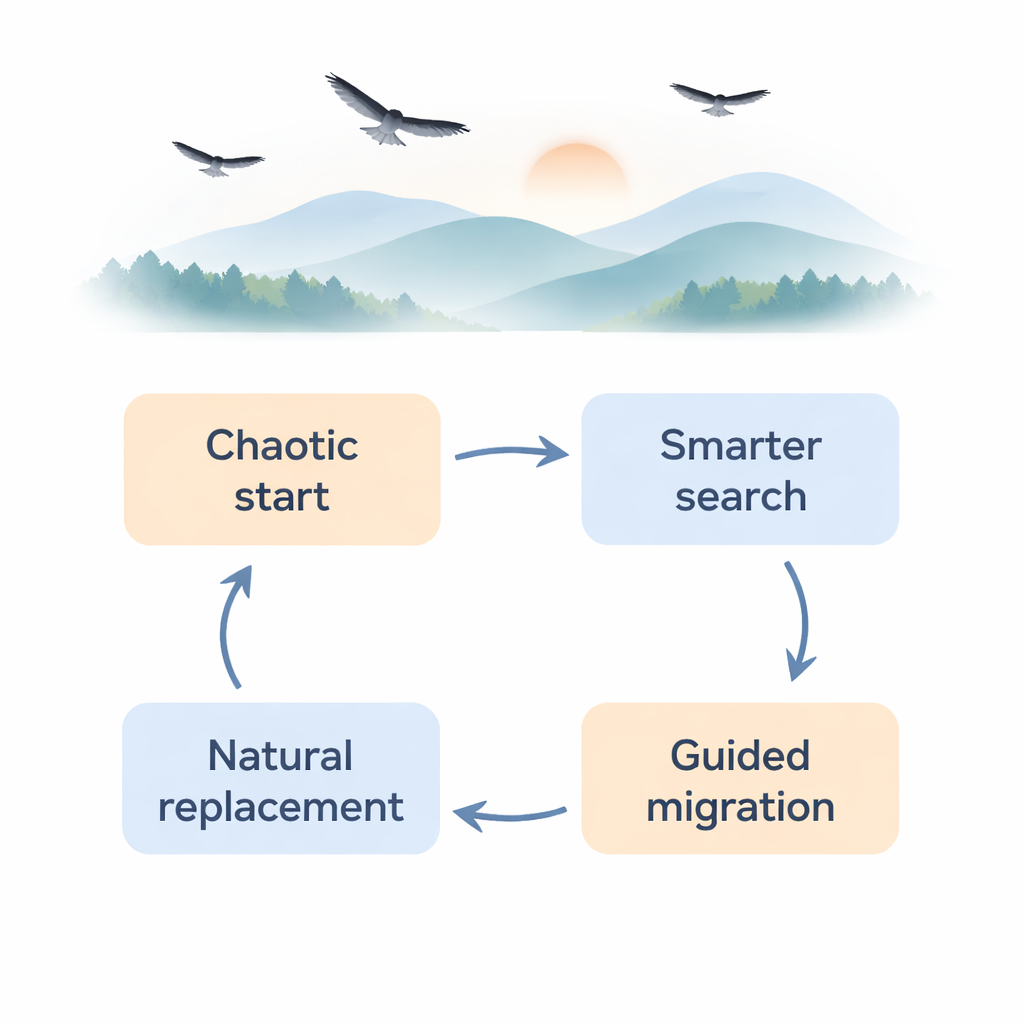
The authors propose an upgraded version called SMNBKA‑ICMIC. The first improvement concerns how the search starts. Instead of placing the virtual birds randomly, the method uses a special type of controlled chaos to scatter them more evenly across the landscape. This increases the chance that at least some birds begin near valuable regions. Next, when the birds “attack,” the algorithm borrows an idea from evolutionary biology: it blends information from strong and weaker candidates in a careful way, similar to how genetic material mixes during reproduction. This mixing step helps the group escape dead ends and keeps the search from becoming too narrow too early.
Guided Migration and Survival of the Fittest
Migration, the second major phase, is also redesigned. In the original method, each bird adjusted its position using a simple random rule that sometimes caused the group to crowd around a local hilltop instead of finding the highest peak. The improved version compares birds’ performance and lets them move based on differences between a strong “leader” and a randomly chosen partner. This back‑and‑forth motion helps the flock explore new directions while still being guided toward good areas. On top of that, a “natural replacement” step mimics survival of the fittest: in every round, the worst‑performing birds are removed and replaced by new ones created near the current best solutions. This keeps fresh ideas coming in while sharpening the search around promising designs.
Putting the Algorithm to the Test
To see whether these ideas actually help, the researchers subjected SMNBKA‑ICMIC to a battery of tests. First, they used standard mathematical benchmarks designed to be tricky, including landscapes with many false peaks and narrow valleys. Across three major test suites widely used in the optimization community, the new method generally found better answers and did so more consistently than both the original BKA and several other state‑of‑the‑art algorithms. The authors then moved to ten classic engineering design problems, such as shaping a metal spring, sizing a pressure vessel, and configuring a gear train or a multiple‑disk brake. In nine out of ten cases, their algorithm produced the best known solutions, often reducing the design “cost” by 1.5% to 15% compared with competitors—differences that can translate into real savings in materials, energy, or safety margins.
Handling Complex Choices and Trade‑Offs
The team also tested the method on multiple‑knapsack problems, a standard challenge where a limited number of items must be packed into several containers without overloading them, while maximizing value. These problems are notoriously hard because the number of possible packings explodes as the problem grows. SMNBKA‑ICMIC not only reached the best possible solutions on several such tasks, it did so with remarkable stability from run to run. This suggests the method can handle both continuous design choices (like the exact thickness of a beam) and discrete ones (such as which component to include), a rare combination for a single algorithm.
Why This Matters
In plain terms, the study shows that carefully combining ideas from chaos theory, evolution, flocking behavior, and natural selection leads to a search strategy that is both adventurous and disciplined. SMNBKA‑ICMIC roams widely enough to avoid being fooled by early, tempting answers, yet it can also settle down to refine high‑quality designs. For engineers and scientists facing complex decisions with many constraints, this means they can obtain near‑optimal solutions with fewer trials and greater confidence. While the authors note that extremely high‑dimensional or rapidly changing problems remain challenging, their work moves computer‑aided design a step closer to behaving like an experienced, adaptable problem solver rather than a rigid calculator.
Citation: Sun, H., Tang, N., Li, Z. et al. Based on binary evolution operator-enhanced black-kite algorithm with natural replacement for engineering numerical optimization problems. Sci Rep 16, 6881 (2026). https://doi.org/10.1038/s41598-026-35846-2
Keywords: metaheuristic optimization, engineering design, nature-inspired algorithms, combinatorial optimization, black-kite algorithm