Clear Sky Science · en
Handcrafted MRI radiomics of enlarged perivascular spaces and machine learning predict cognitive impairment and sleep disturbance in young adults
Why Your Phone Time Might Matter for Your Brain
Many young adults spend hours each day glued to their smartphones—often late into the night. This study asks a pressing question: could that long-term mobile phone use be quietly affecting how well we think and sleep? Using detailed brain scans and artificial intelligence, the researchers looked for subtle changes in tiny fluid-filled channels in the brain and tested whether these changes could flag early problems with memory, focus, and sleep in heavy phone users.
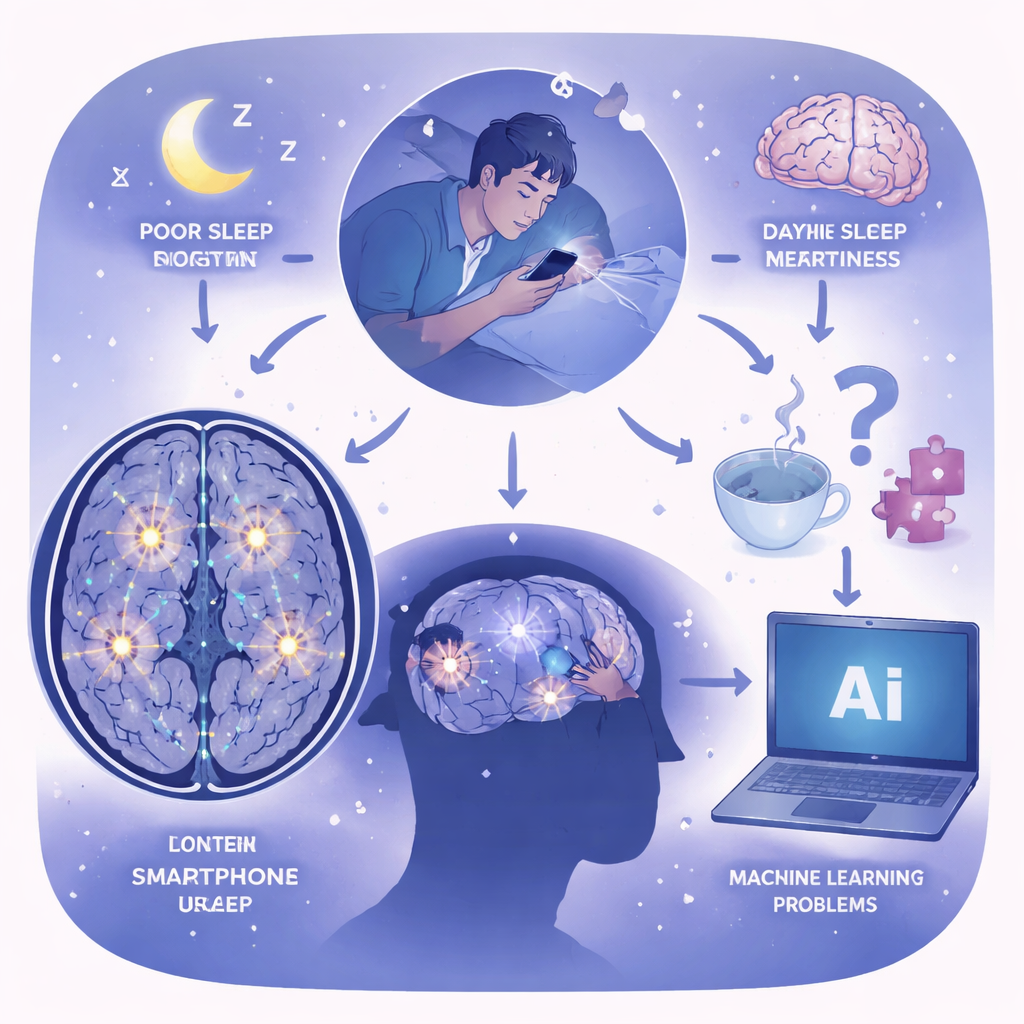
Tiny Brain Channels with a Big Job
Our brains are laced with narrow tunnels that surround blood vessels and help wash away waste products, especially during sleep. These tunnels, called perivascular spaces, can appear enlarged on MRI scans, hinting that the brain’s cleaning system may not be working optimally. Previous work linked these enlarged spaces to conditions such as dementia and poor sleep in older adults. The present study asked whether similar changes show up in younger people who use their phones a lot—and whether those changes relate to how well they sleep and think.
Scanning Heavy Phone Users
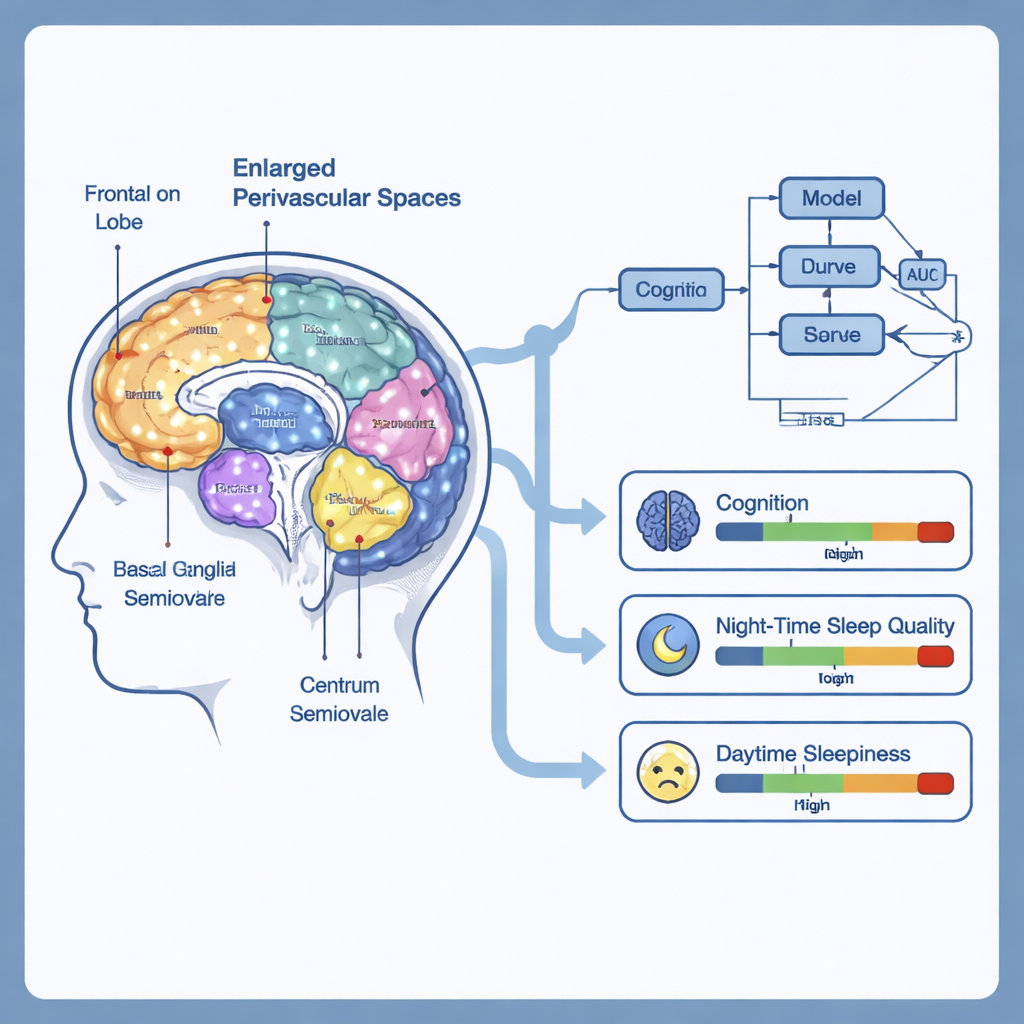
The team studied 82 young and middle-aged adults in China who all used their phones at least four hours a day. Everyone underwent MRI brain scans and completed standard questionnaires that measure thinking ability, sleep quality at night, trouble with insomnia, and daytime sleepiness. Instead of relying on a doctor’s rough visual judgment, the researchers used a trained computer program to automatically outline and measure enlarged perivascular spaces across 17 different brain regions. For each region, the software counted how many spaces there were and calculated their size, length, and shape, producing 70 detailed measurements, which were analyzed together with each person’s age and sex.
Teaching Machines to Spot Risk
To turn these brain measurements into practical warning tools, the scientists used machine learning—teaching algorithms to distinguish between people with and without cognitive problems or sleep disturbance. They first whittled the 70 brain features down to the six most informative ones for each task, then trained two types of models: Gaussian process classifiers and decision trees. One model tried to detect who had measurable cognitive impairment; others tried to identify poor sleep quality, insomnia symptoms, or excessive daytime sleepiness. When tested on new participants, the cognitive model correctly ranked impaired versus unimpaired cases most of the time, and the sleep and sleepiness models performed similarly well.
Where in the Brain the Signals Come From
The most telling features were not scattered randomly: they clustered in regions known to support thinking and regulate sleep. Changes in the frontal lobes, which help with planning and attention, and in deep structures such as the thalamus and basal ganglia, contributed strongly to predictions about cognitive scores and insomnia. Enlarged spaces in the temporal lobes and a white-matter zone called the centrum semiovale were closely tied to reported sleep quality and daytime sleepiness. Using interpretability tools, the authors showed how specific features—like the average length or curvature of these tiny spaces in particular regions—pushed the model toward predicting “impaired” or “normal” for each person.
What This Could Mean for Prevention
Although the study was relatively small and cannot prove that heavy phone use causes these brain changes, the results suggest that the structure of perivascular spaces may serve as an early warning marker for thinking problems and sleep disturbance in otherwise healthy young adults. If confirmed in larger and more diverse groups, quick MRI scans combined with simple machine-learning tools might one day help doctors flag people whose brains show early stress from poor sleep or lifestyle habits—long before full-blown dementia or chronic sleep disorders develop. For readers, the message is straightforward: how long and how late you stay on your phone could be linked not only to feeling groggy but also to subtle changes in brain health that are worth taking seriously.
Citation: Li, L., Wu, J., Li, B. et al. Handcrafted MRI radiomics of enlarged perivascular spaces and machine learning predict cognitive impairment and sleep disturbance in young adults. Sci Rep 16, 5177 (2026). https://doi.org/10.1038/s41598-026-35845-3
Keywords: smartphone use, sleep quality, cognitive impairment, brain MRI, machine learning