Clear Sky Science · en
Seasonal changes in health risks due to exposure to MTBE among workers of a refinery
Why the air around fuel workers matters
Many of us rely on gasoline every day without thinking about the invisible chemicals that make engines run smoothly. One such chemical is methyl tert-butyl ether (MTBE), a fuel additive used to boost performance and reduce certain exhaust pollutants. While MTBE can help the environment, it may pose health risks for the people who work closest to it: refinery employees who blend, move, and store fuel. This study asks a simple but important question: do workers face different health risks from MTBE in summer versus winter, and are current safety limits really enough to protect them over a lifetime?
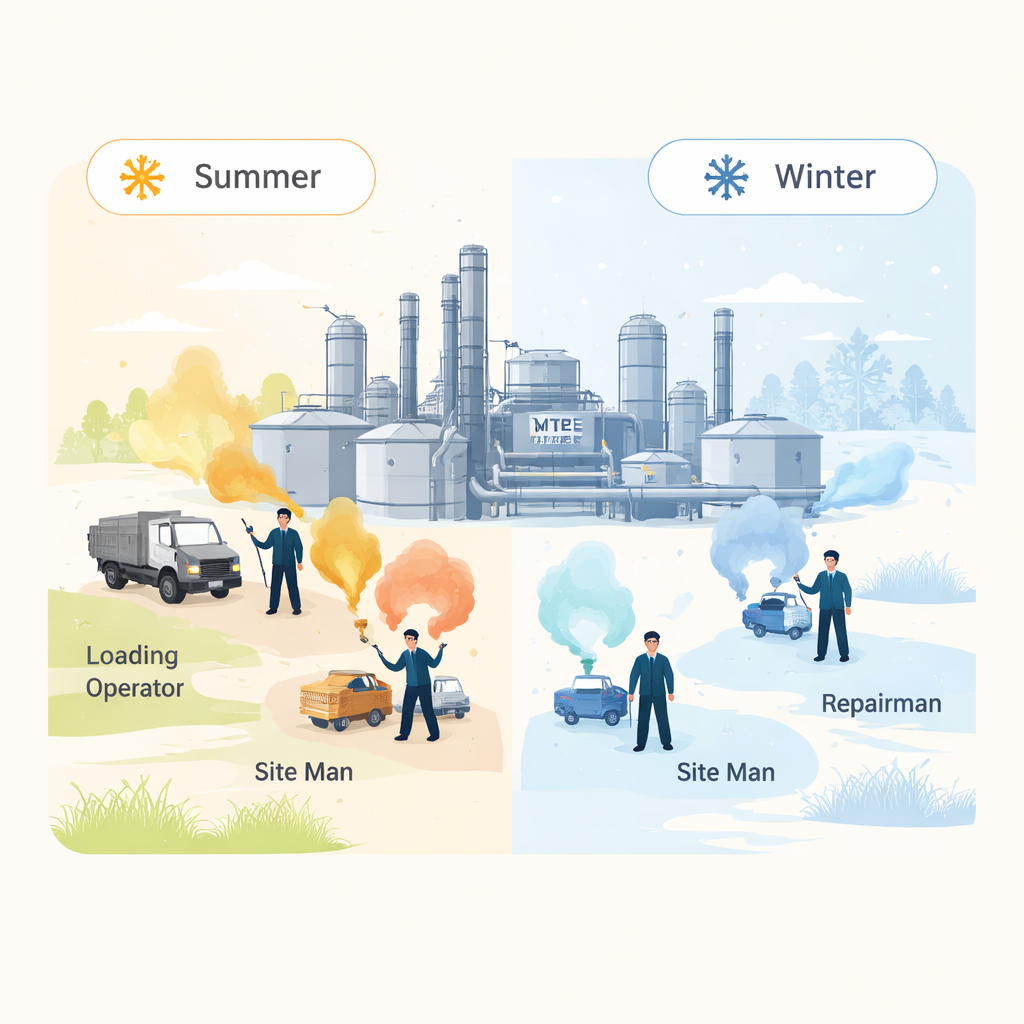
A closer look at fuel workers’ daily air
The researchers examined an oil refinery in Iran where MTBE is still widely used. They focused on five kinds of workers who routinely spend time near tanks, pipelines, and loading areas: site men, repairmen, safety staff, loading operators, and supervisors. Thirty employees who had been on the job for at least a year wore small sampling devices clipped near their breathing zone during a typical workday. These devices collected air in both the hottest part of summer and the cooler winter months. At the same time, the team recorded temperature, humidity, and wind speed to understand how weather might change the amount of MTBE in the air.
Measuring invisible risks in the air
Back in the laboratory, the captured MTBE was measured using sensitive instruments that can detect tiny amounts of chemicals. The scientists then translated these measurements into two types of health risk. The first, called non-cancer risk, reflects the chance of irritation or other short-term health problems. The second, cancer risk, estimates the extra lifetime chance of developing cancer after long-term exposure at the levels observed. To make these estimates more realistic, the team used a mathematical technique known as Monte Carlo simulation, which repeatedly recombines real-world factors such as breathing rate, hours worked, years on the job, and body weight to produce a range of possible outcomes rather than a single number.
Summer heat and who faces the highest exposure
The results showed clear patterns across both seasons. Concentrations of MTBE in the air were always below the widely used workplace limit that is meant to prevent immediate or short-term effects. In other words, workers were not breathing enough MTBE at any moment to trigger obvious acute symptoms in most people. Yet the levels were not evenly spread. Loading operators—who oversee filling and emptying of fuel tanks and trucks—had the highest exposure, followed by site men and repairmen who spend more time close to leaking or open systems. Safety staff and supervisors generally had the lowest levels. Crucially, MTBE concentrations and the associated health risk estimates were consistently higher in summer than in winter, especially for the workers closest to fuel handling operations. Hotter temperatures increase how quickly MTBE evaporates, leading to more vapors in the air that workers breathe.
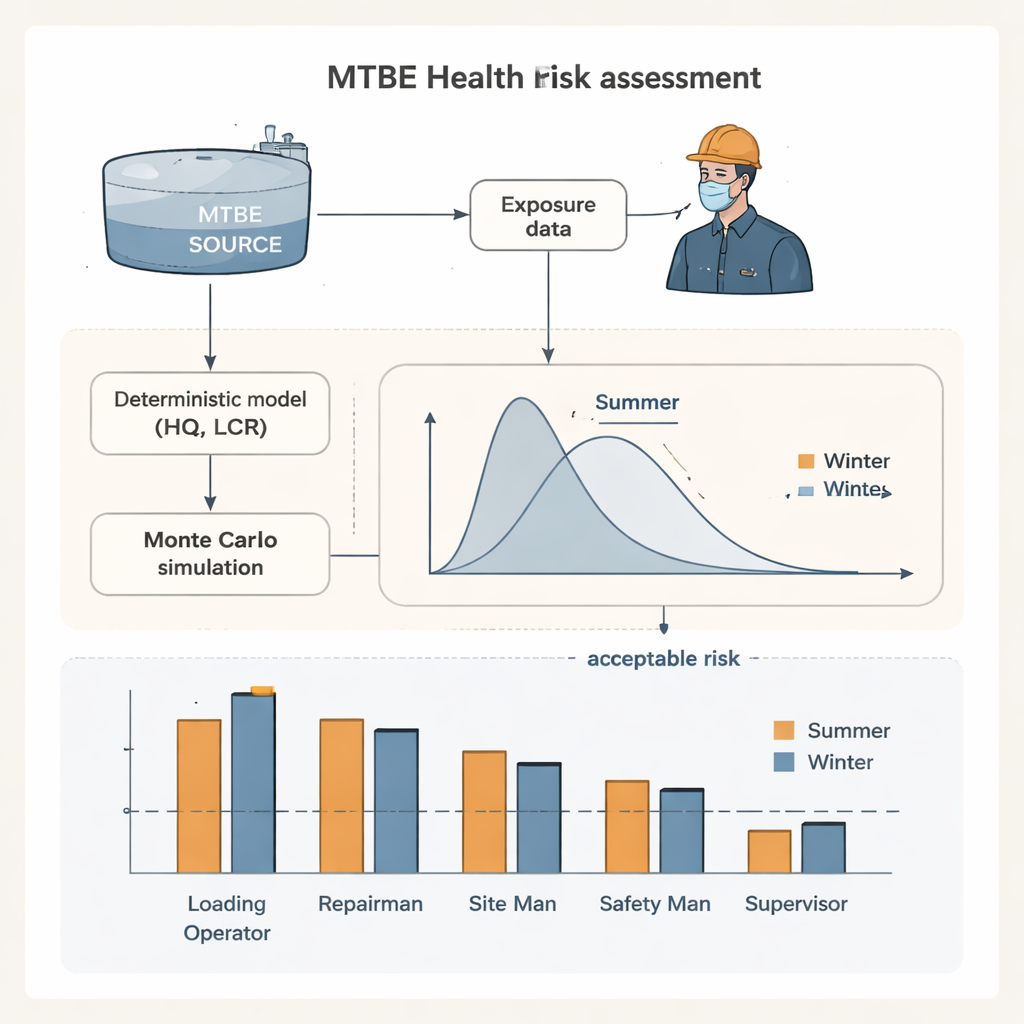
What the numbers say about long-term harm
When the team compared their results with international benchmarks, they found that non-cancer risks were comfortably below the level considered acceptable in both seasons for all groups. The picture changed when they looked at cancer risk. For the refinery as a whole, the average long-term cancer risk from MTBE exposure was higher than the level many agencies regard as negligible, in both summer and winter. The excess risk was most pronounced for loading operators and repairmen, and it was clearly higher in summer. Monte Carlo simulations confirmed that, particularly in warm months, a sizable share of workers could have cancer risk estimates above the commonly used safety threshold—even though their day-to-day exposure never exceeded the official workplace limit.
What this means for workers and fuel safety
To a non-specialist, the key message is that “safe” limits based on short-term effects do not always guarantee safety over a full working lifetime, especially for chemicals like MTBE that may be linked to cancer. This study shows that refinery workers can face elevated long-term cancer risks even when their exposure is below the allowed ceiling, and that these risks rise noticeably in hot weather and in jobs closest to fuel transfer. The authors argue that refineries should strengthen engineering controls such as vapor recovery and ventilation around loading areas, consider adjusting tasks or shift lengths in summer, and continue regular air monitoring. More broadly, their findings support revisiting exposure standards for MTBE and similar fuel additives so they better reflect real working conditions and long-term health.
Citation: Mousavi, S.M., Rismanchian, M., Khoshakhlagh, A.H. et al. Seasonal changes in health risks due to exposure to MTBE among workers of a refinery. Sci Rep 16, 6618 (2026). https://doi.org/10.1038/s41598-026-35843-5
Keywords: MTBE exposure, refinery workers, occupational cancer risk, seasonal air pollution, Monte Carlo health assessment