Clear Sky Science · en
Problematic mobile phone and social media use among adolescents and its relationship with cyberbullying, cybervictimisation and social anxiety
Why Our Kids’ Phones Deserve a Closer Look
Smartphones and social media help teenagers stay connected, but for many, screens are becoming a source of stress rather than support. This study followed more than a thousand adolescents to ask a pressing question: when does everyday scrolling turn into a problem, and how is it tied to online bullying and feeling anxious around other people? The findings shed light on a hidden cycle where heavy phone and social media use, cyberbullying, and social anxiety feed into one another—especially for girls.
Everyday Tools, Emerging Troubles
For today’s teens, mobile phones are nearly constant companions. Many spend several hours a day messaging, gaming, and browsing social networks. The researchers focused on “problematic” use—not just frequent use, but use that is hard to control and starts to interfere with sleep, schoolwork, family life, and mood. Teens who reported this kind of use often felt restless without their phone, lied about how much they used it, or kept using it despite clear problems at home or in class. Social media added another layer, with some adolescents saying they thought about their apps constantly and relied on them to escape from everyday worries.
When Online Life Turns Cruel
Because phones and social networks are the main stage for online harassment, the study also measured cyberbullying—both doing it and being on the receiving end. Cyberbullying included sending hurtful messages, spreading embarrassing photos or videos, and making threats through digital channels. The results were striking: teens with high levels of problematic phone or social media use were much more likely to be involved in cyberbullying, as bullies, as victims, or both, than those with moderate or low use. In other words, the more teens felt glued to their screens, the more they were exposed to or engaged in harmful online behavior.
Hidden Worries Behind the Screen
The study also looked at social anxiety—the fear of being judged, rejected, or embarrassed by others. Teens answered questions about how often they worried about what peers thought of them, and how uncomfortable they felt in new or everyday social situations. Those with the most problematic phone and social media use consistently had the highest levels of social anxiety. Many seemed to use their phones as a shield: interacting online felt safer than talking face to face. But this digital “safe space” came with a cost, as it encouraged avoidance of real-world interactions and deepened emotional dependence on screens.
A Vicious Circle of Screens and Stress
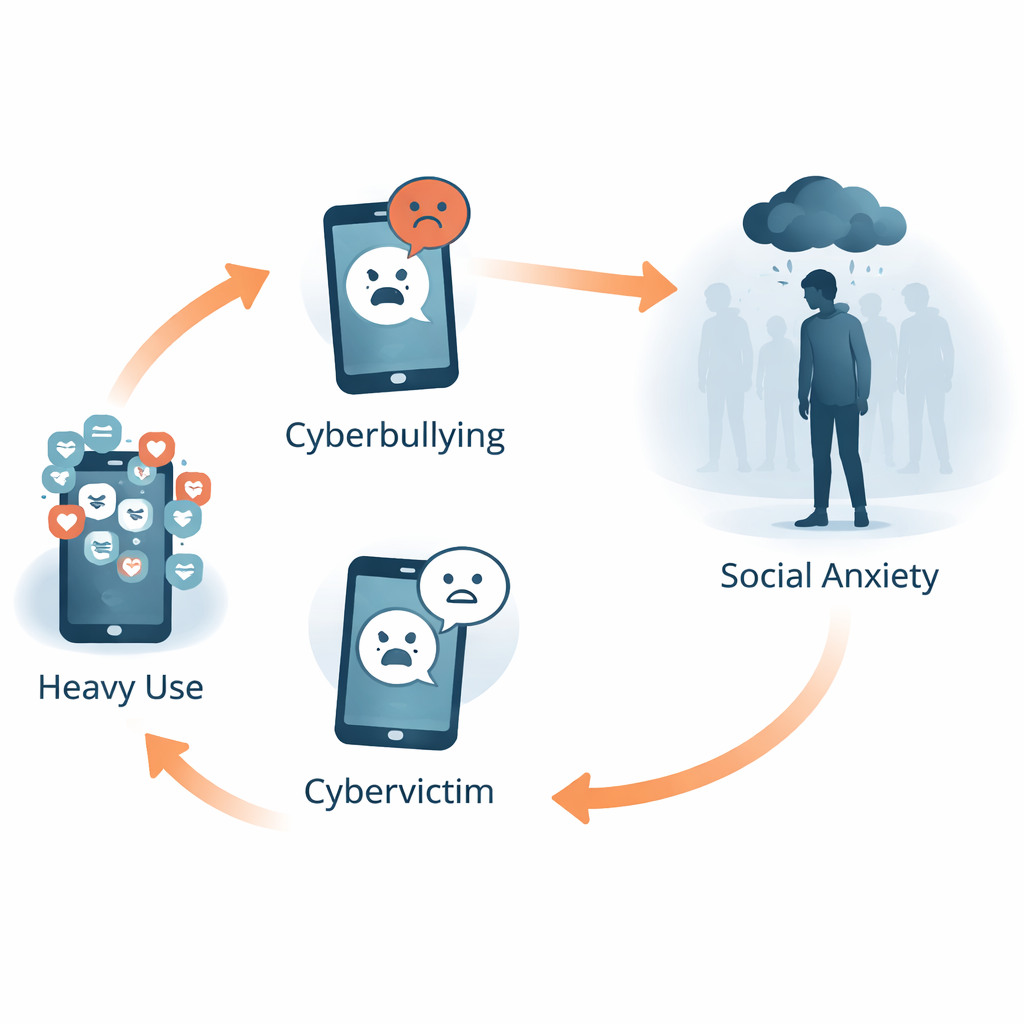
By running statistical models, the researchers showed that cyberbullying, being a cybervictim, and social anxiety all increased the odds that a teenager would develop problematic phone and social media habits. In turn, high levels of problematic use were linked to more bullying and greater anxiety, suggesting a self-reinforcing loop. Girls were at particular risk: they were more likely than boys to show signs of problematic use of both mobile phones and social media. Overall, the pattern points to a cycle in which anxious teens retreat into their phones, encounter more online conflict, and become even more anxious and screen-dependent.
What This Means for Families and Schools
To a layperson, the study’s message is clear: it is not just how long teens spend on their phones that matters, but why and how they use them. When young people rely on screens to cope with fear of judgment or loneliness, they may be more exposed to online cruelty and less able to practice real-world social skills. The authors suggest that helping adolescents manage their emotions, build confidence in face-to-face situations, and use technology more intentionally could break this cycle. Efforts to prevent cyberbullying, set sensible limits on device use in schools, and involve families in digital education may all help ensure that phones and social media support, rather than undermine, teenagers’ mental health.
Citation: Guisot, L., Aparisi, D., Delgado, B. et al. Problematic mobile phone and social media use among adolescents and its relationship with cyberbullying, cybervictimisation and social anxiety. Sci Rep 16, 7082 (2026). https://doi.org/10.1038/s41598-026-35842-6
Keywords: adolescent mental health, problematic smartphone use, social media, cyberbullying, social anxiety