Clear Sky Science · en
Optimization strut-based fuel injection using multi-step hydrogen jets and air-assisted mixing in supersonic flow
Why fast hydrogen engines need better mixing
Future hypersonic aircraft and spaceplanes may rely on scramjet engines, which burn fuel in air rushing through the engine at several times the speed of sound. In this extreme environment, fuel has only a few thousandths of a second to mix with air and burn. This paper explores how to inject hydrogen fuel so that it mixes quickly and evenly with air in a high-speed engine, without wasting too much energy. The findings could help engineers design cleaner, more efficient propulsion systems for ultra-fast flight.
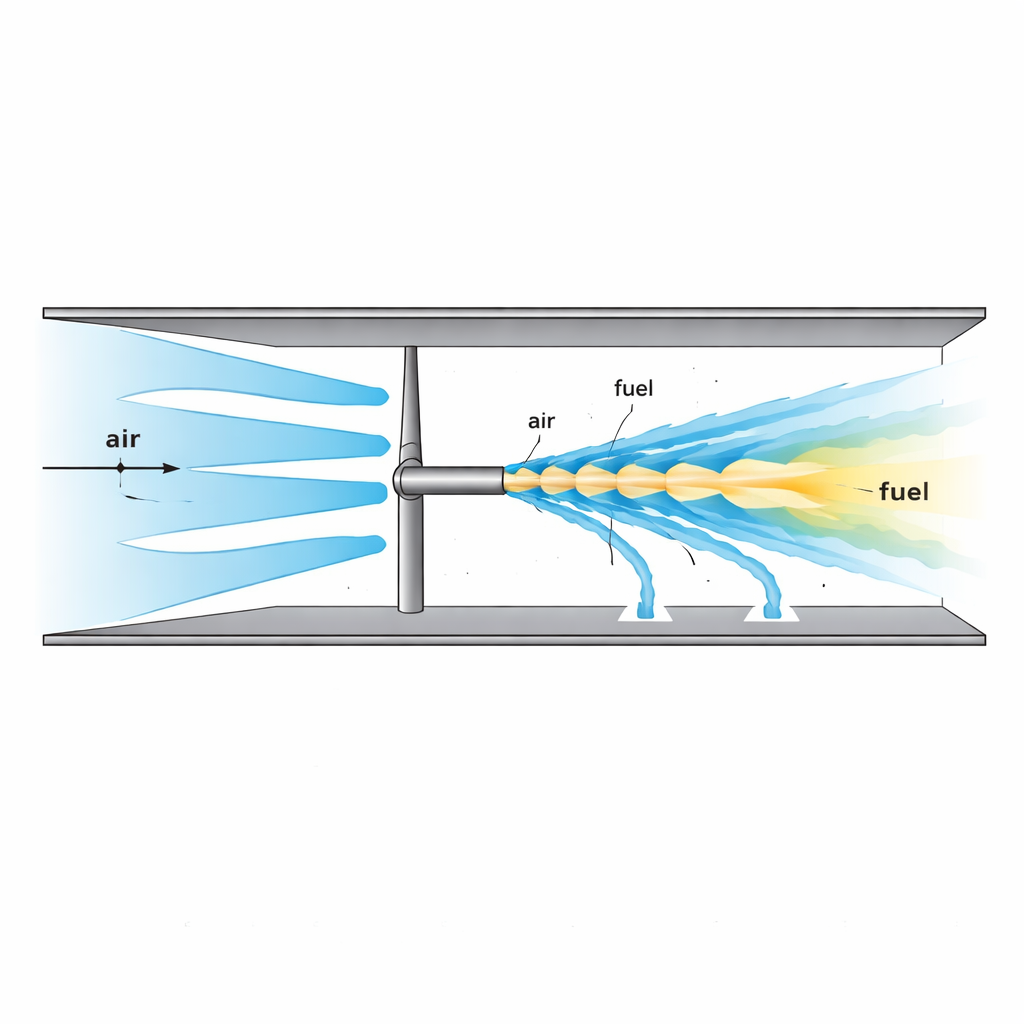
The challenge of burning fuel at supersonic speed
In a scramjet, air races through the engine at about twice the speed of sound, leaving almost no time for fuel and air to blend before the mixture must ignite. If mixing is poor, parts of the fuel stream remain too rich or too lean to burn well, causing lost thrust and unstable combustion. Traditional ways of squirting fuel sideways into the main airflow can create strong shocks and large pressure losses, which rob the engine of useful power. A promising alternative is to place a thin support, called a strut, in the flow and inject fuel from inside it, using the swirling wake behind the strut to help stir the mixture.
Three ways to feed hydrogen into the engine
The authors used detailed computer simulations to test three different fuel-injector shapes mounted behind a strut in a model scramjet. All three delivered the same total amount of hydrogen under the same Mach 2 air conditions, so any differences came from geometry alone. The first design used a single ring-shaped opening at the tip of a small rod, sending out a compact fuel jet that pushed far into the main stream but stayed fairly narrow. The second design broke this ring into several smaller, stepwise openings placed one after another along a short extension, so that fuel entered in stages. The third used a set of thin, ring-shaped slots flush with the wall, creating a sheet-like fuel layer that spread widely near the surface but did not reach as deeply into the core flow.
How the flow shapes mixing and engine losses
The simulations showed that the shape of the injector strongly changed the wake behind the strut—where vortices form, how big they are, and how long they survive. The single-ring design created a strong, focused jet that penetrated deeply but mixed slowly sideways, leaving a tight, fuel-rich core. The flush slots along the wall gave the broadest spread of fuel near the surfaces and caused the least loss of pressure, but the fuel did not reach the middle of the passage as effectively, which slowed mixing in that region. The multi-step staged design fell between these extremes: its several outlets produced overlapping shear layers and rolling structures that stirred the fuel more vigorously, spreading hydrogen both outward and downward while keeping pressure losses at a reasonable level.
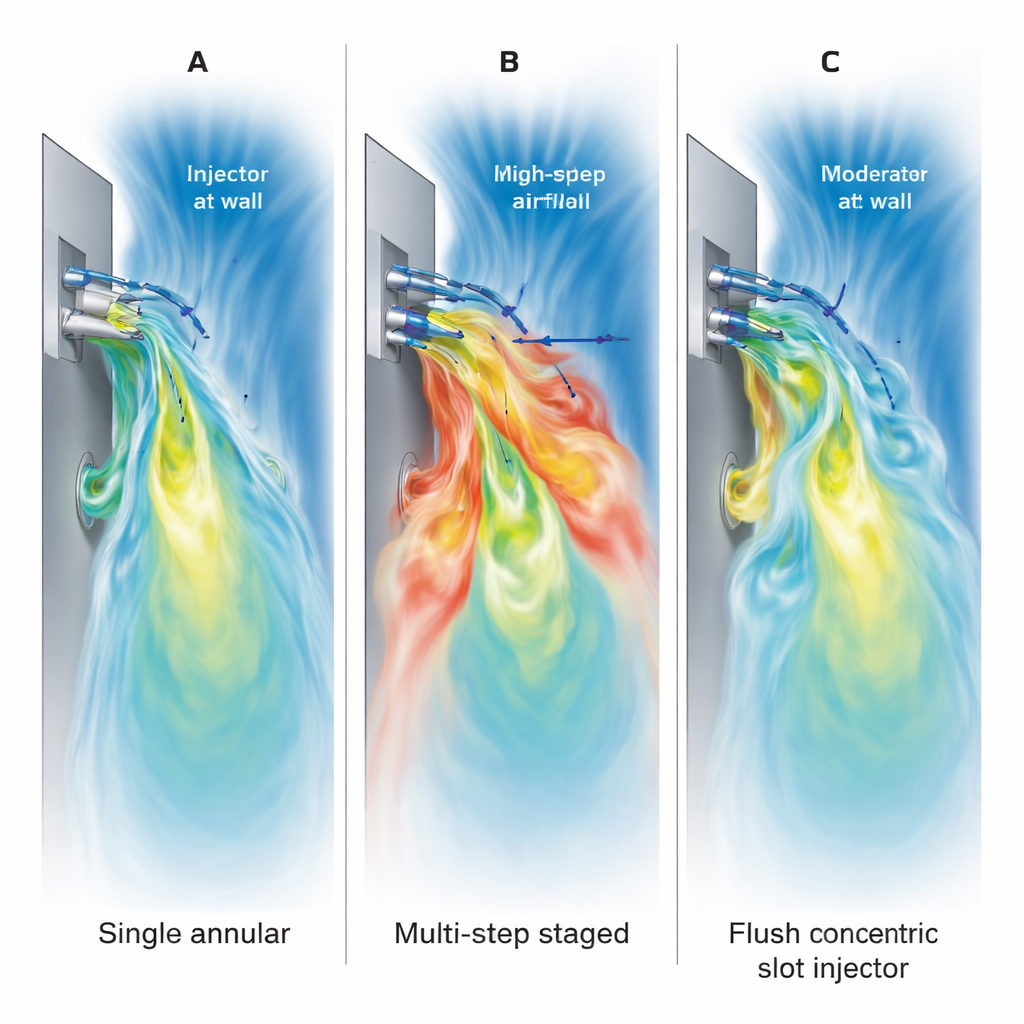
Boosting mixing with an extra push of air
The team also studied what happens when a small stream of air is injected together with the hydrogen inside the injector. This added air sharpened the shearing between streams, strengthened the swirling motion, and helped break up the fuel core. As a result, the hydrogen dispersed more quickly and more evenly across the channel. The staged injector benefited the most from this assistance: its already complex wake became even more effective at drawing air into the fuel, raising the calculated mixing efficiency while only modestly increasing pressure losses. The flush-slot design also improved, but its gains were smaller because it already spread fuel widely along the wall.
What this means for future high-speed flight
For a non-specialist, the message is straightforward: how and where fuel is introduced into a scramjet matters as much as how much fuel is used. The study finds that feeding hydrogen in several small steps behind a strut, and backing it up with a carefully placed air jet, can stir the fuel and air together faster than a single jet while keeping energy losses within acceptable limits. In other words, a thoughtfully shaped, multi-step injector can help future high-speed engines burn fuel more completely and more stably, bringing practical hypersonic flight a step closer.
Citation: Houria, Z.B., Hajlaoui, K., Aminian, S.A. et al. Optimization strut-based fuel injection using multi-step hydrogen jets and air-assisted mixing in supersonic flow. Sci Rep 16, 7245 (2026). https://doi.org/10.1038/s41598-026-35841-7
Keywords: scramjet, hydrogen fuel, supersonic combustion, fuel–air mixing, aerospace propulsion