Clear Sky Science · en
Frost resistance improvement of recycled powder concrete by chemical admixtures
Turning Construction Waste into Winter-Ready Concrete
Every year, cities generate mountains of broken concrete and brick from demolitions and renovations. Much of this rubble is treated as trash, even though it still contains valuable cement materials. At the same time, roads and buildings in cold regions crumble under repeated freeze–thaw cycles, costing billions in repairs. This study explores how finely ground construction waste, called recycled powder, can be safely reused in new concrete while still standing up to harsh winters—offering a path toward more durable and sustainable infrastructure.
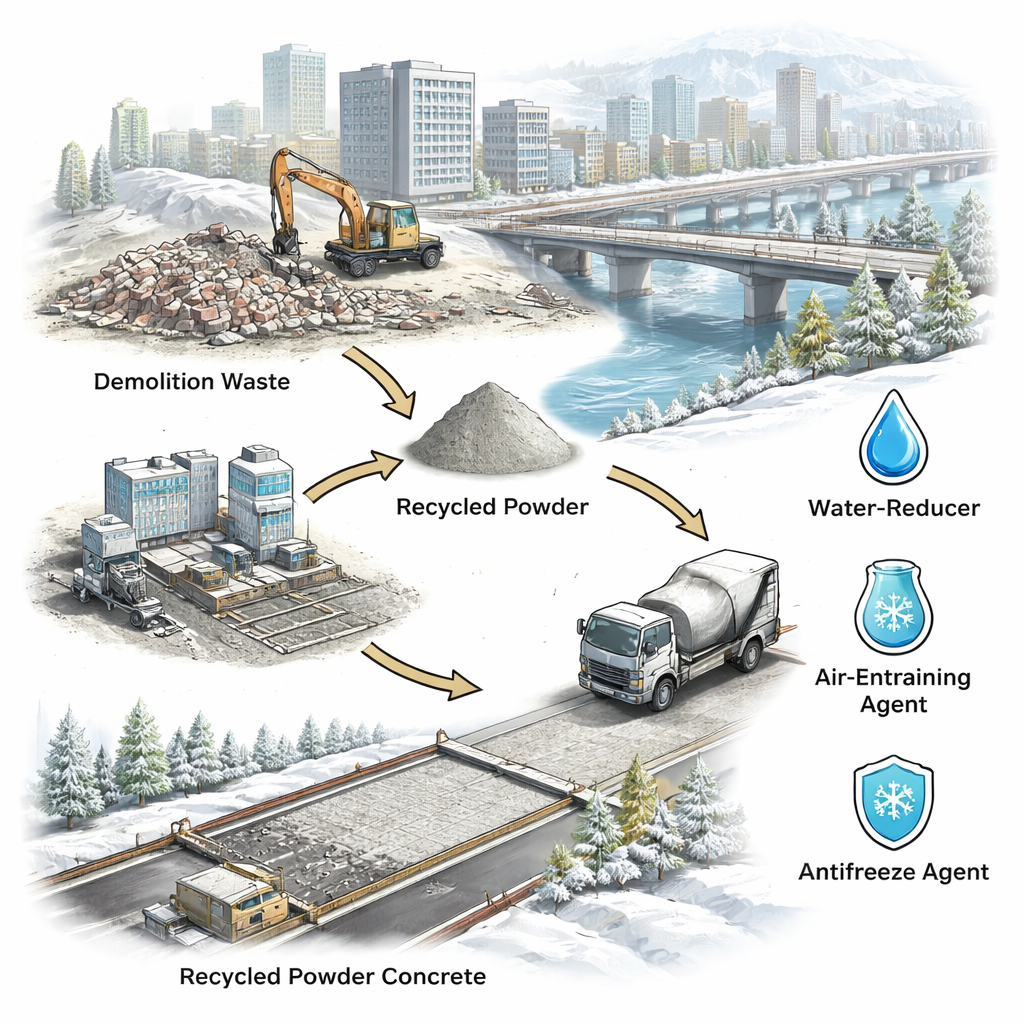
From Rubble to Recycled Powder
Instead of sending old concrete and masonry to landfills, engineers can crush and grind this material into a fine recycled powder that partially replaces fresh cement in new concrete. This approach saves natural resources, cuts carbon emissions from cement production, and helps manage huge waste streams, particularly in countries like China where construction debris exceeds two billion tons a year. However, there is a catch: recycled powder tends to make concrete thirstier for water, which often leads to weaker performance against freezing and thawing. The key question of this research was whether the right chemical additives could overcome this weakness and unlock the full potential of recycled powder concrete in cold climates.
Fine-Tuning the Chemical Toolkit
The researchers first identified a high-performance water-reducing chemical, a polycarboxylate superplasticizer, that works especially well with recycled powder. This additive helps cement grains disperse evenly, reducing the extra water normally needed when recycled powder is used. With this as a baseline, the team tested three additional types of admixtures aimed directly at improving frost resistance: a combined water-reducing and antifreeze additive (AR), an air-entraining agent (AE) that intentionally creates tiny bubbles, and an inorganic salt–based antifreeze agent (AF). Concrete samples containing 30% recycled powder were mixed with different water-to-binder ratios, cured, and then subjected to up to 200 harsh freeze–thaw cycles while their strength, surface damage, and internal stiffness were tracked.
How the Concrete Behaved in the Cold
All three improvement strategies helped the recycled powder concrete resist freezing damage better than the control mix without these additives, but they did so in different ways and to different degrees. The air-entraining agent worked by creating many small, well-spaced bubbles that acted as relief chambers, giving freezing water room to expand and thereby slowing surface peeling and internal cracking. The antifreeze water-reducing agent lowered water demand and refined the pore system, which reduced mass loss and preserved the concrete’s stiffness during cycling. The star performer, however, was the 1% antifreeze agent (AF). It not only enhanced early strength by accelerating the formation of binding gels inside the concrete, but also maintained the highest relative stiffness and the lowest surface damage after 200 cycles, especially at the lower water-to-binder ratio.
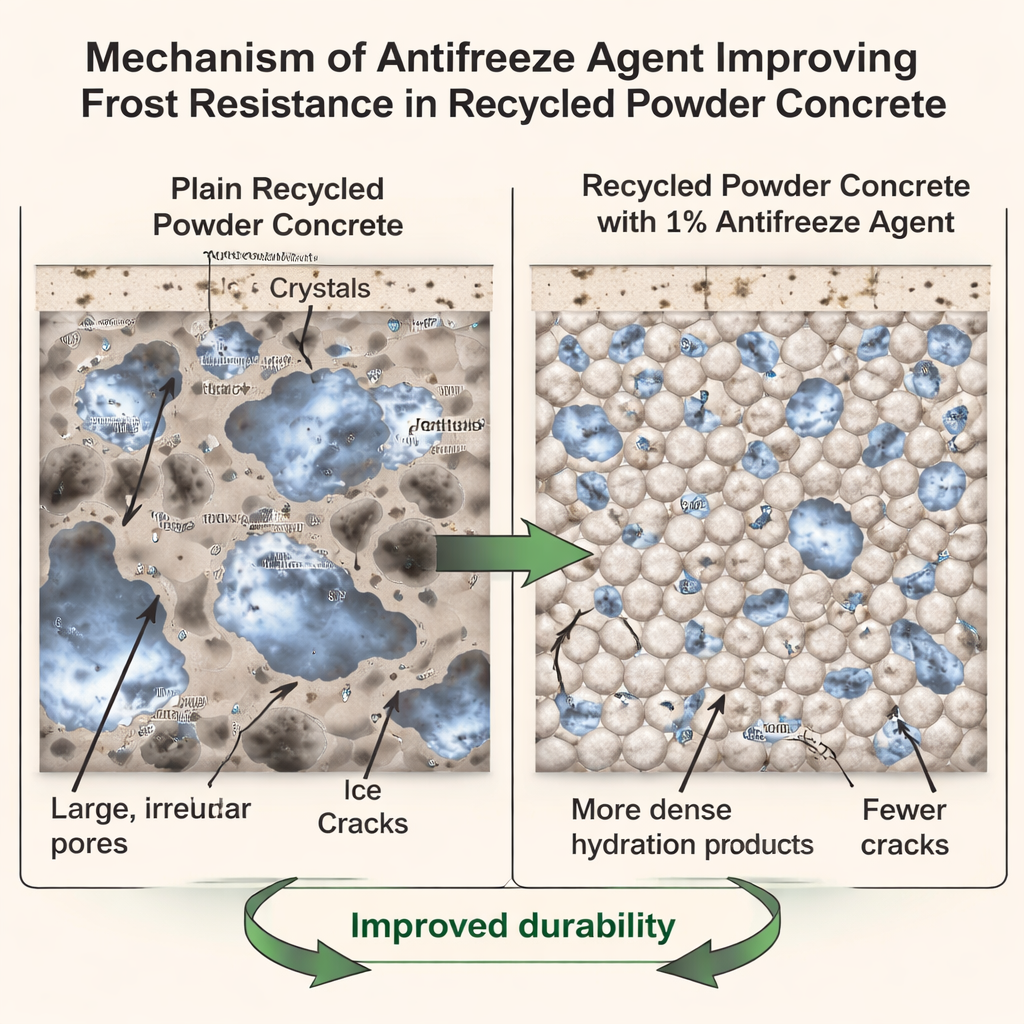
A Closer Look Inside the Concrete
To understand why the antifreeze agent worked so well, the team peered inside the concrete using microscopes and pore-measuring techniques. Images showed that concrete without special additives contained many large, uneven pores and wide cracks at the boundary between stones and mortar—ideal pathways for water and ice to do damage. When AR, AE, or AF were added, this weak transition zone became denser, with fewer large voids and more tightly packed crystals that glued the structure together. Detailed pore measurements confirmed that the antifreeze agent in particular shifted the concrete’s internal pores toward smaller, less harmful sizes, cutting the share of large, damage-prone pores (over 200 nanometers) by 8.73%. Even though the overall porosity increased slightly, the pores were now shaped and sized in ways that made the concrete far more resilient to freezing.
Why This Matters for Greener Cities
For non-specialists, the bottom line is straightforward: this study shows that concrete made with a substantial share of recycled powder can still be tough enough for cold climates if it is paired with the right chemistry. A modest dose of antifreeze agent—about 1% of the binder—turned a vulnerable, waste-based concrete into a durable material that survives repeated winter freezing with much less cracking and surface loss. That means cities can confidently turn demolition waste into new roads, bridges, and buildings that last longer in icy conditions, advancing both sustainability and durability without sacrificing performance.
Citation: Yang, C., Zhou, W., Zhao, H. et al. Frost resistance improvement of recycled powder concrete by chemical admixtures. Sci Rep 16, 6087 (2026). https://doi.org/10.1038/s41598-026-35840-8
Keywords: recycled concrete, construction waste, freeze–thaw durability, chemical admixtures, sustainable infrastructure