Clear Sky Science · en
Timing of decompressive craniectomy and short-term outcomes in pediatric severe traumatic brain injury: a nationwide observational study in Germany
Why the timing of brain surgery in children matters
When a child suffers a severe head injury, swelling inside the skull can become life‑threatening within minutes or hours. One of the most drastic emergency treatments is to remove part of the skull, giving the swollen brain room to expand. Parents and doctors then face a wrenching question: should this operation be done as quickly as possible, or only after other treatments fail? A nationwide German study set out to explore how the timing of this surgery relates to survival and early recovery in children.
What this risky operation involves
The operation, called decompressive craniectomy, is usually reserved for the sickest children with severe traumatic brain injury after accidents or falls. Surgeons temporarily remove a large piece of skull so that high pressure inside the head does not crush the brain. Doctors may perform this surgery right away, often while also removing a blood clot, or later, after trying medicines and intensive care measures to lower brain pressure. Until now, research in children has been limited and often came from single hospitals, leaving big uncertainties about when this last‑resort procedure should be used.
How the researchers used real‑world hospital data
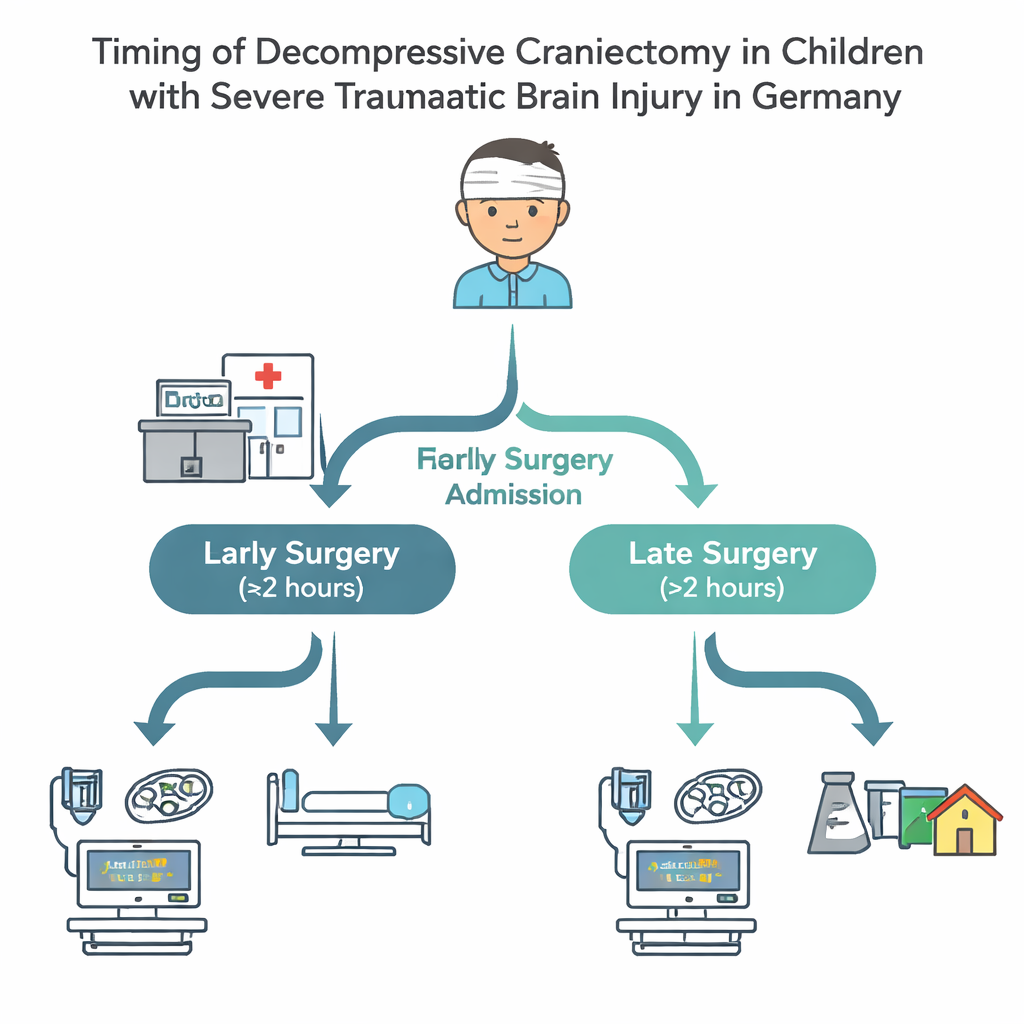
In this study, scientists analyzed Germany’s national hospital database, which covers nearly all public hospitals. They looked at more than 13 million hospital stays of patients under 18 between 2016 and 2022 and identified 9,495 children with severe traumatic brain injury. Among them, 589 underwent decompressive craniectomy. The team divided these cases into an “early” group, where surgery occurred within two hours after hospital arrival, and a “late” group, where surgery took place more than two hours after admission. They then compared death rates, time spent on a breathing machine, length of hospital stay, and the presence of serious ongoing medical problems at discharge.
Who received early versus late surgery
About half of the children had surgery within the first two hours. These early‑surgery patients tended to be more critically ill: they more often needed urgent removal of brain blood clots, had more severe injuries outside the head, and were less likely to have had brain‑pressure monitoring before the operation. In contrast, children in the late‑surgery group were more likely to go through a step‑by‑step treatment plan, starting with intensive monitoring of pressure inside the skull and drainage of fluid from the brain before surgeons decided to remove part of the skull.
What the study found about survival and recovery
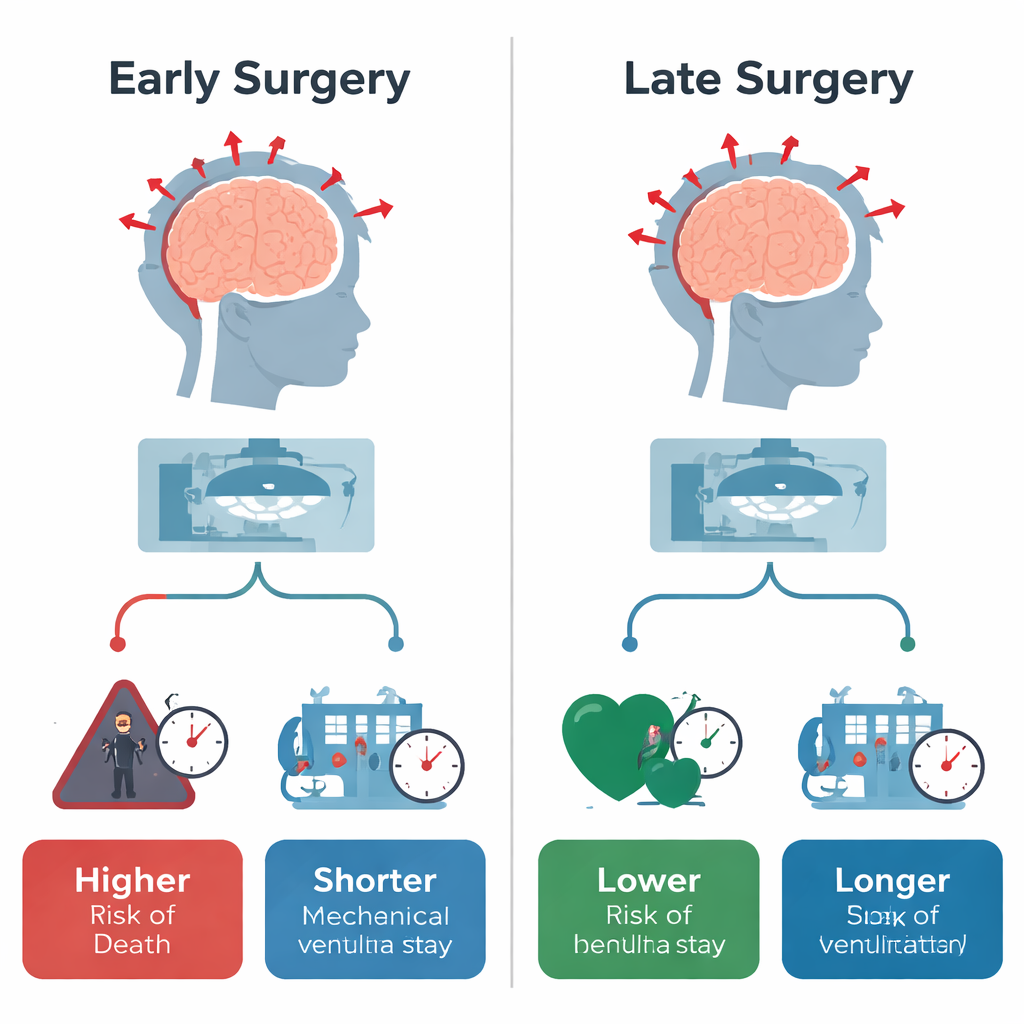
The researchers discovered a striking pattern. Children who had the operation very early were more than twice as likely to die in the hospital compared with those who had later surgery, even after taking injury severity and other factors into account. However, among the children who survived, early surgery was linked to a shorter stay on mechanical ventilation and a shorter overall hospital stay. In other words, the sickest children tended to receive early decompression and had a higher chance of dying, but those who pulled through seemed to recover faster in the acute phase. Measures of complex chronic medical problems at discharge were similar between early and late groups, suggesting that short‑term disability levels were not dramatically different.
What this means for families and doctors
For families, the study’s message is both sobering and hopeful. Early skull‑removal surgery often signals that a child’s brain injury is extremely severe, which helps explain the higher death rate in that group. Yet the results also suggest that, when early surgery is lifesaving, surviving children may spend fewer days on a breathing machine and come home sooner. Late surgery, usually after a careful escalation of treatments, appears to offer better overall survival but often leads to a longer and more complex hospital course. The study does not provide a simple rule for when to operate; instead, it shows that timing is tightly bound to how badly the child is injured. The authors argue that clearer, evidence‑based timelines and shared decision‑making tools are needed so doctors and parents can better weigh the immediate risks of surgery against the chances of survival and recovery.
Citation: Hojeij, R., Brensing, P., Kowall, B. et al. Timing of decompressive craniectomy and short-term outcomes in pediatric severe traumatic brain injury: a nationwide observational study in Germany. Sci Rep 16, 2596 (2026). https://doi.org/10.1038/s41598-026-35837-3
Keywords: pediatric brain injury, decompressive craniectomy, brain swelling, intensive care, neurosurgery