Clear Sky Science · en
Peer interaction in physical activity programs predicts matched changes in psychological capital and social support among undergraduate students
Why the kind of exercise class you choose matters
College students are often told that any exercise is good for their body and mind. But this study asks a more nuanced question: does the type of physical education class you take—whether you play alone, one-on-one, or in a full team—shape different kinds of psychological benefits? By tracking Chinese undergraduates through a semester of three very different sports classes, the researchers show that how much you interact with classmates during exercise can influence whether you build inner confidence or protect your sense of social support.
Different sports, different kinds of togetherness
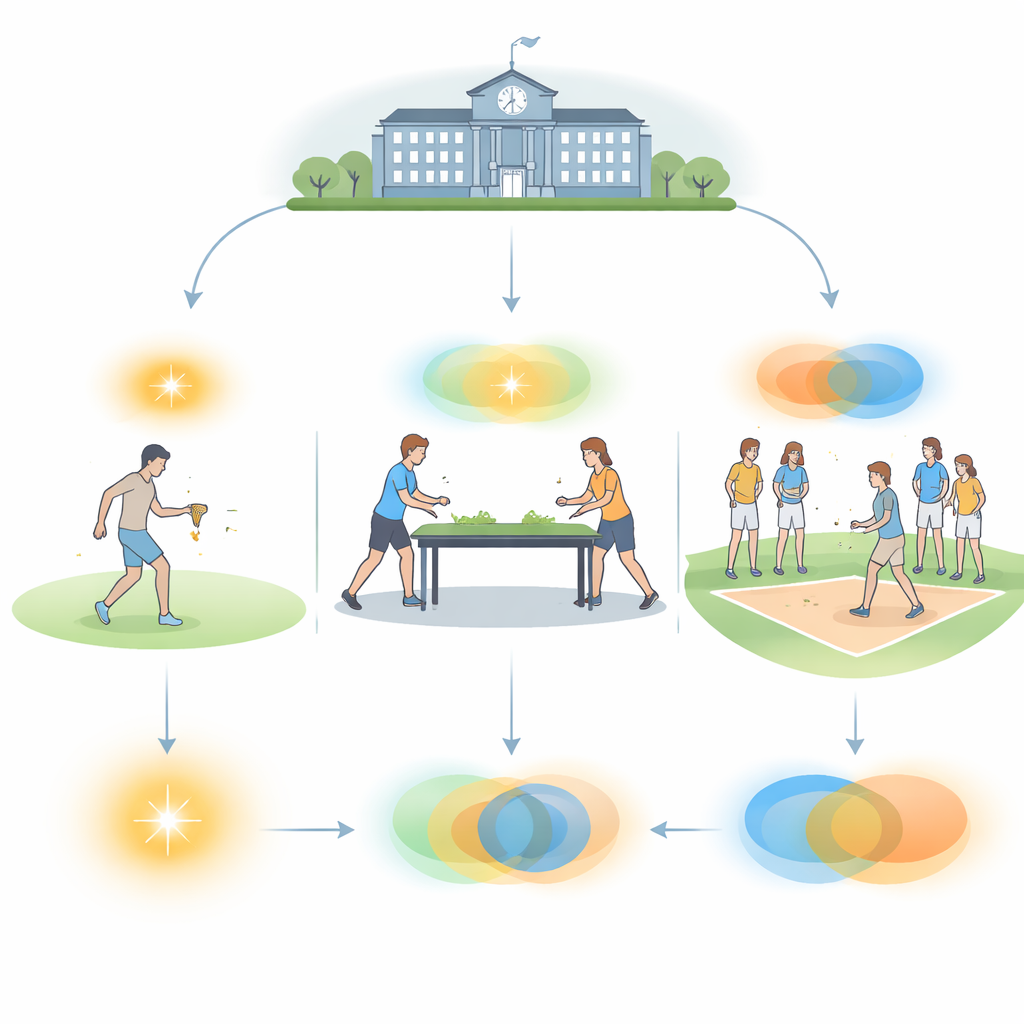
The researchers focused on three common physical education options that naturally vary in how much students interact with one another. Shuttlecock kicking is largely a solo skill activity, where each person practices by themselves. Table tennis usually involves pairs rallying across a table, offering moderate interaction. Baseball and softball are classic team sports, with many players coordinating on the field and in the dugout. All students trained for 90 minutes per week over 12 weeks, following similar class structures with warm-ups, skills practice, and cool-downs. This setup allowed the team to compare not just how much the students moved, but how the social dynamics of each sport related to changes in their mental resources.
Two types of psychological resources
The study zoomed in on two key ingredients of well-being. The first, called psychological capital, captures inner strengths such as confidence, optimism, hope, and resilience—traits that help students keep going when exams pile up and life feels challenging. The second, social support, reflects how much students feel cared for, encouraged, and helped by the people around them. Drawing on a "matching" idea from stress research, the authors proposed that more solitary activities might be especially good for building inner resources, while more socially rich team activities might be better at strengthening the safety net of support from others.
What changed over a stressful semester
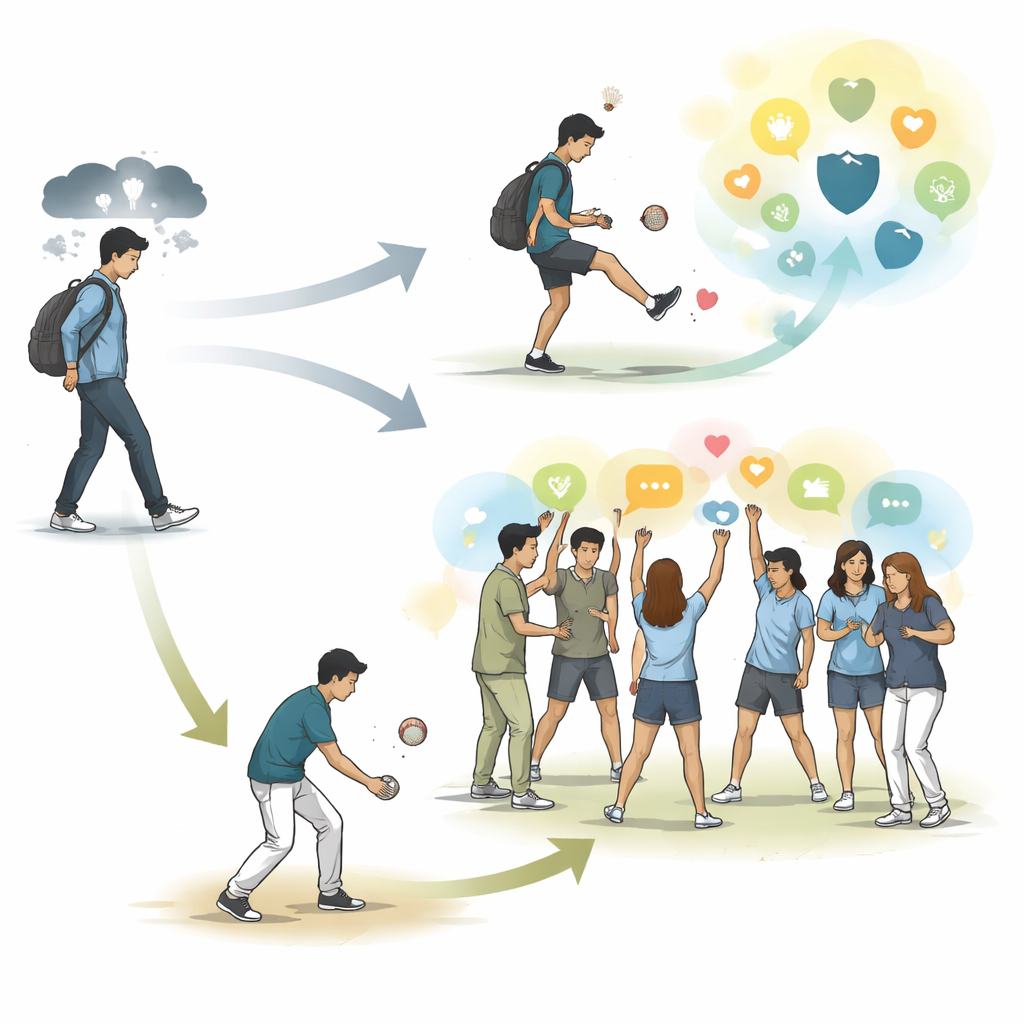
Across the semester, the researchers surveyed 137 undergraduates before and after their courses, measuring both psychological capital and social support while accounting for age and gender. The timing was important: the follow-up survey took place near the end of term, just as final exams were creating extra pressure. In this demanding context, students in the most solitary class—shuttlecock kicking—actually showed a noticeable boost in their psychological capital. Their inner sense of capability and resilience grew, while students in table tennis and baseball/softball did not see similar gains, and in some cases showed slight declines. This suggests that practicing a skill alone, focusing on personal mastery, may help shore up inner strength when academic stress is rising.
Social connections: more complicated than expected
The story for social support turned out to be more complex. Students in shuttlecock kicking and table tennis reported drops in social support over the semester, whereas those in baseball and softball saw a small, non-significant uptick. In other words, high-interaction team sports seemed to help students avoid losing their sense of being supported, but did not clearly raise it. The authors suggest several reasons: classmates under exam strain may have had less energy to support one another, pre-existing friendship patterns may limit who benefits, and the social skills honed on the playing field may not automatically carry over to classrooms or dorm life. Still, the overall pattern fits the matching idea in a guarded way: low-interaction activities mainly feed inner resources, while highly interactive ones help preserve social resources when stress threatens them.
What this means for students and educators
These findings imply that not all exercise classes are interchangeable when it comes to mental well-being. Solo or low-interaction activities may be especially helpful for students who need to build confidence, hope, and resilience from within. Team-based classes, by contrast, may be better suited to protecting students’ feelings of connection with others—provided they are thoughtfully designed to encourage trust, communication, and mutual care. For universities, the message is that a balanced menu of physical education offerings can help students cultivate both inner strength and social bonds. For individuals, choosing the right kind of activity at the right time may be a practical way to "match" exercise to the psychological resources they most want to strengthen.
Citation: He, Z., Tong, J., Zhang, Z. et al. Peer interaction in physical activity programs predicts matched changes in psychological capital and social support among undergraduate students. Sci Rep 16, 9179 (2026). https://doi.org/10.1038/s41598-026-35829-3
Keywords: college students, physical education, team sports, mental well-being, social support