Clear Sky Science · en
Nutrient-free biorefinery of corn steep water into lactic acid by Bacillus licheniformis OP16-2 under thermo-alkaline conditions with a pilot-scale assessment
Turning a Corn Byproduct into a Valuable Green Chemical
Lactic acid is a workhorse of the modern economy: it helps preserve food, soothes skin in cosmetics, and is a key building block for biodegradable plastics. Yet making large amounts of it sustainably and cheaply remains a challenge. This study explores an unexpected hero—corn steep water, a nutrient-rich byproduct of corn wet milling—and shows how a hardy soil bacterium can convert this liquid waste into high-value lactic acid without needing extra nutrients, under hot and alkaline conditions that naturally limit contamination.
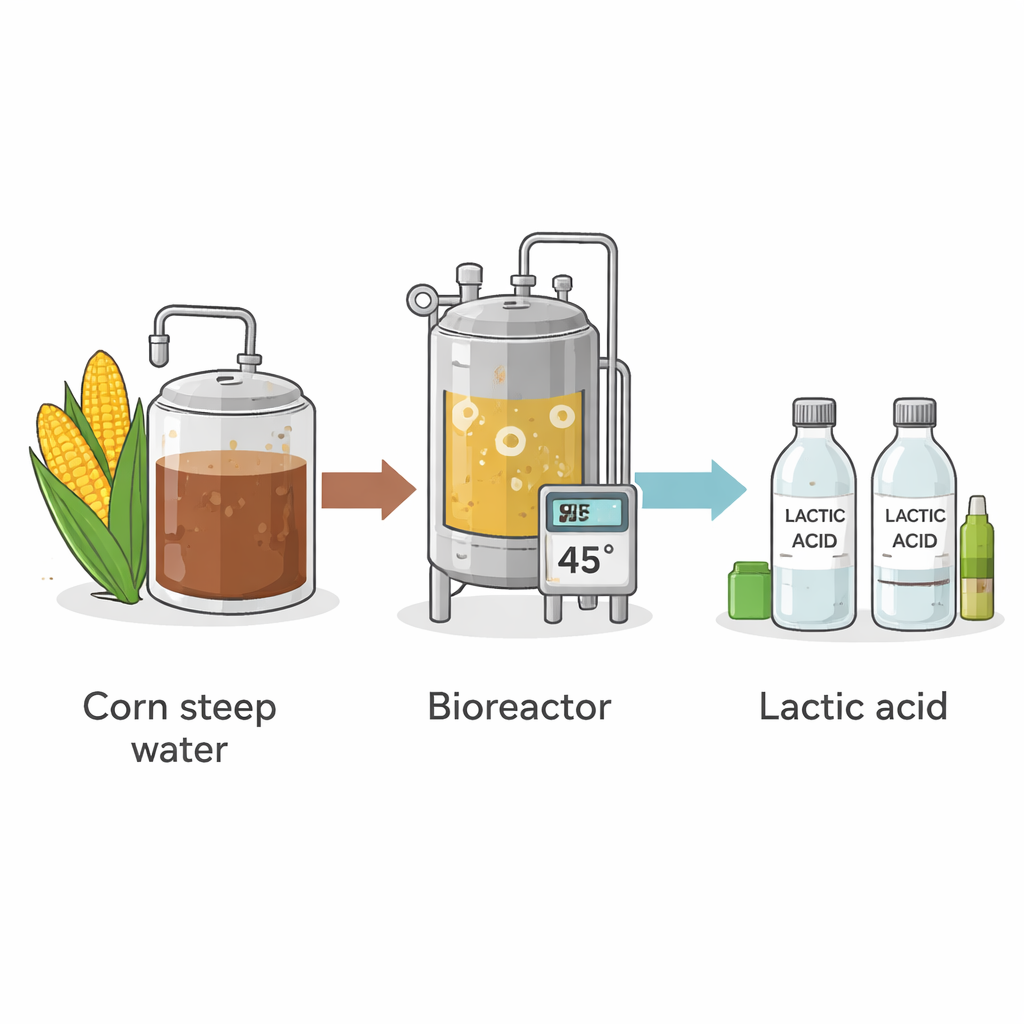
A Hidden Resource in the Corn Industry
When corn is processed in large factories, the kernels are soaked in warm water containing sulfur dioxide to soften them and release starch. The leftover liquid, known as corn steep water, is loaded with sugars, amino acids, vitamins, and minerals. Traditionally, it has been used only in small amounts as a supplement in fermentation. The authors of this paper asked a more ambitious question: could corn steep water itself, without added nutrients, serve as the sole food source for microbes to make lactic acid, transforming a low-value byproduct into a central feedstock for a “nutrient-free” biorefinery?
Finding a Heat- and Alkali-Loving Microbial Workhorse
Industrial fermentations often struggle with two issues: the cost of refined sugars and the risk of unwanted microbes spoiling the broth. To tackle both, the researchers searched soil samples from across Egypt for bacteria that thrive at high temperature (around 50–60 °C) and in alkaline conditions (around pH 9). Such harsh settings naturally discourage common contaminating microbes. From 50 candidates, one strain, later identified as Bacillus licheniformis OP16-2, stood out. It could grow vigorously in corn steep water, tolerate inhibitors such as salts and sulfur compounds leftover from corn processing, and consistently turned the available sugars into lactic acid with very high efficiency.
Tuning the Recipe for Maximum Output
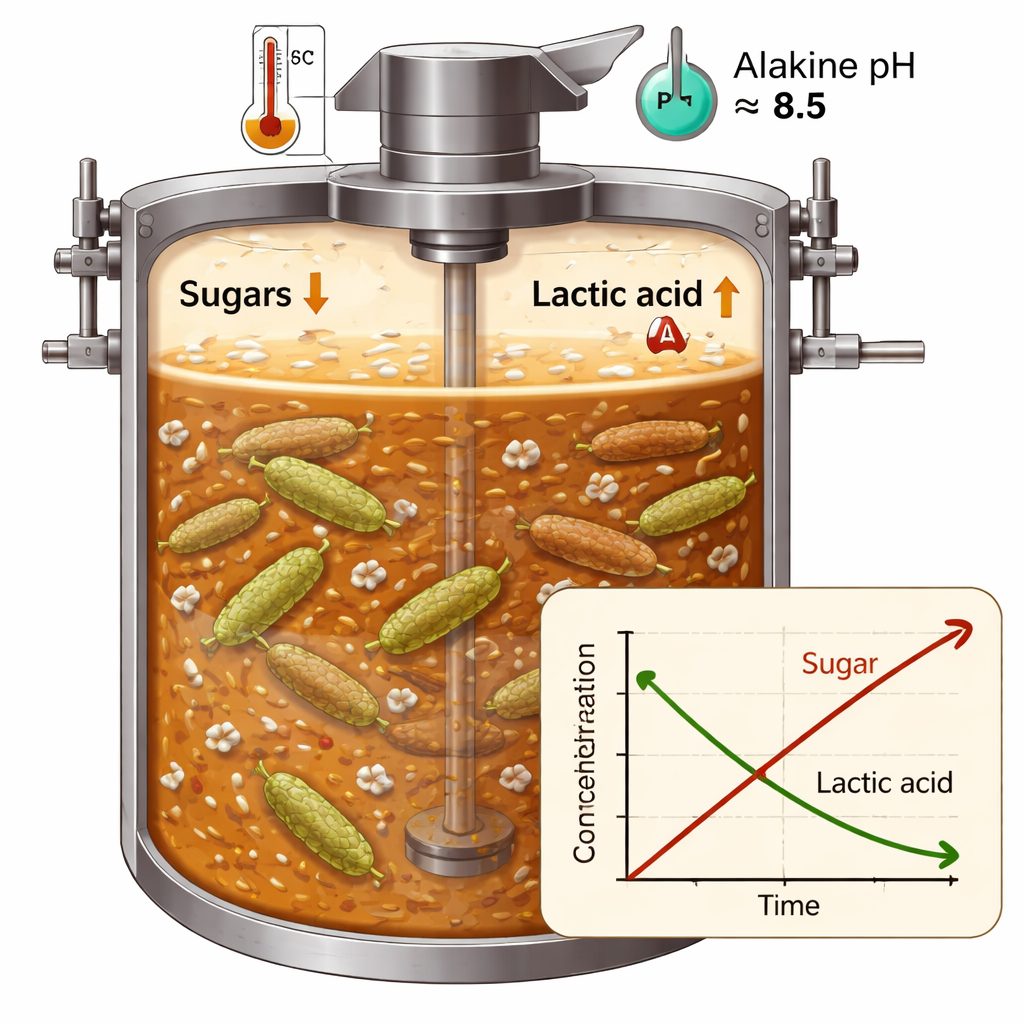
After choosing this promising strain, the team systematically tuned the fermentation recipe. They tested different sugar levels in the corn steep water, temperatures, starting amounts of bacteria, and pH values. They also compared two ways of keeping the pH in check as lactic acid accumulated: adding sodium hydroxide (NaOH) or using solid calcium carbonate. Then, they used advanced statistical tools to evaluate how all these factors work together, rather than one at a time. This approach revealed an optimal “sweet spot”: about 80–83 g/L of corn steep water sugars, a temperature near 45 °C, a slightly alkaline pH of about 8.5–9.0, and a moderate-to-high starting amount of bacteria. Under these conditions, the microbe converted roughly 94% of the consumed sugar into lactic acid, a remarkably high yield.
Scaling Up from Flasks to a Pilot Bioreactor
Laboratory flasks are useful for discovery, but real-world impact depends on performance in larger tanks. The researchers therefore moved to a 50-liter bioreactor, feeding it only untreated corn steep water, adjusted to the right sugar level and pH. In a standard batch run, they reached about 74–76 g/L of lactic acid, matching their statistical predictions. To push production further, they switched to a "multi-pulse fed-batch" strategy: instead of adding all the sugar at once, they gradually fed in concentrated corn steep water as the bacteria consumed sugars. This kept the sugar level in a comfortable range for the microbes, avoiding stress from high concentrations. Over about a week of operation, lactic acid levels climbed to around 153 g/L, still with high yield and steady productivity.
Why This Matters for Sustainable Materials
Lactic acid made from renewable resources is central to producing biodegradable plastics such as polylactic acid (PLA), as well as eco-friendly solvents and food ingredients. This study shows that a single robust bacterium, growing under hot and alkaline conditions, can transform corn steep water—often treated as a waste stream—directly into lactic acid without added yeast extract or other costly nutrients. By cutting both raw-material and sterilization costs, this thermo-alkaline, nutrient-free process brings us closer to affordable, large-scale production of green chemicals from agricultural byproducts, turning waste into a valuable ingredient for more sustainable consumer products.
Citation: Selim, M.T., Salem, S.S., El-Belely, E.F. et al. Nutrient-free biorefinery of corn steep water into lactic acid by Bacillus licheniformis OP16-2 under thermo-alkaline conditions with a pilot-scale assessment. Sci Rep 16, 4357 (2026). https://doi.org/10.1038/s41598-026-35828-4
Keywords: lactic acid fermentation, corn steep water, biorefinery, Bacillus licheniformis, bioplastics