Clear Sky Science · en
Commonalities in gene expression and methylation changes across two rat models of acquired epilepsy
Why Changing Genes Matter for Seizures
Epilepsy affects millions of people and, for about one in three, current medicines cannot fully control their seizures. Most drugs simply dampen the electrical storms in the brain but do not stop epilepsy from developing in the first place. This study explores whether lasting chemical marks on DNA, and the way genes are switched on or off, might explain how a healthy brain becomes epileptic—and whether those changes are shared across different forms of the disease.
Two Different Roads to the Same Illness
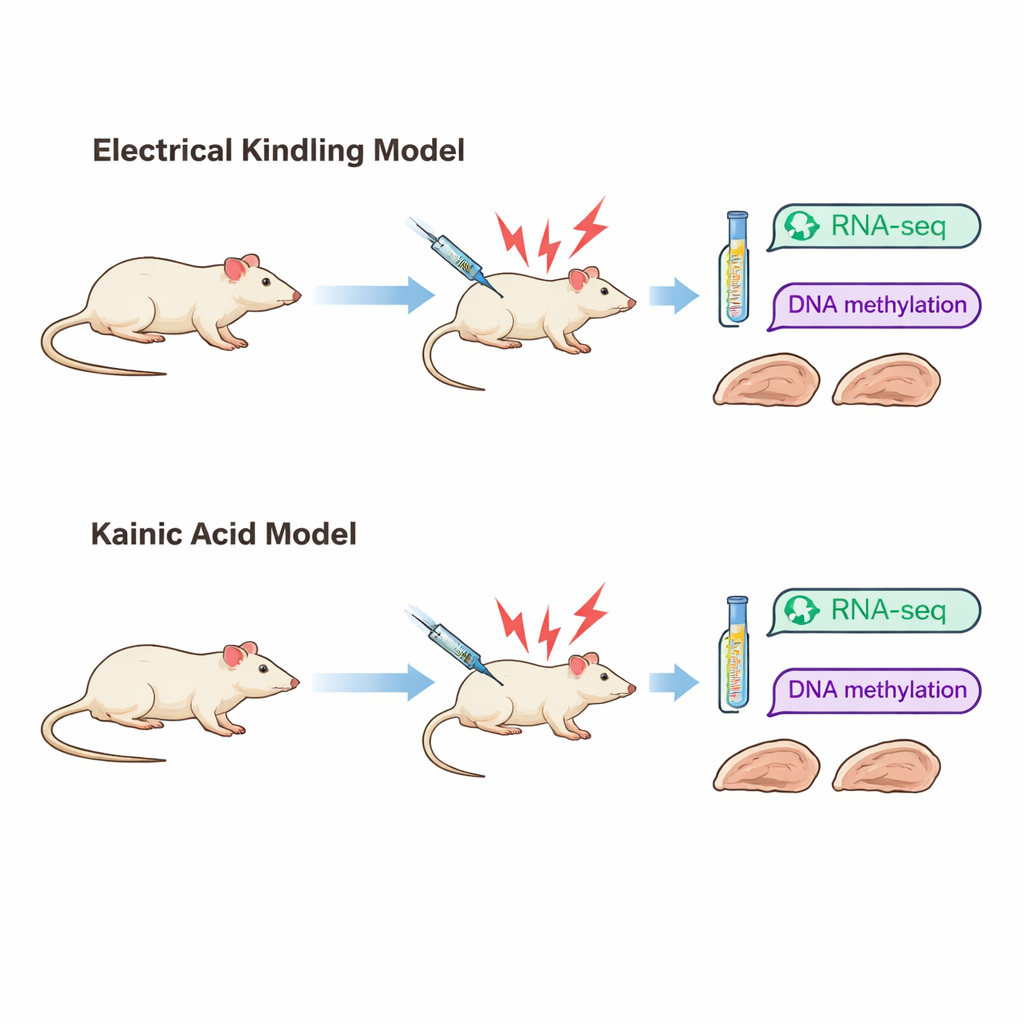
The researchers focused on temporal lobe epilepsy, a common form of the condition that often resists treatment. They used two well-established rat models that mimic different ways epilepsy can arise. In the “kindling” model, brief electrical pulses are delivered to part of the hippocampus over time until seizures become easy to trigger. In the “kainic acid” model, a chemical causes an intense bout of seizures, after which spontaneous seizures appear later. Although both models ultimately produce similar outward behavior—severe convulsive seizures—their brain damage looks very different. Kindled rats show largely preserved tissue structure, while kainic acid–treated rats display pronounced cell loss and scarring in key hippocampal regions.
Reading the Brain’s Genetic Activity
To see how these different paths to epilepsy change the brain at the molecular level, the team examined the hippocampus after rats in each model had experienced three severe seizures. They measured which genes were more or less active using RNA sequencing, and they mapped chemical tags called methyl groups on DNA using a method known as reduced-representation bisulfite sequencing. Activity changes in genes reflect how cells are responding and adapting, while methylation marks are often thought of as a longer-term “memory” that can influence whether genes are turned on or off.
Gene Activity Changes Outpace DNA Marks
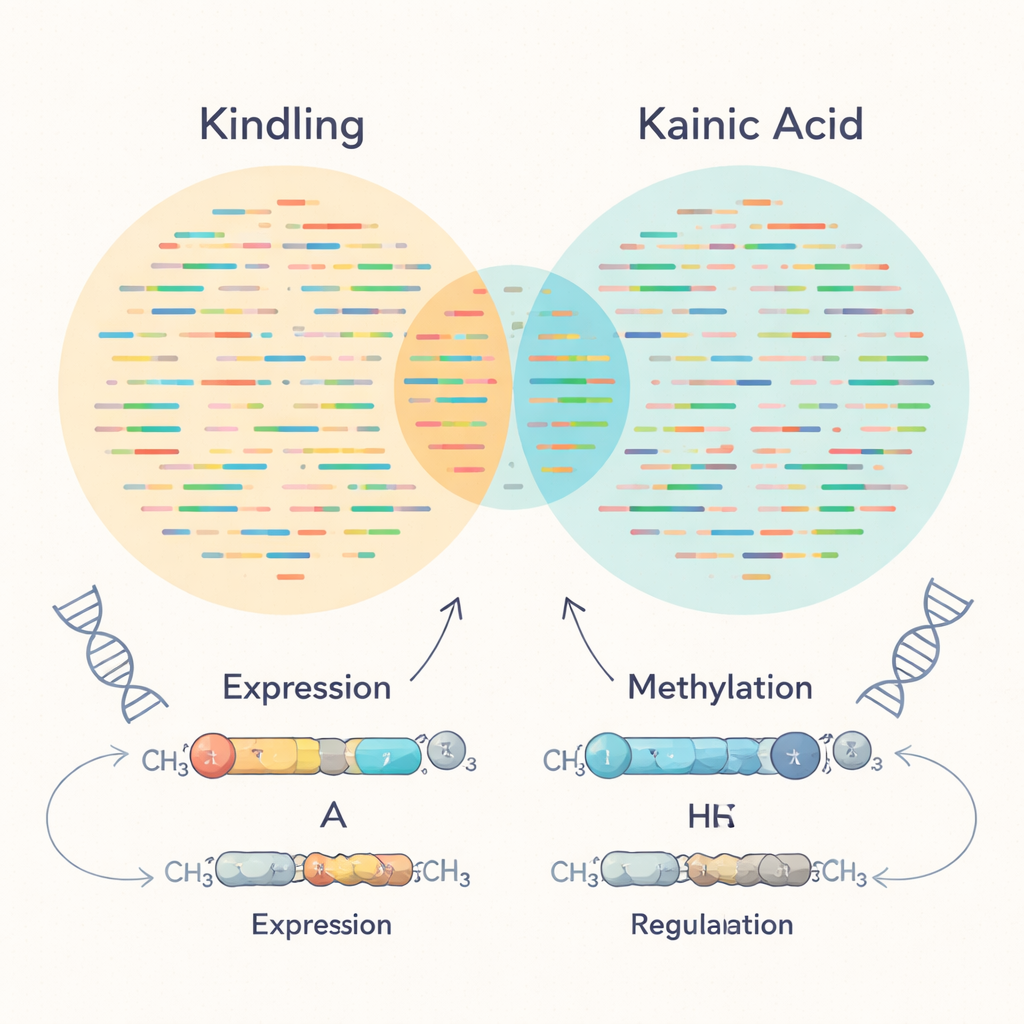
The two models produced strikingly different patterns of gene activity. The kindling model showed changes in more than ten times as many genes as the kainic acid model. Yet when the researchers overlapped the two lists, they still found over a hundred genes that shifted in both models, and most of those moved in the same direction. One example is Mmp9, a gene linked to how brain cells remodel their connections and to seizure-related damage; it was strongly increased in both models. These shared changes suggest there are core genetic responses to epileptogenesis, even when the initial trigger and visible brain injury differ.
DNA Tags Tell a Different Story
When the team looked at DNA methylation, the picture changed. Both models showed many genes with altered methylation, and there was a sizeable overlap between them. However, only a modest subset of genes showed both altered methylation and altered activity within the same model, and even fewer behaved that way in both models. In some of these shared genes, such as Nedd9 and Ptpre, expression rose in both models, but the direction of DNA methylation change at individual sites could be opposite between models. Overall, there was no simple rule that “more methylation means less gene activity” or vice versa. This suggests that, in these epilepsy models, most shifts in gene activity are not directly driven by broad changes in DNA methylation.
What This Means for Future Treatments
For people hoping for better epilepsy therapies, these findings deliver both caution and guidance. The work shows that the genetic programs switched on during epilepsy development can be quite model-specific, and that DNA methylation is only one part of a larger, more complex regulatory picture. Promising gene targets identified in a single animal model may not generalize, so they should be tested across multiple models before moving toward human treatments. At the same time, the small set of genes that change in both expression and methylation across models may represent especially robust starting points for developing disease-modifying therapies that aim not just to quiet seizures, but to prevent epilepsy from taking hold.
Citation: Purnell, B.S., Hur, J., Ruskin, D. et al. Commonalities in gene expression and methylation changes across two rat models of acquired epilepsy. Sci Rep 16, 5095 (2026). https://doi.org/10.1038/s41598-026-35826-6
Keywords: epileptogenesis, DNA methylation, gene expression, temporal lobe epilepsy, rat models