Clear Sky Science · en
Synthesis of carbon-supported multimetallic palladium-based electrocatalysts for direct ethanol fuel cells (DEFCs)
Turning plant-based alcohol into clean power
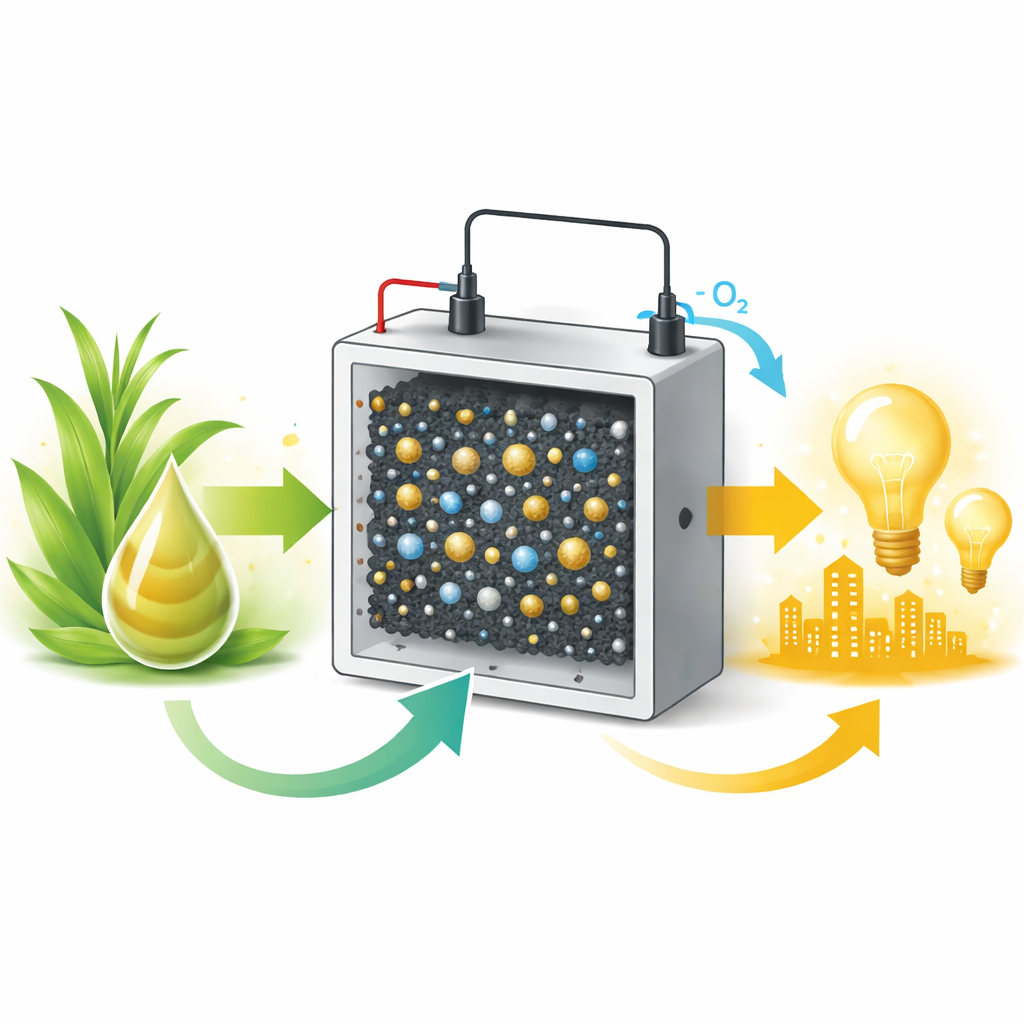
Imagine running small generators, backup power units, or even future vehicles on the same kind of alcohol found in biofuels—without smoke, moving parts, or noisy combustion. Direct ethanol fuel cells do exactly that: they turn the chemical energy of ethanol straight into electricity. But to work well, they need precious metal catalysts that are expensive, can be poisoned by reaction byproducts, and wear out too quickly. This study explores new, smarter catalyst materials that use less scarce metal yet deliver far better performance, bringing ethanol-powered clean energy a step closer to practical reality.
Why ethanol fuel cells matter
Ethanol is attractive as a fuel because it can be produced from renewable biomass such as crops or agricultural waste, making it part of a potentially carbon-neutral cycle. When used in a direct ethanol fuel cell, ethanol reacts electrochemically with oxygen to produce electricity, water, and small carbon-containing molecules, instead of burning in a flame. However, today’s best-performing catalysts rely heavily on platinum, which is costly, rare, and easily poisoned by carbon monoxide–like fragments that stick to its surface. Palladium offers a cheaper alternative with better resistance to these poisons, but by itself still struggles to fully break down ethanol and to maintain high activity over time. Finding a catalyst that is both powerful and durable, while using less critical metal, is a key barrier to wider adoption of ethanol fuel cells.
Designing smarter metal mixtures
The researchers tackled this challenge by building tiny alloy particles—each only a few billionths of a meter across—made from three metals at once: palladium, gold, and either rhodium, iridium, or silver. These nanoparticles were deposited on a high–surface area carbon support, forming four different catalysts to compare: simple palladium on carbon, and three trimetallic versions (PdAuRh/C, PdAuIr/C, and PdAuAg/C). By carefully controlling how the metals are reduced from solution and capped during growth, the team tuned particle size and mixing of the metals. Advanced techniques such as X-ray diffraction, electron microscopy, and photoelectron spectroscopy confirmed that the metals form alloyed structures, with particle sizes typically in the 3–5 nanometer range and subtle changes in the metal lattice and surface chemistry that are known to influence how molecules adsorb and react.
How the new catalysts perform in action
To find out how these materials behave in real electrochemical conditions, the team tested them in alkaline solution with ethanol, using several complementary methods. Cyclic voltammetry tracked how much current each catalyst produced as the voltage was swept, revealing how easily ethanol begins to oxidize and how strongly the surface becomes blocked. Chronoamperometry followed the current over longer holds at fixed voltages, showing how fast the catalysts lose activity as reaction intermediates accumulate. Impedance measurements probed how much resistance the catalysts offer to charge transfer during the reaction. Across these tests, one material stood out: the palladium–gold–rhodium catalyst produced a peak ethanol-oxidation current more than five times higher than plain palladium, and began reacting at a much lower voltage, meaning less extra “push” was needed to drive the reaction. The palladium–gold–iridium catalyst also performed strongly, with roughly double the peak current of palladium alone, while the palladium–gold–silver version, though the weakest of the three, still improved on the base material and showed unusual double peaks in its reaction profile that hint at a more complex pathway.
What is happening at the tiny metal surface
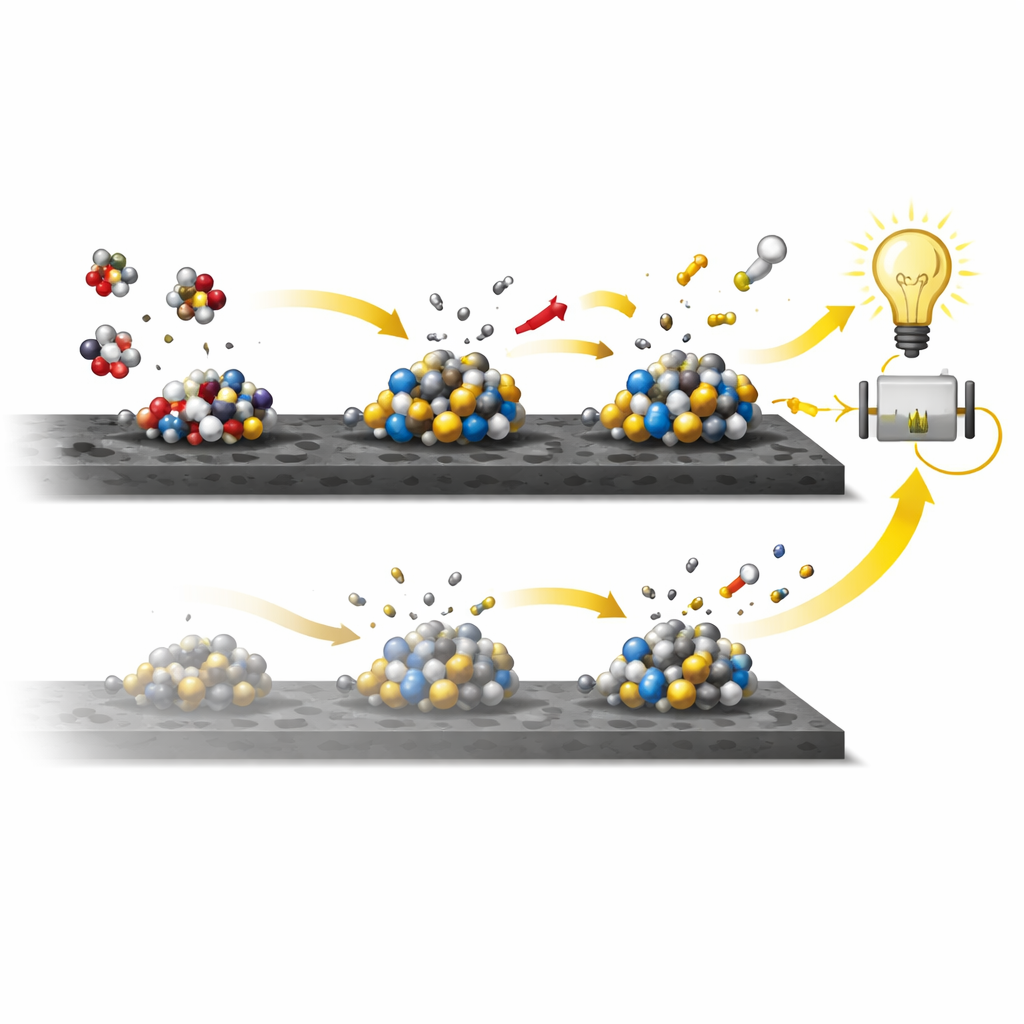
The superior performance of the trimetallic catalysts appears to arise from a combination of size, structure, and electronic effects. Alloying palladium with gold and a third metal shrinks the particles, increasing the number of active sites available per gram of palladium. At the same time, small shifts in lattice spacing and in the binding energies of surface atoms adjust how strongly ethanol and its fragments stick to the surface. In the best-performing palladium–gold–rhodium system, these changes seem to favor rapid removal of poisoning carbon species and easier formation of reactive oxygen-containing groups that help “burn off” adsorbed intermediates. Impedance data confirm that this catalyst has by far the lowest charge-transfer resistance among those tested, meaning electrons move across the interface more readily during the reaction. By contrast, the silver-containing catalyst shows weaker alloying and larger particles, which likely explain its comparatively lower, though still improved, activity.
From lab-scale particles to future devices
Overall, the study demonstrates that carefully engineered mixtures of palladium, gold, and a third metal can dramatically boost the performance of ethanol fuel cell catalysts while offering a route away from platinum dependence. In particular, the palladium–gold–rhodium material combines very high activity with a low energy barrier for ethanol oxidation, making it a strong candidate for next-generation anodes in direct ethanol fuel cells. While further work is needed to confirm long-term durability and to optimize cost and composition, these results show that tuning metal combinations at the nanoscale can unlock cleaner, more efficient use of renewable liquid fuels—and bring compact, alcohol-powered clean energy sources closer to everyday use.
Citation: ElSheikh, A., Alsoghier, H.M., Mousa, H.M. et al. Synthesis of carbon-supported multimetallic palladium-based electrocatalysts for direct ethanol fuel cells (DEFCs). Sci Rep 16, 9188 (2026). https://doi.org/10.1038/s41598-026-35821-x
Keywords: direct ethanol fuel cells, palladium catalysts, ethanol oxidation, nanoparticle electrocatalysts, clean energy materials