Clear Sky Science · en
Geometric moment-based spectral descriptors for robust non-rigid 3D shape analysis
Why bending 3D shapes is harder than it looks
As 3D scans of people, animals and everyday objects become common in medicine, movies and virtual reality, computers need reliable ways to tell when two shapes are really “the same” despite bending, stretching or missing pieces. This paper introduces a new mathematical tool that helps computers compare and retrieve such flexible 3D shapes much more robustly, even when they appear in very different poses or with noisy, incomplete data.
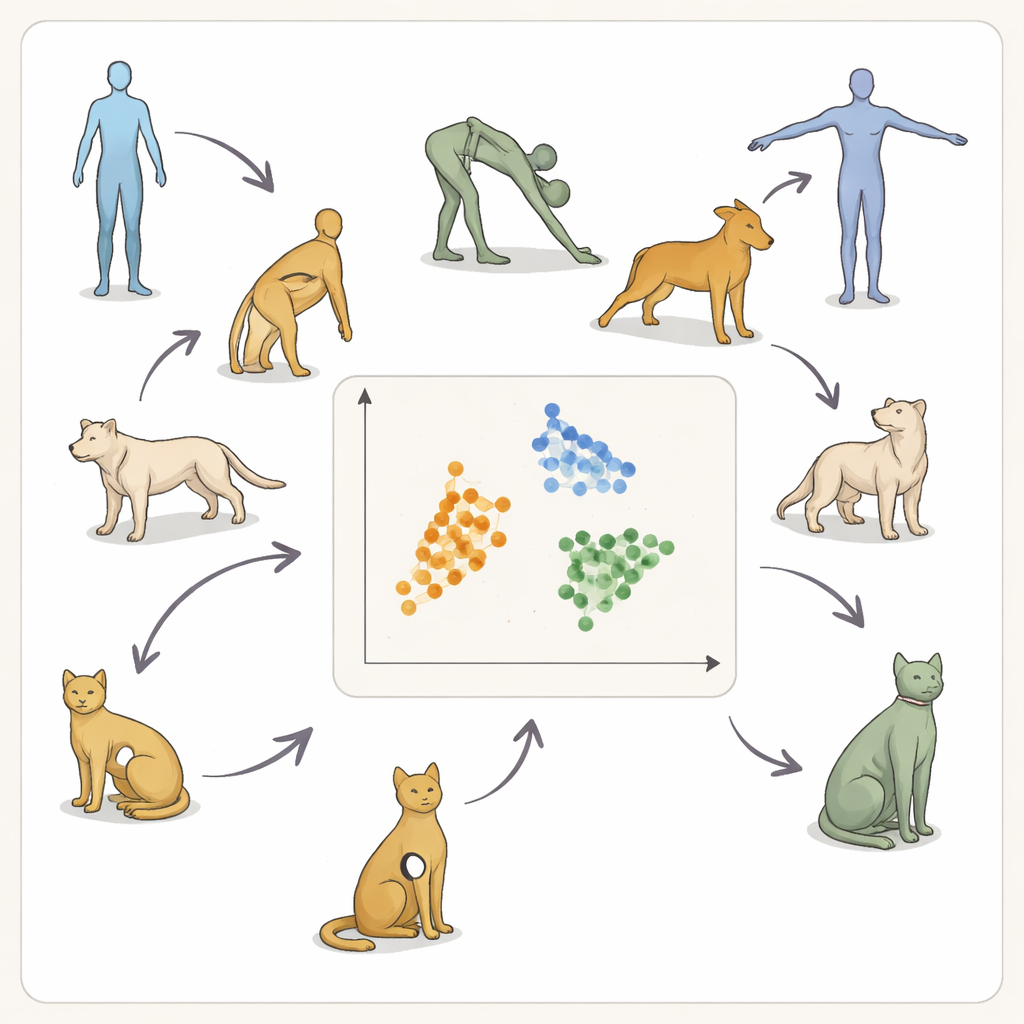
From raw surfaces to musical fingerprints
To a computer, a 3D model is just a mesh of tiny triangles. Turning that mesh into something comparable across shapes requires a compact fingerprint, or descriptor, that captures what makes a shape unique while ignoring irrelevant differences. A popular family of descriptors treats each shape like a vibrating drum or a surface that conducts heat. By studying how heat diffuses or how waves travel across the surface, these “spectral” methods summarize the geometry in a way that is naturally insensitive to simple movements, such as rigid rotations or bending of limbs without stretching. Well-known examples, the Heat Kernel Signature (HKS) and the Wave Kernel Signature (WKS), have powered many recent advances in 3D shape analysis.
The hidden problem of tuning knobs
Despite their success, existing spectral descriptors depend heavily on user-chosen parameters, such as how long to let heat diffuse or which wave energies to examine. If these settings focus too narrowly, the descriptors only capture fine details and miss overall structure; if they are too broad, subtle local features disappear. Worse, parameters that work well for one type of shape or dataset may perform poorly on another. Some methods try to fix this by stacking many parameter choices together, but this leads to long descriptors that are slow to compute and compare. The authors argue that this parameter sensitivity has quietly limited the robustness and general usefulness of spectral descriptors in real-world applications.
Summarizing behavior with geometric moments
The central idea of the paper is to keep the strengths of HKS and WKS while removing most of the parameter headache. Instead of picking a few preferred time or energy scales, the authors treat the full evolution of each spectral descriptor as data and then summarize that data using statistical moments, such as the mean, variance and skewness. They do this both over time or frequency (the “temporal” side) and over the local neighborhood of each point on the surface (the “spatial” side). The result is a set of six carefully chosen moment values, called Geometric Moments of Spectral Shape Descriptors (GMSDs), that together form a short, informative signature for every point on a shape.
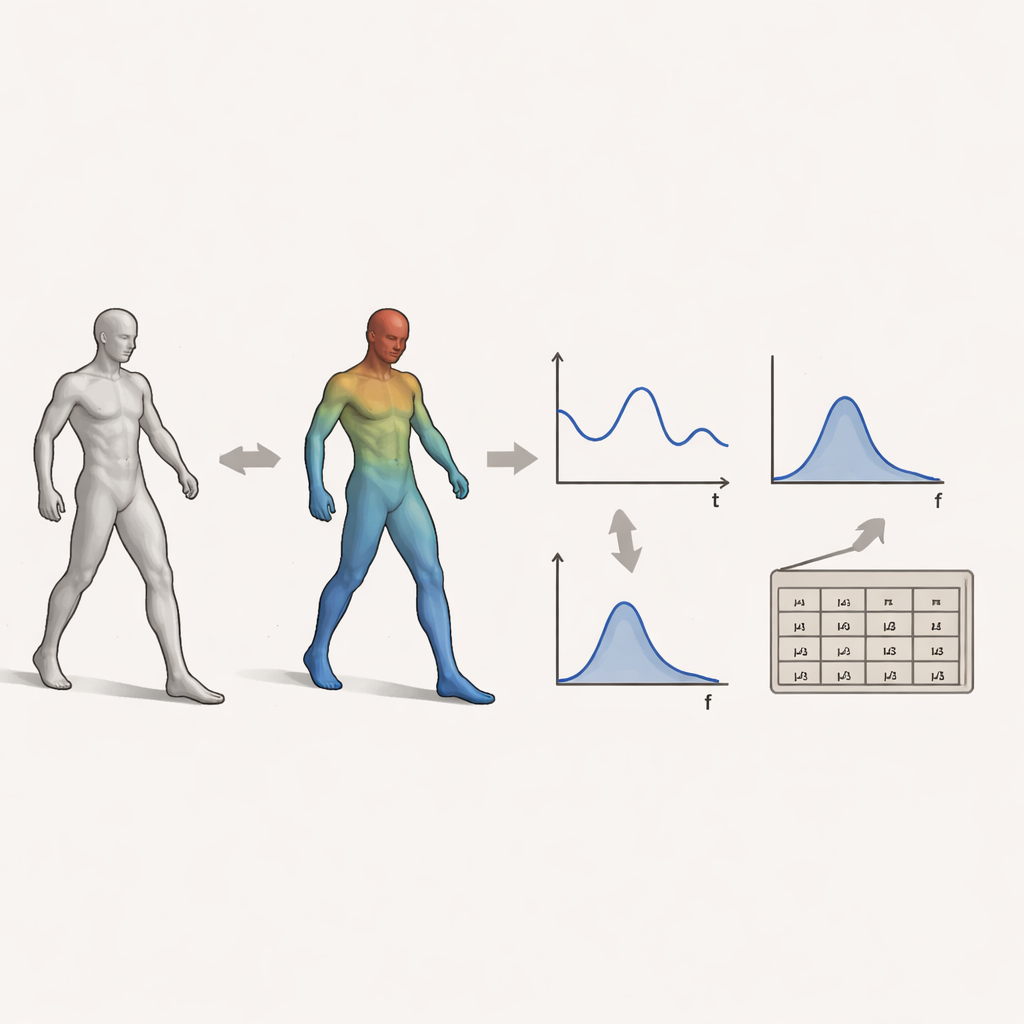
Staying stable under bends, cuts and noise
Because GMSDs are built on the same spectral foundation as HKS and WKS, they inherit important guarantees: they remain essentially unchanged when a shape bends without stretching, and they are resistant to changes in mesh resolution and small surface perturbations. The authors further exploit these properties by defining a shape-to-shape distance based on how far their GMSD signatures are from each other on average, using a robust variant of a classical distance called the Modified Hausdorff Distance. Extensive tests on four widely used 3D shape benchmarks show that GMSDs not only survive difficult transformations—such as holes, topological changes, heavy noise and non-rigid pose changes—but also outperform many state-of-the-art competitors in matching, classification and retrieval tasks.
What this means for future 3D applications
For non-experts, the takeaway is straightforward: the paper presents a way to turn complex, bendable 3D objects into concise, stable fingerprints that work reliably across many datasets without painstaking parameter tuning. This makes it easier to search large shape libraries, track how forms deform over time, and provide robust inputs to more advanced methods like functional maps or neural networks. In practice, GMSDs offer a compact, training-free building block that could strengthen everything from medical shape comparison to animation and 3D content recommendation systems.
Citation: Zhang, D., Liu, N., Wu, Z. et al. Geometric moment-based spectral descriptors for robust non-rigid 3D shape analysis. Sci Rep 16, 5687 (2026). https://doi.org/10.1038/s41598-026-35820-y
Keywords: 3D shape analysis, spectral descriptors, shape retrieval, non-rigid geometry, invariant moments