Clear Sky Science · en
Thermal dynamics of vector breeding habitats and their impact on immature survivorship of Anopheles stephensi in Chennai, India
Why hot water tanks matter for city malaria
In many growing cities, malaria is no longer spread from swamps and rice fields alone. It can emerge from the very water that households store on their rooftops and in their courtyards. This study asks a deceptively simple question with big public health consequences: how does the temperature of these everyday water containers shape the survival of malaria mosquitoes, and what does that mean for malaria control in a warming, urbanizing world?
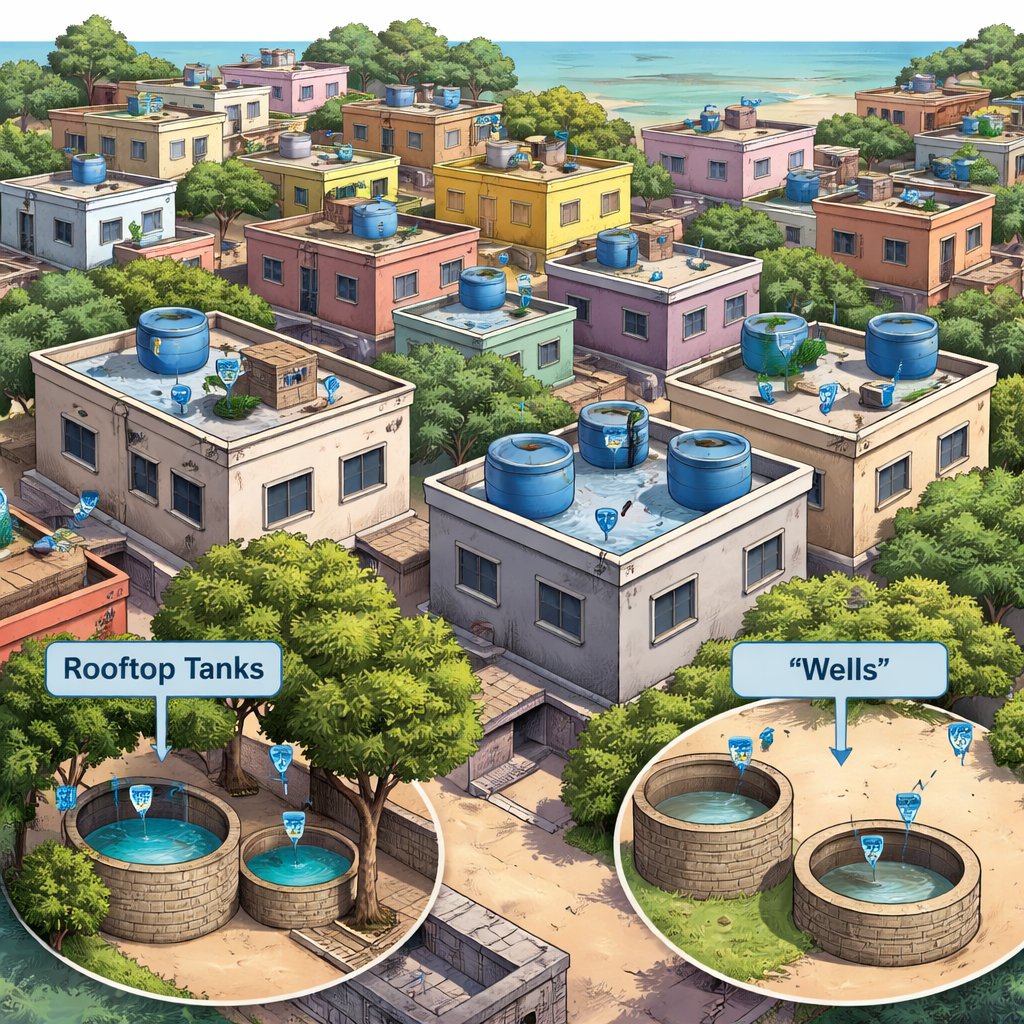
Hidden mosquito nurseries in a seaside neighborhood
The research took place in Besant Nagar, a coastal residential area of Chennai in South India where malaria is transmitted mainly by the urban mosquito Anopheles stephensi. Here, mosquitoes do not rely on muddy puddles; they thrive in clean water stored in overhead tanks and wells. The team focused on four common breeding spots: cement overhead tanks, synthetic (plastic) overhead tanks, shaded wells and wells exposed to direct sun. Using floatable temperature loggers that sat at the water surface where mosquito larvae live, they recorded the water temperature every hour for a full year, capturing the fine-scale heating and cooling that larvae actually experience.
Following the daily rhythm of water temperatures
The measurements revealed striking differences between habitats. Plastic overhead tanks were the hottest and most unstable: in pre-monsoon and summer months, water often exceeded 32 °C and swung by more than 8 °C in a single day. Cement tanks were slightly cooler and more buffered, while both types of wells stayed several degrees cooler with very small daily swings, especially shaded wells surrounded by vegetation. Heavy rains, especially during the northeast monsoon, temporarily cooled all habitats and reduced the daily temperature range. In effect, a few meters of height or a ring of trees could turn two neighboring water bodies into very different thermal worlds for mosquito larvae.
Recreating city water climates in the laboratory
To understand what these temperature patterns mean for mosquito survival, the scientists recreated the habitat-specific conditions in programmable incubators. They raised the first-generation offspring of wild-caught An. stephensi under four regimes: the detailed temperature profiles of cement tanks, plastic tanks and wells, and a constant “standard” laboratory temperature. For each setting they tracked what fraction of eggs hatched, how many larvae reached the pupal stage, and how many adults finally emerged. The young adults were then moved to an incubator mimicking the warm, humid conditions inside thatched-roof houses—structures known to shelter malaria mosquitoes—and their lifespan was monitored.
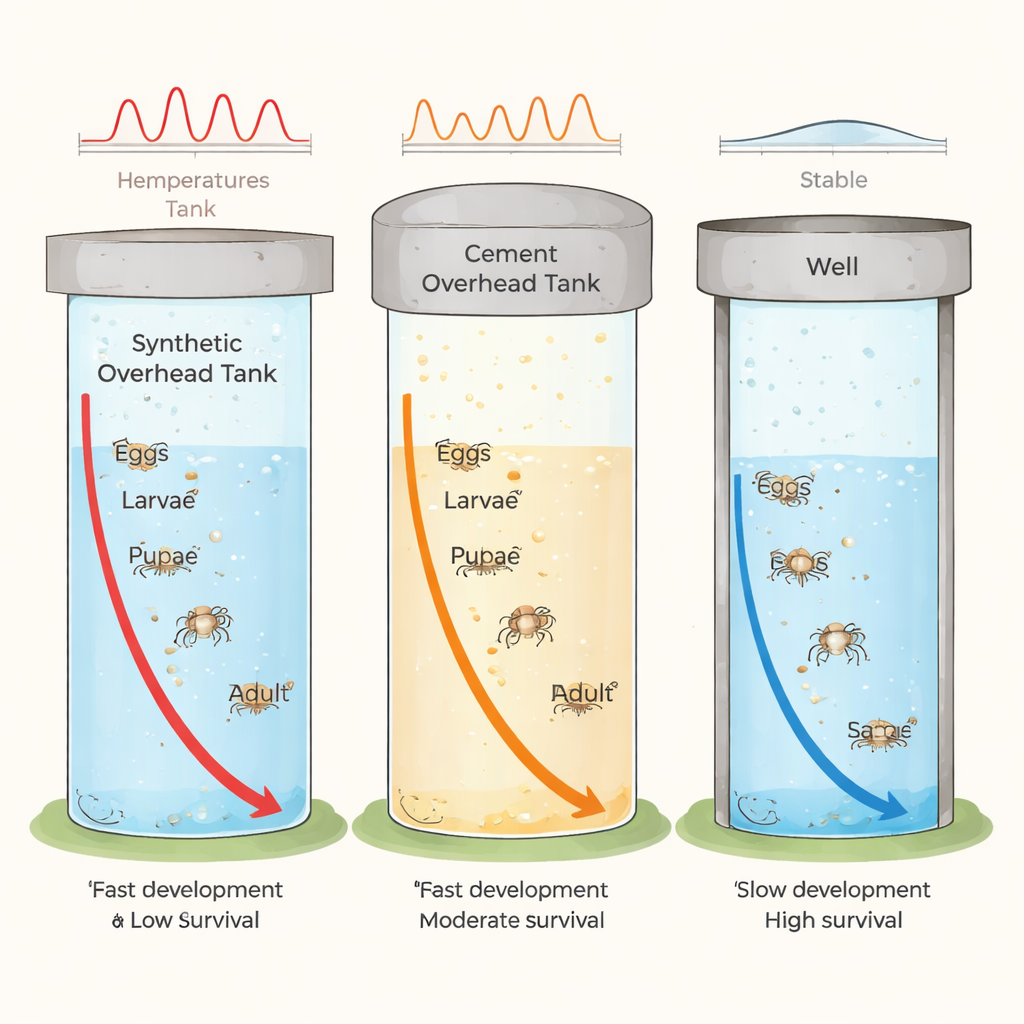
Fast childhood, risky adulthood in hot tanks
Eggs and larvae generally did best under the stable temperatures of wells and under standard laboratory conditions, with very high hatching and pupation rates. In contrast, both types of overhead tanks, especially plastic ones with strong daily heating and cooling, reduced the chances that eggs and larvae would survive, even though development was faster there. Interestingly, once larvae from the harsher cement-tank conditions made it to adulthood, they tended to live longer than those from plastic tanks, but the longest-lived adults came from the cooler, well-like conditions. Statistical analyses that looked at all three life stages together confirmed that temperature regimes explained about one-third of the differences in development and survival, with cement tanks producing the most variable outcomes and wells clustering closely with the stable standard setting.
What this means for city planning and malaria control
For a non-specialist, the main message is that not all water containers are equal in how they feed malaria risk. Hot, plastic rooftop tanks speed mosquitoes through their youth but are tough environments overall, while cooler wells act as slow but reliable nurseries that produce sturdy, long-lived adults capable of transmitting malaria. Because synthetic tanks are spreading rapidly in modern housing and wells often remain open and poorly protected, both habitat types need attention. Simple steps—secure screw-type lids on tanks, proper covering and maintenance of wells, and routine inspections guided by fine-scale temperature profiling—can sharply reduce breeding in these hidden urban reservoirs. As cities warm and expand, designing and managing water storage with mosquito ecology in mind could become a powerful, low-tech tool for sustaining malaria elimination gains.
Citation: Ravishankaran, S., Asokan, A., Kripa, P.K. et al. Thermal dynamics of vector breeding habitats and their impact on immature survivorship of Anopheles stephensi in Chennai, India. Sci Rep 16, 5726 (2026). https://doi.org/10.1038/s41598-026-35819-5
Keywords: urban malaria, Anopheles stephensi, water storage tanks, microclimate, vector control