Clear Sky Science · en
Hybrid quasi Z source multi output converter system with performance control and real time validation for photovoltaic microgrid
Powering Homes Smarter, Not Just Harder
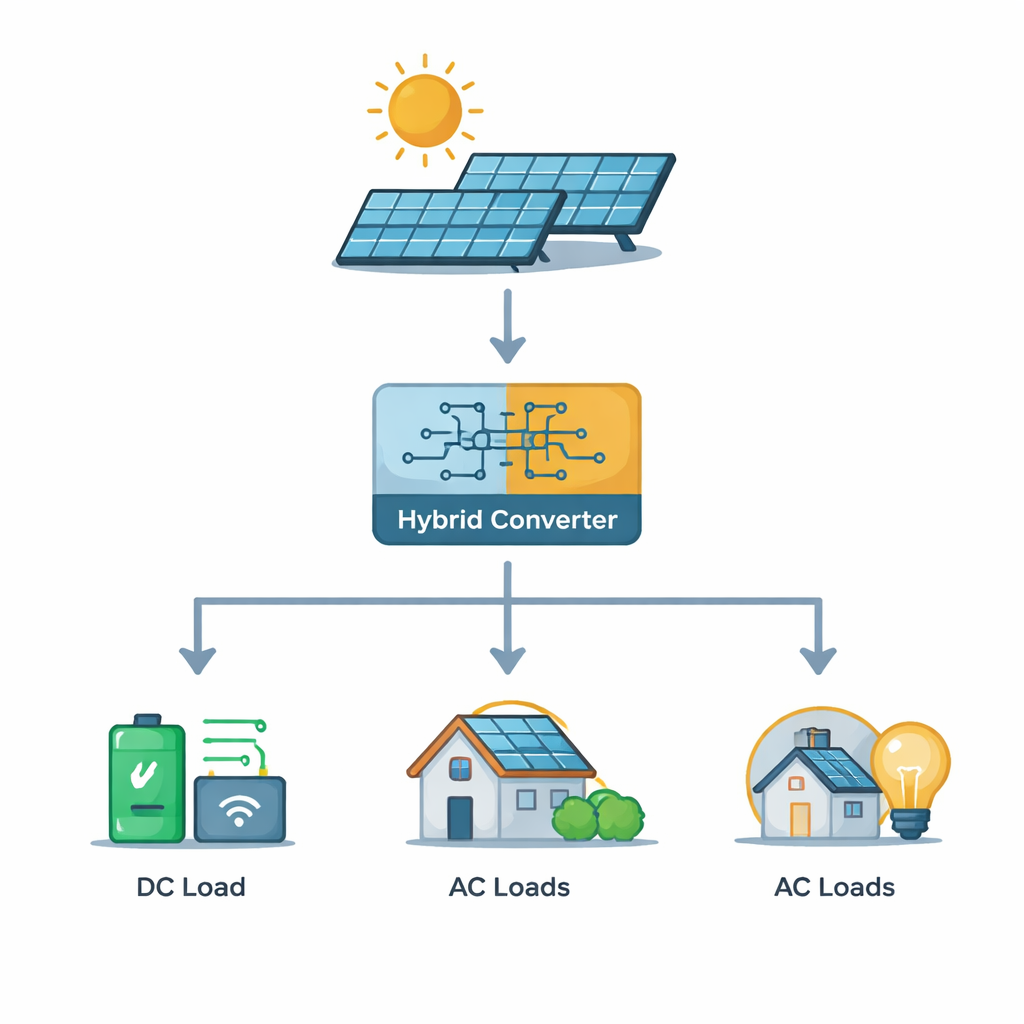
As more homes add rooftop solar panels and plug in electronic gadgets, they need electricity in different forms: steady direct current (DC) for electronics and batteries, and alternating current (AC) for the household grid. Today this usually means stacking several bulky power converters between the solar panels and the wall outlet. This study introduces a compact “all‑in‑one” solar power box that can feed both DC and multiple AC lines at once, while automatically squeezing the most energy from the sun and keeping power quality high.
Why Current Solar Setups Waste Space and Energy
In a typical microgrid, solar panels, batteries, and household loads are linked through several stages of power electronics. One device boosts the low voltage from the panels, another converts DC to AC, and extra converters are added if more voltage levels or outputs are needed. Every added box increases cost, heat loss, and physical size. Many modern designs that try to simplify things still end up serving only one kind of output well—usually a single AC line—leaving DC needs or multiple circuits to be handled elsewhere. This gap becomes more serious as homes and small communities move toward mixed systems that power both local DC devices and the wider AC grid.
An All‑in‑One Solar Power Box
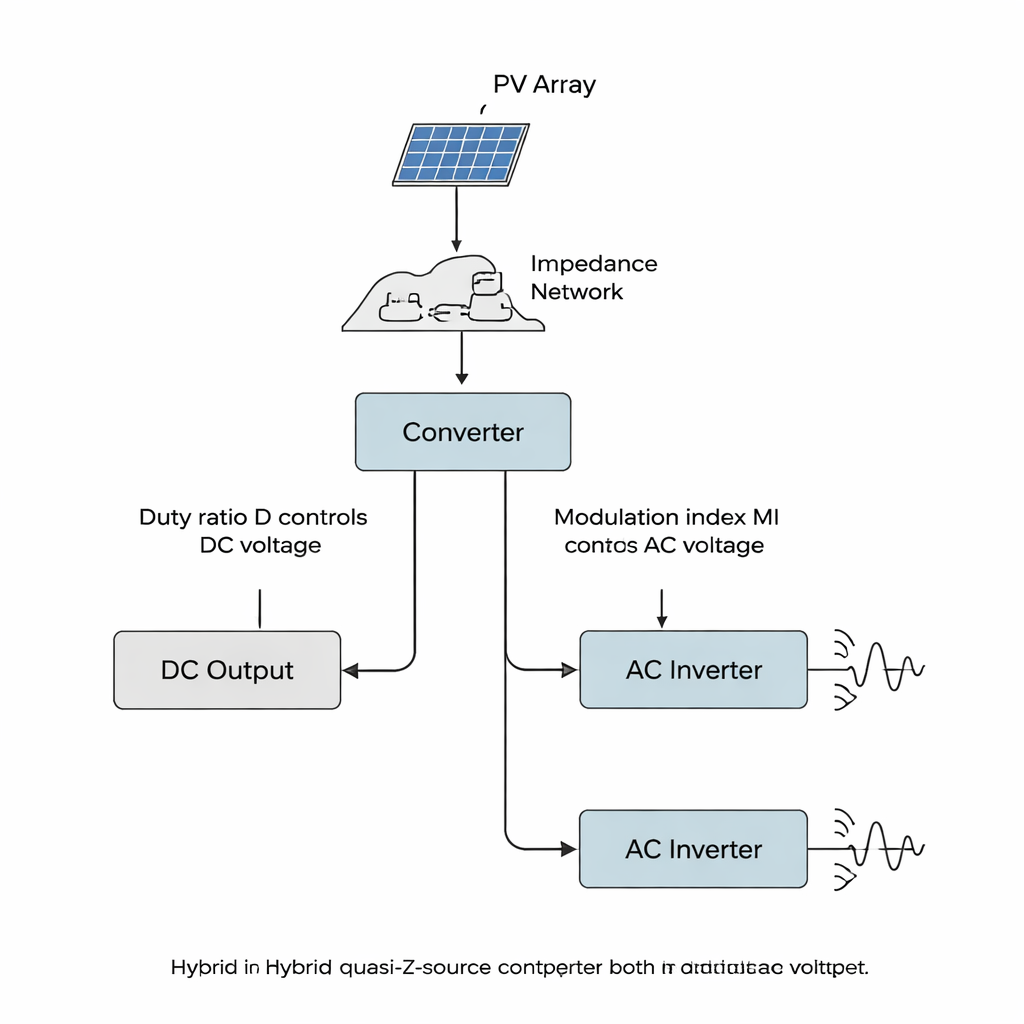
The authors propose a hybrid converter that merges boosting, DC supply, and AC conversion into a single stage. At its heart is a refined version of a "quasi Z‑source" network, a special arrangement of inductors, capacitors, diodes, and switches that can step the panel voltage up or down as needed. The new twist is an added switched‑capacitor branch that improves the voltage boost and allows a clean, well‑regulated DC output to be taken directly from the network, instead of as a side effect. From the same boosted link, two separate single‑phase inverter modules generate independent AC outputs after simple filtering. The design is modular: more inverter blocks can be added to feed additional AC circuits or higher power levels without changing the basic structure.
Smart Control That Separates DC and AC Jobs
A major challenge in such combined hardware is avoiding tug‑of‑war between DC and AC demands. The study tackles this with a control method that gives each side its own "knob." One control variable, the shoot‑through duty ratio, mainly sets the boosted DC voltage; the other, the modulation index, sets the AC output levels. The authors show mathematically that within practical limits these two knobs can be adjusted independently. A well‑known tracking algorithm, perturb‑and‑observe maximum power point tracking, slowly tweaks the duty ratio so the panels operate where they produce maximum power, even as sunlight changes. Faster inner loops monitor AC voltage and current so that power sent to the grid stays in phase with grid voltage, preserving a good power factor and limiting distortion.
From Computer Models to Real‑Time Testing
To see whether the idea works beyond paper equations, the team first simulated a 16‑kilowatt system sized for a small house. With a single solar array feeding the converter, they obtained one strong DC output and two AC outputs, all holding steady even when loads were suddenly increased or decreased on one side. The next step used a hardware‑in‑the‑loop platform, which mimics real‑world behavior in real time. There too, when the researchers changed sunlight levels or abruptly stepped the DC or AC loads up and down, the converter kept voltages close to their targets. Disturbances on one output—such as a sudden jump in DC current—did not significantly upset the other AC outputs, confirming the promised decoupling in practice.
What This Means for Future Solar Microgrids
In plain terms, this work shows that a single, smartly designed box can replace several conventional converters in a solar‑powered microgrid, while still giving clean and independently controlled DC and multiple AC supplies. That can translate into smaller installations, lower cost, and less wasted energy for homes and communities that want to rely more heavily on rooftop solar. The authors note that scaling to higher power levels will require careful attention to heat, component stress, and efficiency, but the one‑stage architecture and strong control scheme make the design promising for next‑generation residential and microgrid applications.
Citation: Deori, P., Ahmad, A. & Routray, A. Hybrid quasi Z source multi output converter system with performance control and real time validation for photovoltaic microgrid. Sci Rep 16, 6255 (2026). https://doi.org/10.1038/s41598-026-35817-7
Keywords: solar microgrid, hybrid converter, quasi Z source, multi output inverter, photovoltaic control