Clear Sky Science · en
An efficient tripartite remote state preparation scheme with noise analysis
Sharing Quantum Information Without Sending Particles
Imagine three people scattered across the globe who want to swap very delicate pieces of information without ever sending the original particles that carry it. This paper shows how that futuristic idea, based on quantum physics, can work for three users at once, even when real‑world noise tries to scramble their signals. The result is a more efficient way to build the plumbing of a future quantum internet.
From Teleportation to Remote Preparation
Many people have heard of quantum teleportation, where information about an unknown quantum state is transferred from one location to another using a pair of entangled particles and ordinary communication lines. Remote state preparation is a close cousin: the state being sent is already known to the sender, which allows some steps to be streamlined. Instead of guessing what is being transmitted, the sender uses prior knowledge to reduce the amount of classical information that must be exchanged. This makes remote state preparation attractive for quantum networks and secure communication, where efficiency and reliability are both crucial.
Three‑Way Quantum Exchange in One Shot
The authors present a new scheme where three parties—traditionally called Alice, Bob, and Charlie—can all send their single‑qubit quantum states to one another at the same time. Rather than running separate two‑user protocols, they share a specially designed 12‑qubit entangled channel. Each user holds four of these qubits and also has one extra qubit encoding the state they want to share. By choosing suitable ways to measure their qubits and then applying simple correction steps, all three users end up holding the other two users’ states. In one synchronized round, six quantum states are successfully exchanged among three participants. 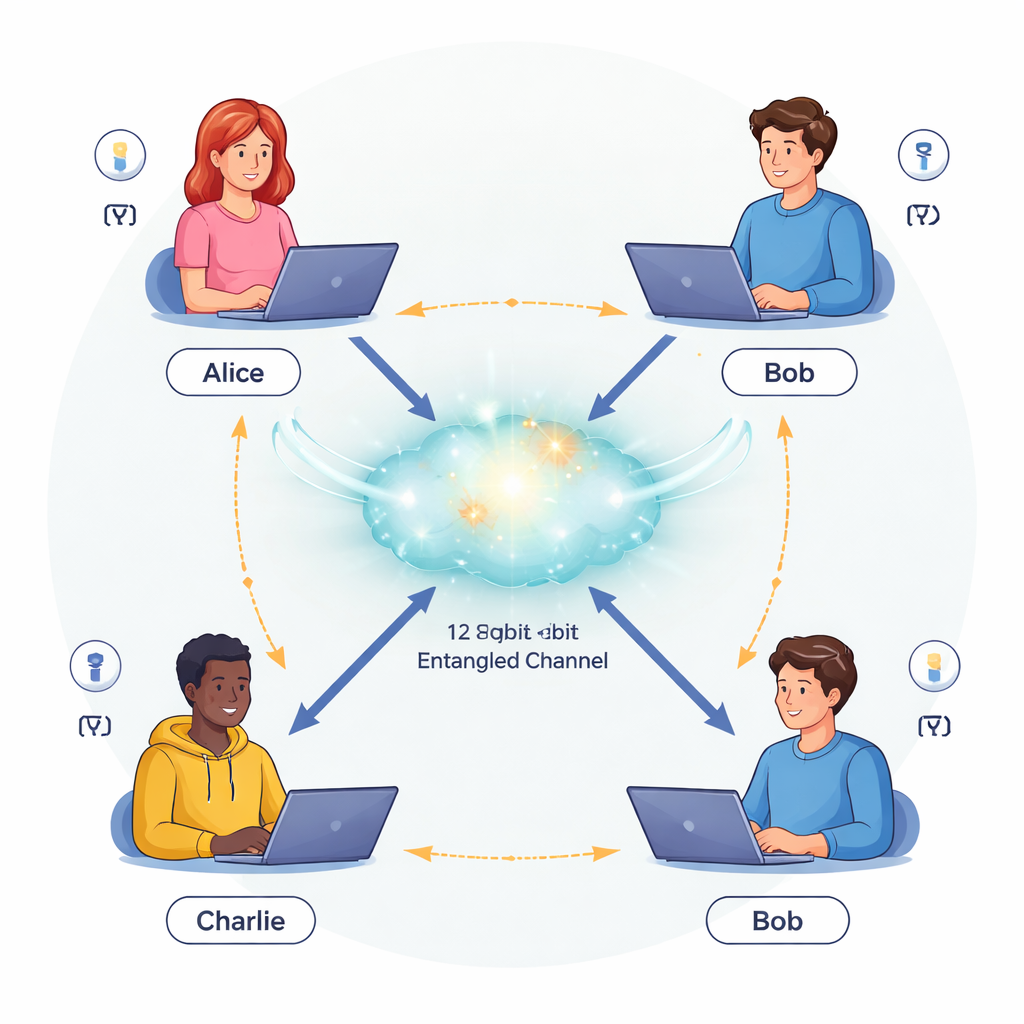
Scaling Up Beyond Single Particles
The protocol is not limited to single‑qubit states. The researchers show how it can be extended so that each user can send states built from an arbitrary number of qubits. They do this by first compressing the essential information about a multi‑qubit state into one “control” qubit using a sequence of standard quantum logic gates, and then applying their three‑user protocol to these control qubits. At the receiving end, another set of gates reconstructs the original multi‑qubit states. Because the underlying 12‑qubit channel is built entirely from widely used gates called Hadamard and CNOT, the design is modular: it can be adapted to different network sizes and state dimensions without exotic hardware.
Testing the Scheme on Today’s Quantum Hardware
To demonstrate that the idea is more than just algebra on paper, the authors implement the full three‑user protocol using IBM’s open‑source Qiskit framework. They program the 12‑qubit channel, the measurements for Alice, Bob, and Charlie, and the follow‑up correction operations prescribed by the protocol. Running the circuit many times (1000 “shots”), they examine the statistics of the measurement outcomes for the final qubits held by each user. The measured probability distributions match the predicted ones extremely well in an ideal, noise‑free simulation, confirming that the scheme faithfully transfers the intended quantum states.
How Noise Eats Away at Quantum Signals
Real devices are never perfect, so the authors go further and analyze how different kinds of noise affect their protocol. They model five common types of disturbance: three that apply paired quantum flips (known as XX, YY, and ZZ noise), a depolarizing channel that randomly scrambles a qubit, and an amplitude‑damping channel that mimics energy loss. In their simulations, parts of the shared entangled channel are exposed to these noisy effects before the protocol runs. They then compare the received states with the ideal ones using a quantity called fidelity, which measures how similar two quantum states are. By averaging this fidelity over many possible input states and sweeping the noise strength, they find that the scheme is generally robust, with amplitude‑damping noise being the least harmful among the models considered. 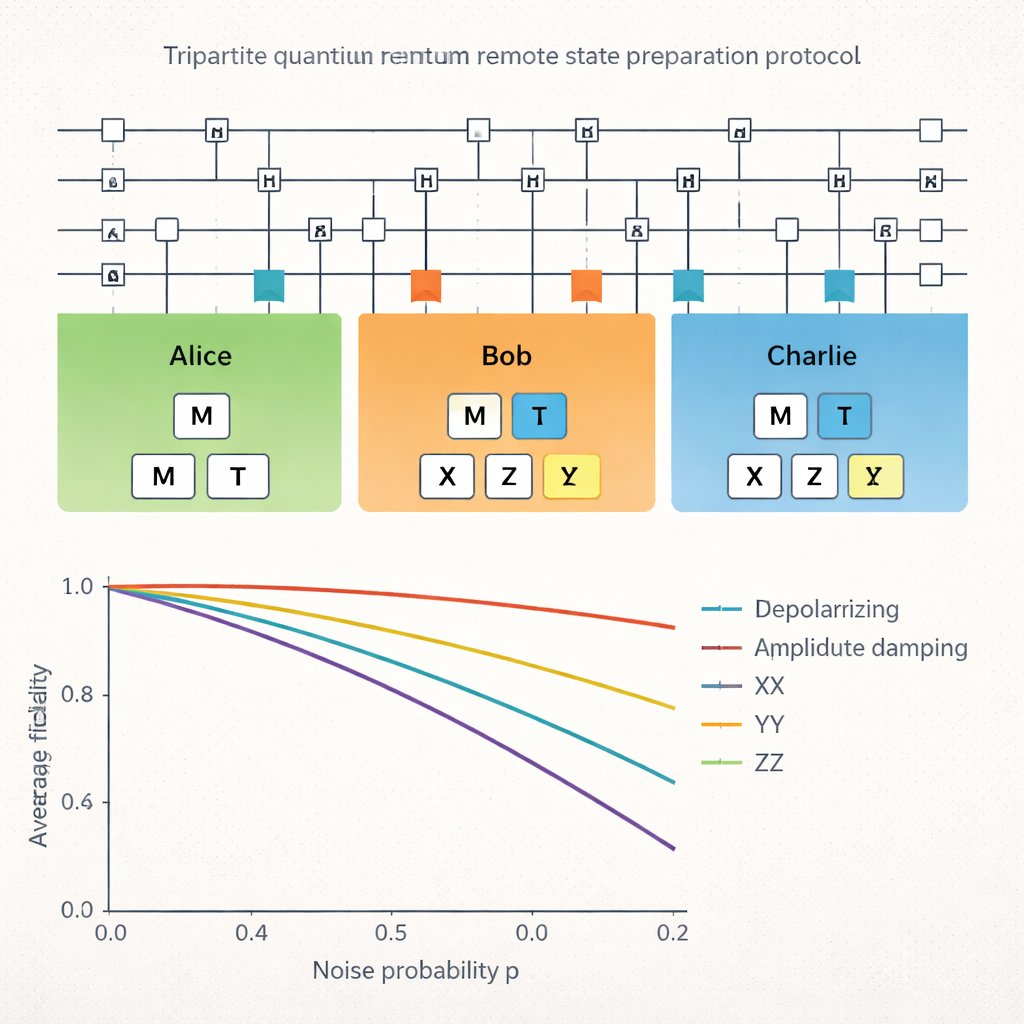
Why This Matters for the Quantum Internet
Compared with earlier three‑party remote state preparation methods, the new protocol packs more information into the same number of quantum resources. It prepares six single‑qubit states using a 12‑qubit channel, giving an efficiency of 0.50, higher than previous schemes that only managed three states with fewer channel qubits. The fact that it relies only on standard gates and has been tested in realistic simulations makes it a promising candidate for near‑term experiments. For a lay reader, the key takeaway is that this work shows how three users can reliably and efficiently exchange quantum information in a single coordinated step, even when noise is present—a small but important stride toward practical, multi‑user quantum networks and secure quantum communication.
Citation: Bolokian, M., Orouji, A.A. & Houshmand, M. An efficient tripartite remote state preparation scheme with noise analysis. Sci Rep 16, 7243 (2026). https://doi.org/10.1038/s41598-026-35816-8
Keywords: quantum communication, remote state preparation, entanglement, quantum networks, noise robustness