Clear Sky Science · en
Evaluation of traffic congestion mitigation techniques using an entropy-TOPSIS integrated method
Why everyday traffic jams matter
Anyone who has been stuck in a long line of cars knows that traffic jams waste time, fuel, and patience. In rapidly growing cities like Peshawar, Pakistan, congestion is more than a daily annoyance: it harms air quality, raises transport costs, and slows the local economy. This study looks closely at one of Peshawar’s busiest road corridors to find out exactly where the worst bottlenecks are, why they happen, and which fixes would give residents the biggest relief.
Zooming in on a crowded city corridor
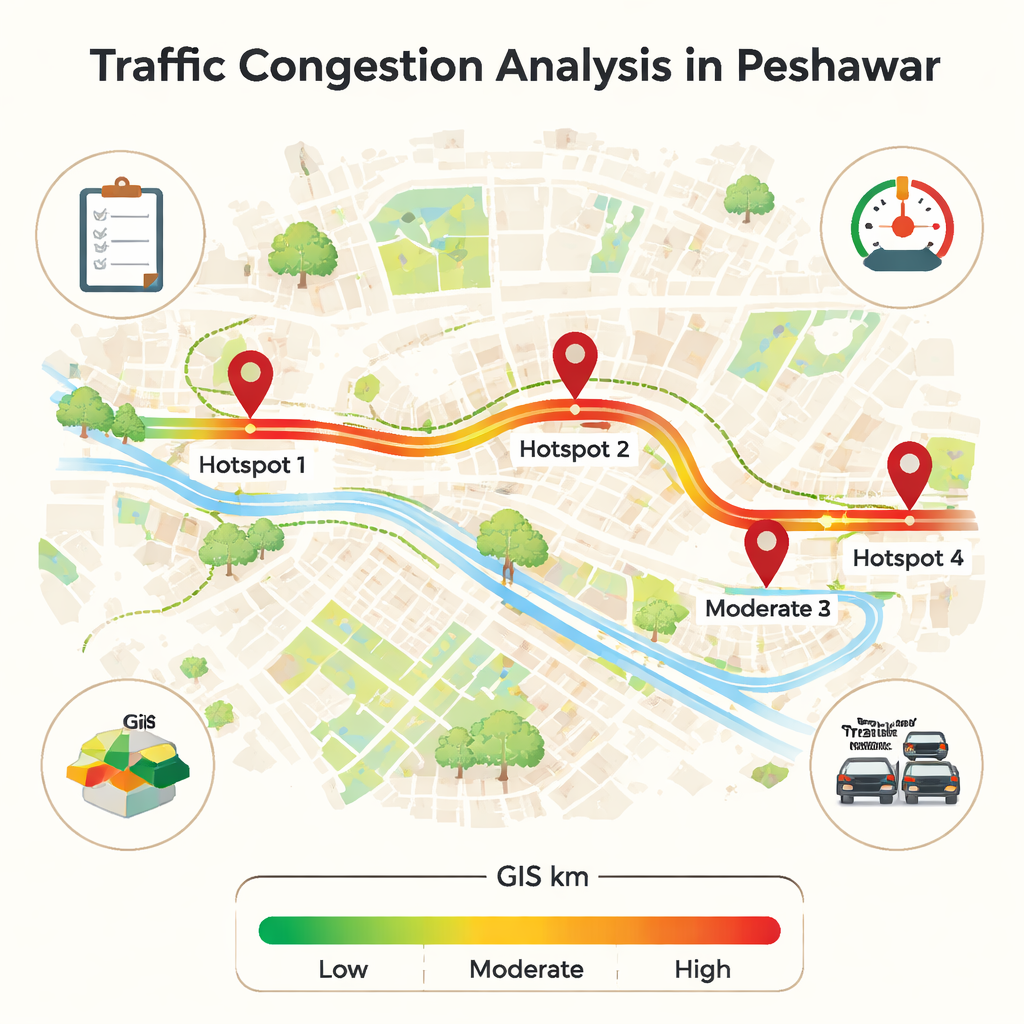
Peshawar is among Pakistan’s most polluted and traffic-choked cities, with a population approaching two and a half million and most freight now moving by road instead of rail. The researchers focused on a 16-kilometer stretch from Bab‑e‑Peshawar to the Haji‑Camp bus station, a route that thousands of people use daily for work, school, and shopping. Using digital maps and a geographic information system (GIS), they first identified the city’s most important zones—dense built‑up areas, markets, schools, hospitals, and major roads. This mapping step highlighted a main corridor where daily life, commerce, and traffic collide.
Measuring how bad the jams really are
To move beyond impressions and complaints, the team carried out detailed on‑site measurements. They counted vehicles in short intervals for an entire week, tracked travel speeds, and converted the mixed stream of cars, motorcycles, buses, and trucks into a common scale called passenger car units, which reflects how much road space each type of vehicle uses. They then compared the actual flow of traffic with the road’s capacity and graded service quality, from free‑flowing to heavily congested. All four major hotspots along the corridor—near Amin Hotel, PC Hotel, Army Stadium, and Jalil Kabab House—were found to be operating beyond their designed limits during peak hours.
Sorting the worst trouble spots with smart ranking
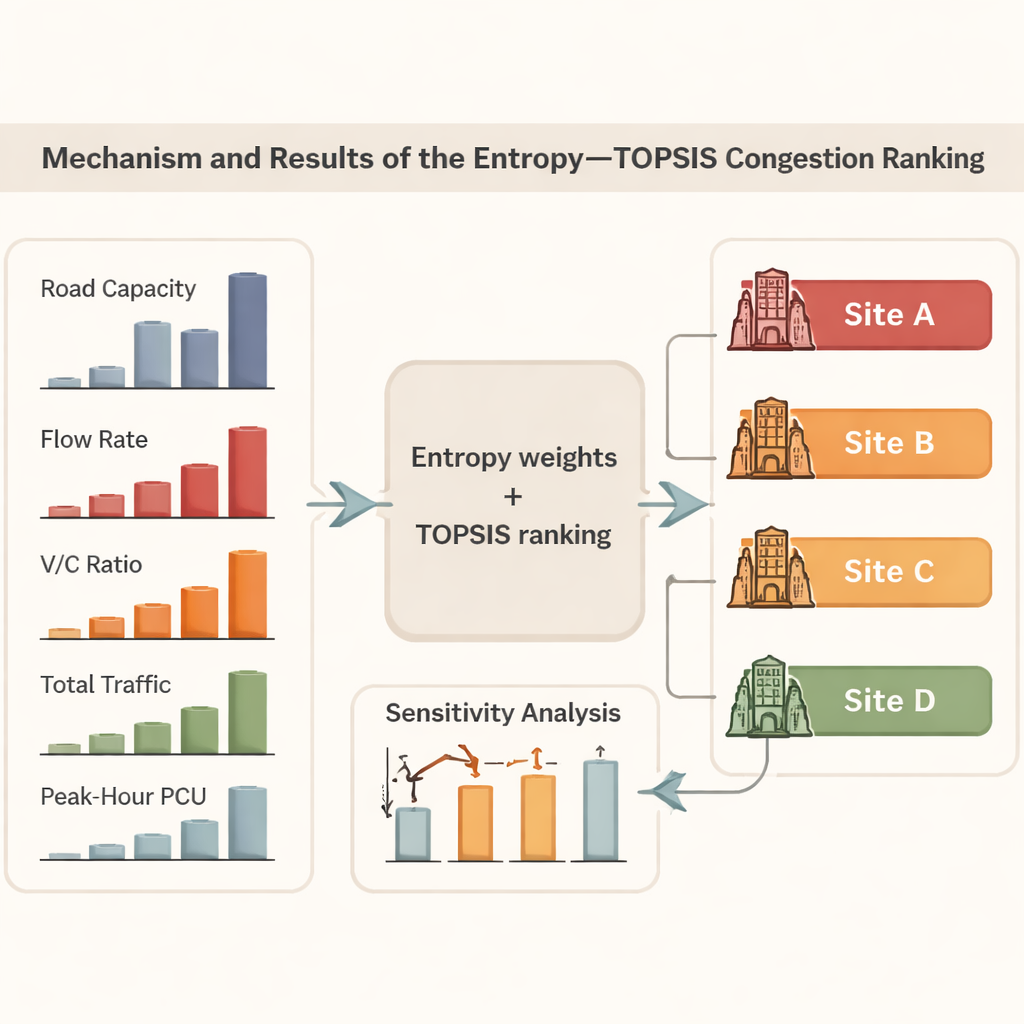
Rather than relying on opinion to decide which location deserves attention first, the authors used a pair of mathematical tools borrowed from decision science: Shannon entropy and TOPSIS. In simple terms, these methods weigh multiple clues—such as how full the road is, how heavy the total traffic volume is, and how far conditions are from ideal—and combine them into a single score for each site. This approach reduces personal bias and lets the data “speak” for themselves. The analysis showed that total traffic and the ratio of flow to capacity are the most telling indicators of serious congestion.
What the rankings reveal about Peshawar’s traffic
When the numbers were run, the Amin Hotel area emerged as the clear front‑runner for gridlock, with a closeness score indicating that it is much closer to a worst‑case scenario than to free‑flowing traffic. PC Hotel and Jalil Kabab House also suffer severe overload, while Army Stadium, though still congested, performs slightly better. The study links these jams to specific, visible problems: narrowed carriageways caused by the city’s bus rapid transit line, a shortage of formal parking that pushes vehicles onto the roadway, missing lane markings and signs, poorly placed police checkpoints, uneven road surfaces, and fixed obstacles such as electric poles.
Practical steps to get traffic moving again
To a non‑specialist, the takeaway is straightforward: these jams are not inevitable, and targeted, fairly simple measures could make a noticeable difference. The authors recommend stricter enforcement of parking and lane rules, clearer markings and modern signals, relocation of checkpoints away from narrow sections, regular maintenance of road surfaces and drainage, and, where possible, widening lanes to safer widths. Their calculations suggest that such changes could cut the most extreme congestion at the worst hotspot by roughly a quarter. Just as important, the combined use of GIS mapping and data‑driven ranking offers a reusable playbook that other growing cities in Pakistan and beyond can adopt to tackle their own traffic headaches more efficiently.
Citation: Hussain, D., Jamal, A., Farooq, A. et al. Evaluation of traffic congestion mitigation techniques using an entropy-TOPSIS integrated method. Sci Rep 16, 5036 (2026). https://doi.org/10.1038/s41598-026-35814-w
Keywords: traffic congestion, urban mobility, Peshawar, GIS analysis, transport planning