Clear Sky Science · en
Marine heatwaves are transforming Western mediterranean marine ecosystems
Why hotter seas matter close to home
Beachgoers and seafood lovers may not notice it on a single summer day, but the Western Mediterranean Sea is quietly experiencing more and more marine heatwaves—periods when ocean temperatures stay far above normal for days to weeks. This study looks beyond individual species to ask a bigger question: how are these recurring bursts of extreme heat reshaping the entire marine food web, from tiny plankton to top predators, and what does that mean for fisheries and coastal communities?
Heatwaves beneath the waves
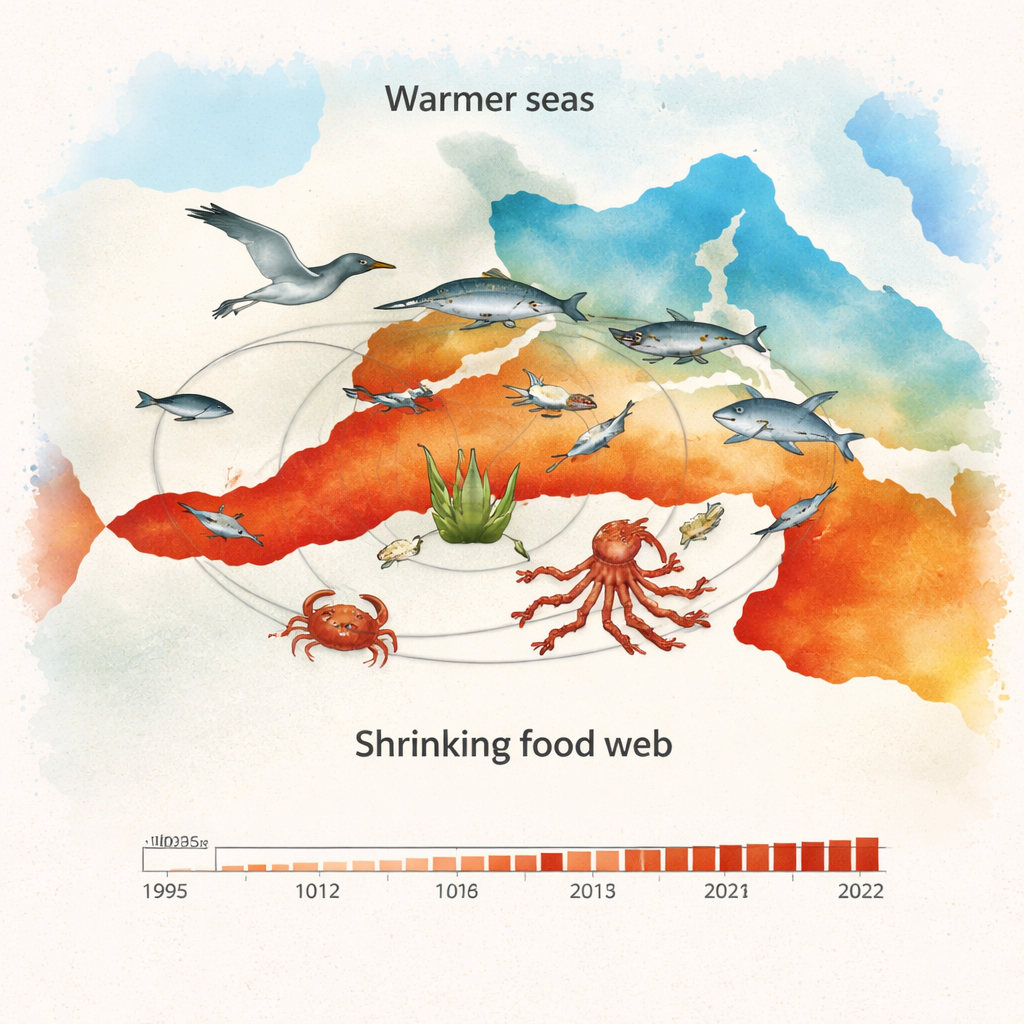
Marine heatwaves are not just warm afternoons at the surface. By analyzing detailed ocean reanalysis data from 1995 to 2022, the authors show that in the Western Mediterranean these events have become more frequent, more intense, and deeper over time. After a landmark heatwave in 2003, years in which more than 60% of the sea surface was affected became increasingly common. Since about 2016, the heat has penetrated down to mid‑water and near the seafloor, with some years seeing more than 40% of the basin experiencing heatwaves at depth. The southern areas of the basin, such as the Alboran and Algerian seas, have consistently been warmer than the north during these events, setting the stage for uneven ecological impacts.
A virtual Mediterranean in a computer
To understand how this changing thermal landscape affects marine life, the researchers used an ecosystem modeling framework called Ecopath with Ecosim. Instead of tracking a few famous species, the model represents 93 functional groups—bundled into 11 categories including plankton, benthic producers like seagrasses and algae, fish, seabirds, sharks and rays, and top predators. For each group, the model links feeding, growth, and movement to temperature at different depths. Crucially, the team ran two versions of the model: one that included all recorded marine heatwaves on top of long‑term ocean warming and fishing, and a “control” version where the same warming and fishing pressures were applied but the short, sharp heatwaves were mathematically removed. Comparing these two virtual futures reveals what heatwaves themselves contribute, beyond the slow background warming.
Food webs under pressure
The simulations show that most components of the Western Mediterranean food web have been declining in biomass over recent decades due to long‑term warming and fishing. When marine heatwaves are added, these declines become steeper. Benthic producers—habitat‑forming plants and algae on the seafloor—stand out as the most consistently and strongly affected group, with negative trends exceeding 15% along much of the coastline. Commercially valuable species, including pelagic and demersal fish and invertebrates, also suffer, leading to modeled catch reductions of more than 10% across the basin and more than 5% in particularly hard‑hit southern areas. Early‑responding plankton groups show rapid swings in abundance after heatwaves, while large, slow‑growing predators react more gradually over several years, reflecting their longer life cycles.
A tale of two Mediterraneans
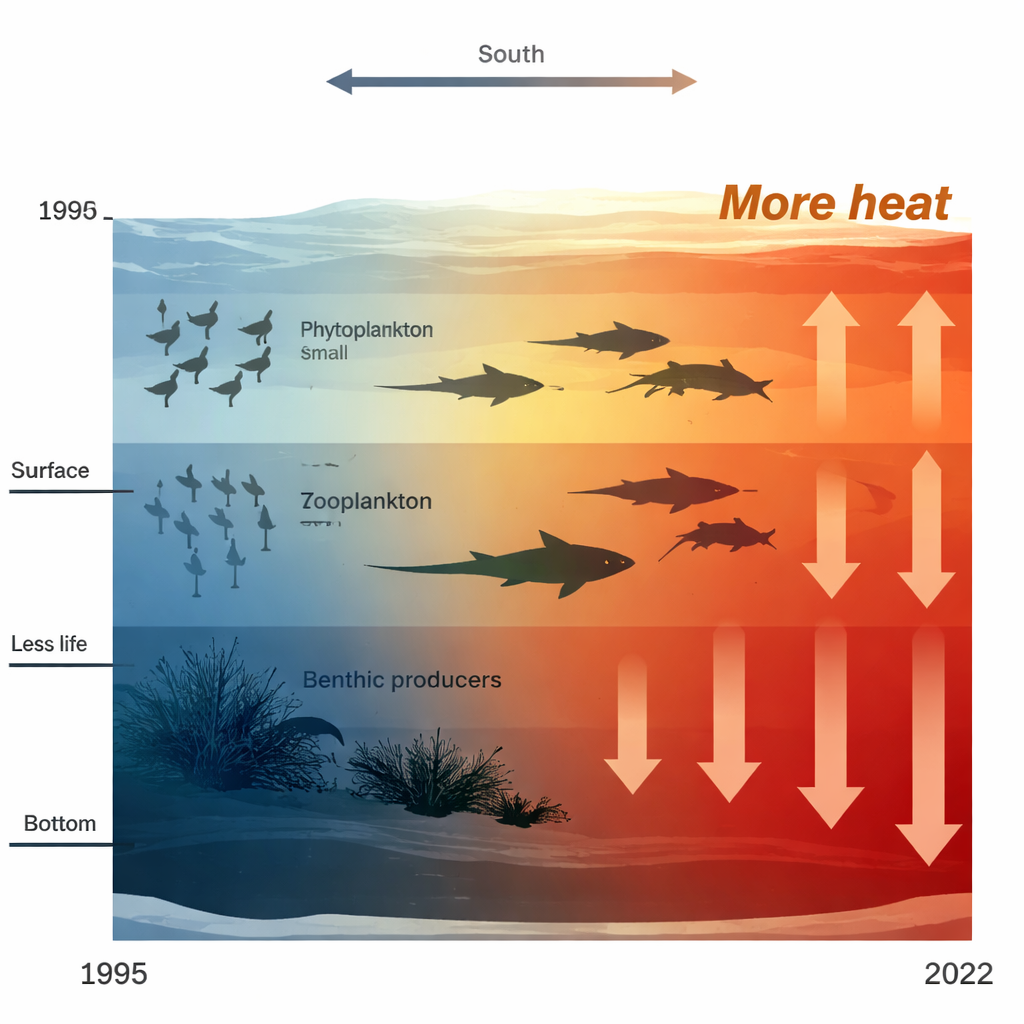
One of the most striking findings is a north–south split in how the ecosystem responds. In the northern regions—such as the Gulf of Lion, Corsica, and parts of the Tyrrhenian Sea—marine heatwaves sometimes produce neutral or even slightly positive changes in biomass for several groups. In contrast, the southern zones, especially the Alboran and Algerian seas, show strong and increasingly negative responses over time. By the late 2010s and early 2020s, top predators, seabirds, and sharks and rays in these southern areas experience marked declines. This “dipole” pattern reflects the underlying temperature gradient: species near the warm edge of their comfort zone in the south are pushed beyond their limits by additional heatwaves, while those in the cooler north may initially cope better—though recent extreme years suggest this buffer could soon erode.
What this means for people and the future
For non‑specialists, the takeaway is clear: marine heatwaves are not isolated curiosities but powerful drivers of change layered on top of long‑term warming and fishing. By shrinking seafloor habitats, stressing commercial species, and nudging the food web toward lower overall biomass, they threaten the resilience of a sea that supports jobs, food, and recreation for millions. The study also highlights species and regions whose vulnerability had not been fully recognized, underscoring the value of whole‑ecosystem models for guiding adaptive management. As heatwaves continue to grow in intensity, size, and depth, the Western Mediterranean is likely to see even larger ecological and economic impacts unless climate action and ecosystem‑based management keep pace.
Citation: Artana, C., Kaplan, A., Ramírez, F. et al. Marine heatwaves are transforming Western mediterranean marine ecosystems. Sci Rep 16, 5843 (2026). https://doi.org/10.1038/s41598-026-35813-x
Keywords: marine heatwaves, Mediterranean Sea, marine ecosystems, fisheries impacts, climate change