Clear Sky Science · en
Dynamic modelling and experimental validation of involute gears based on multi-damage evolution mechanisms
Why the health of gears matters
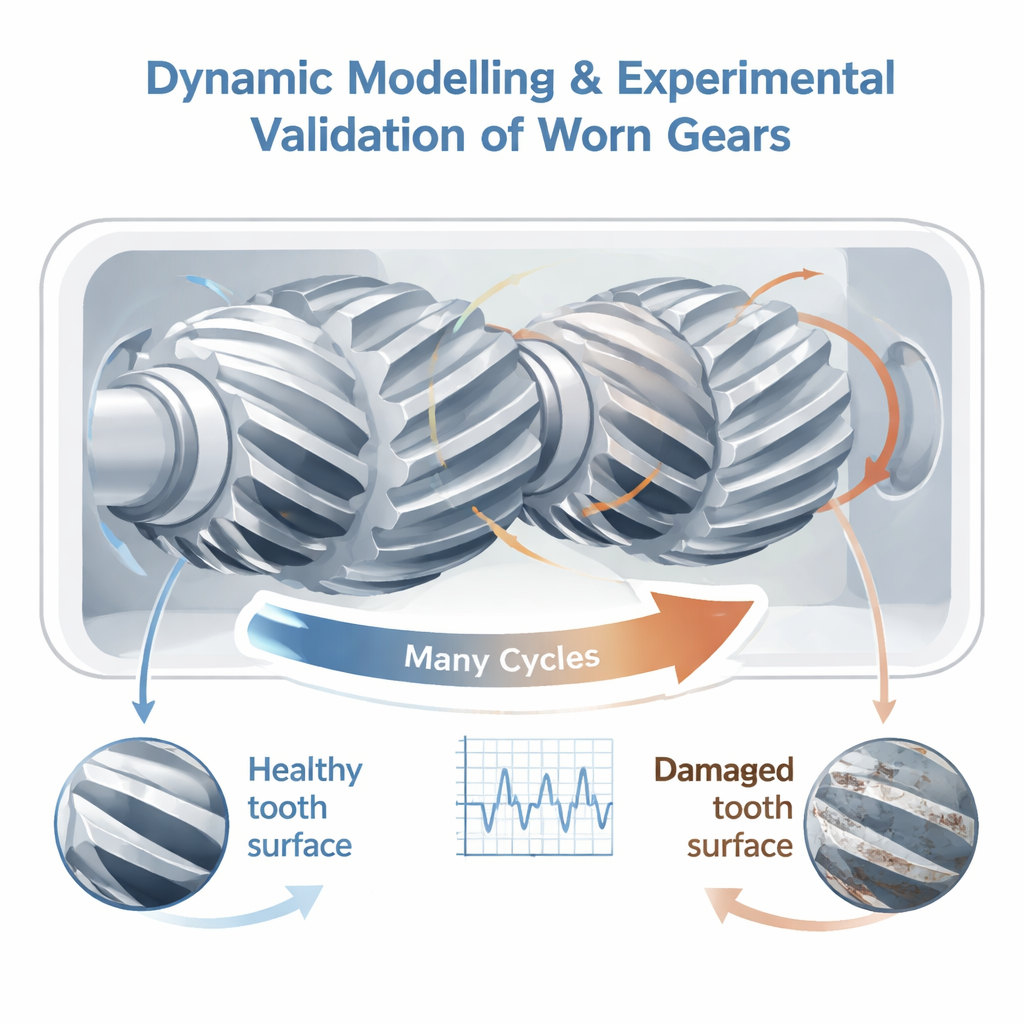
From car gearboxes to wind turbines and aircraft engines, gears quietly keep modern technology turning. But as these metal teeth grind through millions of cycles, their surfaces slowly wear, pit, and crack. That damage changes how gears vibrate, how noisy they are, and how close they are to failure. This study develops a new way to model and measure those changes so that engineers can spot trouble earlier, design more durable gear sets, and avoid costly breakdowns.
How gear teeth get tired
Gear teeth are designed to roll smoothly against each other, but in reality most of the contact area slips slightly. Under heavy loads, this repeated sliding plows and tears tiny bits of metal from the surface. Over time, shallow hollows form and grow, a process called pitting. The authors combine classic wear laws with a mathematical description of rough surfaces to predict how deep the wear will be at each contact point and how roughness evolves over many millions of revolutions. They also treat pits as randomly distributed damage zones whose size and density increase from light to severe damage, closely mimicking what is seen under the microscope.
From damaged teeth to changing stiffness
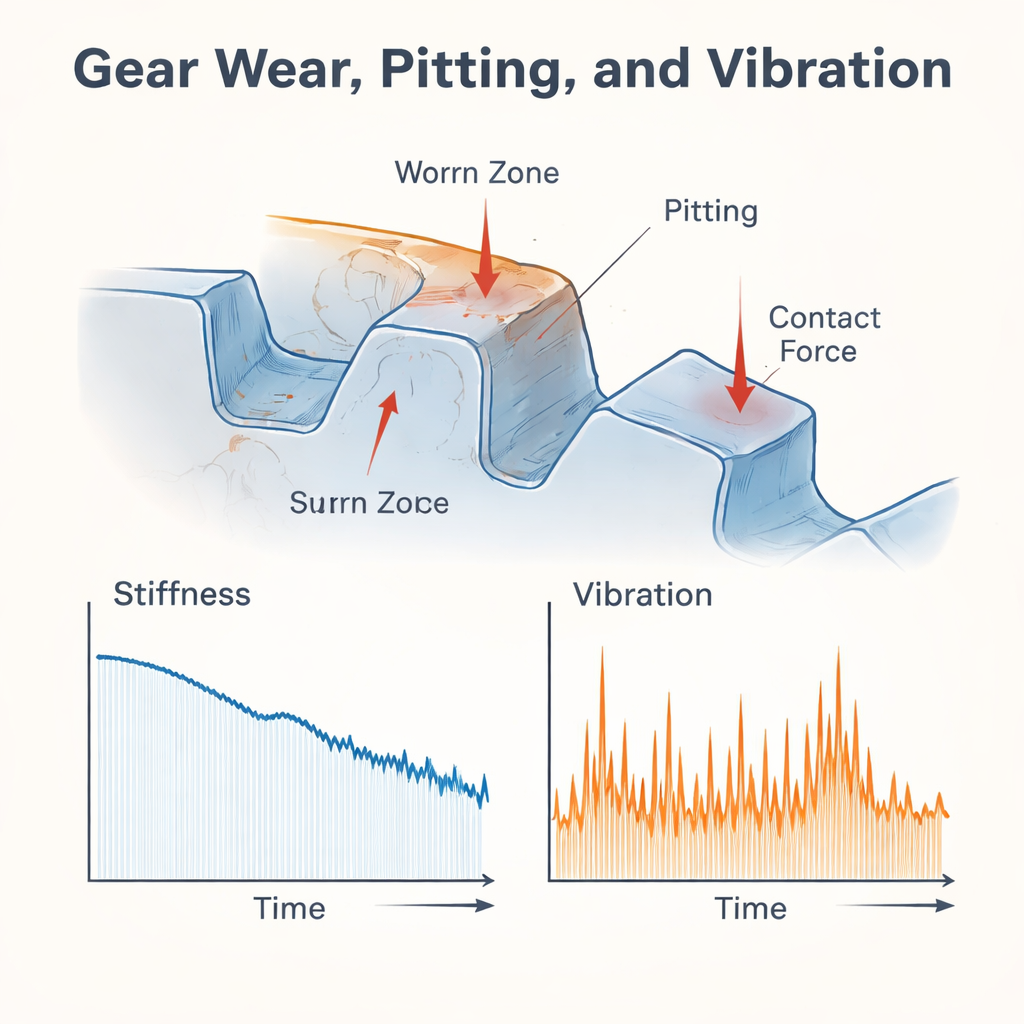
When metal is lost from a tooth, its shape, thickness, and contact area all change. That alters the tooth’s stiffness—its ability to resist bending and compression as it meshes with its partner gear. The researchers break each helical gear into many thin slices and calculate how contact stiffness, bending, shear, and axial compression contribute to the overall “mesh stiffness.” They include the effects of surface roughness, friction between the teeth, and the missing material in worn or pitted regions. As wear deepens and pits spread, the average stiffness drops and its fluctuations become larger, especially when the line of contact passes directly through a pitted zone.
Following vibrations as damage grows
Lower and more uneven stiffness changes how a gearbox vibrates. Using their stiffness results, the team builds a full dynamic model in which each gear can move, twist, and vibrate in several directions. They then solve the equations step by step on a computer. Starting from a healthy state, they track how the vibration signal changes as the gears progress through stages: initial wear, early pitting, moderate pitting, and finally severe damage. Time traces show growing vibration peaks; frequency plots reveal sidebands—small extra peaks—around the main meshing tone; and phase diagrams become increasingly tangled, signaling more complex, less stable motion.
Putting the model to the test
To see whether their theory matches reality, the authors run experiments on a test rig with a real helical gearbox. They measure vibration for both healthy gears and gears that have controlled wear and pitting. The recorded signals show the same key patterns predicted by the model: stronger vibration linked to each damaged tooth, and characteristic sidebands in the frequency spectrum. Compared with earlier models that treated only pitting or assumed ideal surfaces, the new approach reproduces the measured vibration more accurately, because it captures the combined effect of wear, pits, friction, and changing tooth clearance.
What this means for machines
In everyday terms, the study shows how tiny scars on gear teeth gradually turn a smooth-running gearbox into a noisier, more erratic system on the verge of failure. By tying together surface damage, stiffness changes, and vibration signatures in one validated model, the work provides a stronger foundation for condition monitoring and fault diagnosis. Engineers can use these insights to better interpret vibration data, schedule maintenance before damage becomes critical, and design gears that stay quieter and safer over their entire service life.
Citation: Mao, H., Ding, Y., Li, X. et al. Dynamic modelling and experimental validation of involute gears based on multi-damage evolution mechanisms. Sci Rep 16, 5212 (2026). https://doi.org/10.1038/s41598-026-35811-z
Keywords: gear wear, gearbox vibration, mechanical failure, condition monitoring, pitting damage