Clear Sky Science · en
Smart irrigation-based internet of things and cloud computing technologies for sustainable farming
Why Smarter Watering Matters
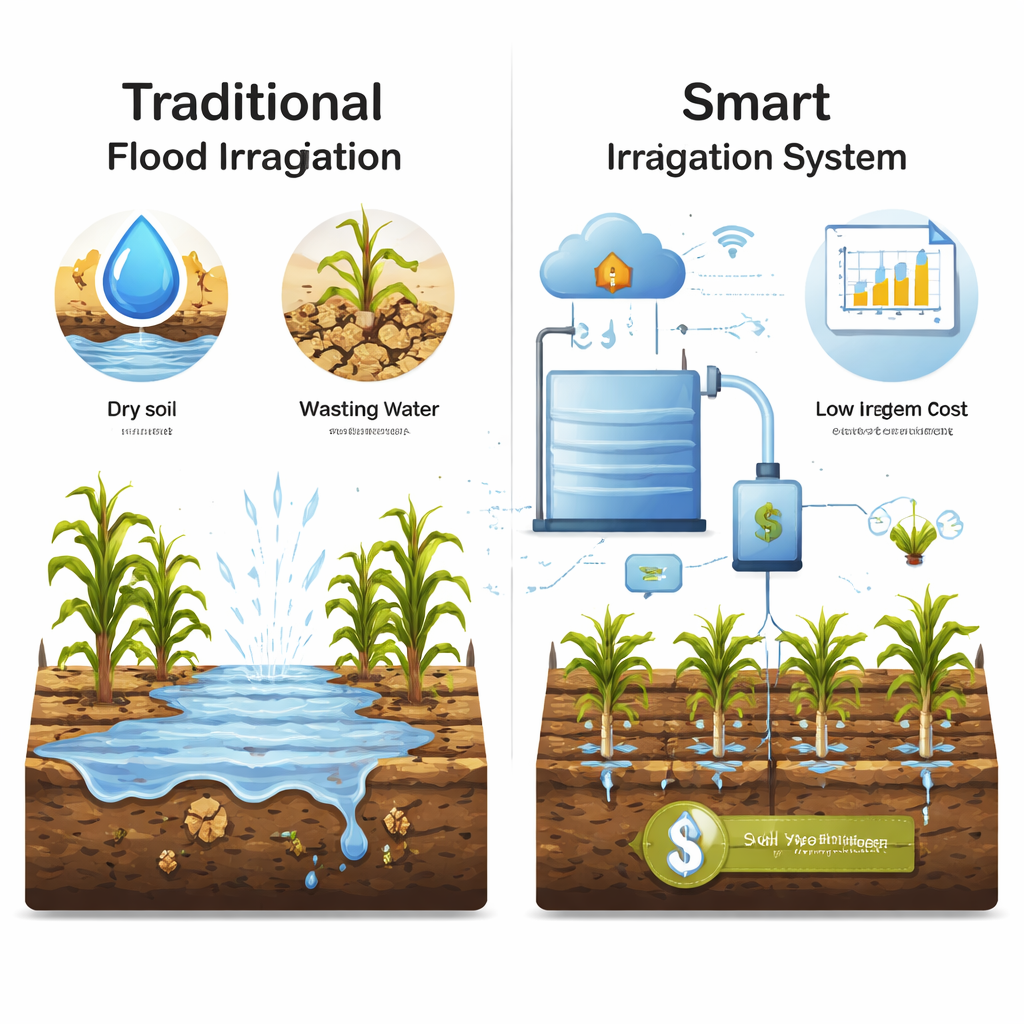
Across the world, farmers are being squeezed by two forces: growing demand for food and shrinking supplies of freshwater. In many dry regions, including parts of North Africa, traditional irrigation methods let water run freely over fields, often soaking some areas while leaving others dry. This wastes a resource that is increasingly precious under climate change. The article describes a low-cost, smart irrigation system that uses simple electronics and cloud computing to give plants just the water they need—no more, no less—helping farmers save water, stabilize yields, and cope with a hotter, drier future.
From Thirsty Fields to Connected Farms
Conventional irrigation can be surprisingly blunt. Water is delivered on fixed schedules, even if the soil is already wet or the tank is nearly empty. The authors focus on a typical rain-fed farming area in Morocco, where hilly terrain and erratic rainfall make water management especially difficult. Their goal is to replace guesswork with measurement. By placing sensors in the field and linking them to an internet-connected controller, they turn a plot of land into a monitored system where temperature, air humidity, soil moisture, and water level in the storage tank are tracked in real time. This information becomes the basis for every watering decision instead of relying on habit or visual inspection alone.
How the Smart Watering System Works
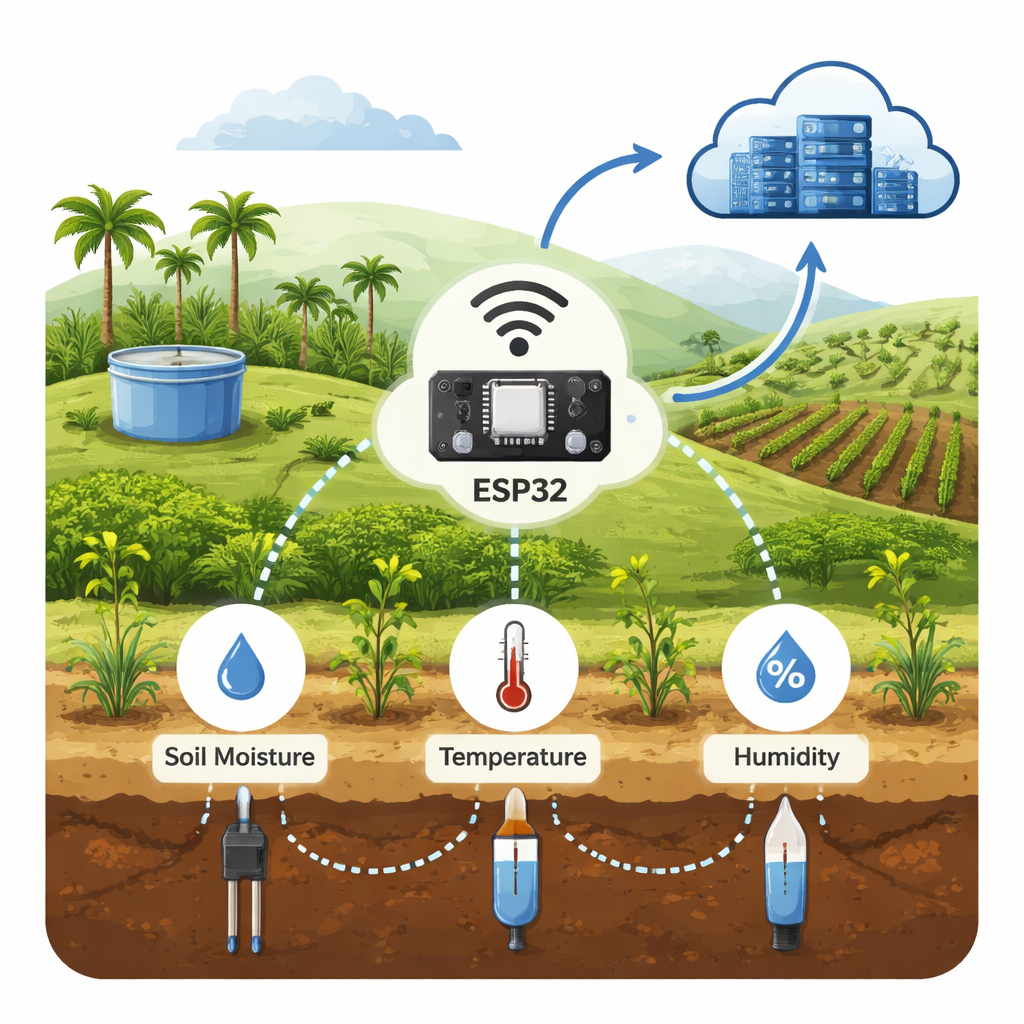
The heart of the setup is a small, inexpensive microcontroller called ESP32, which acts like the brain of the system. It collects data from several low-cost sensors: a probe that measures how wet the soil is, a device that records air temperature and humidity, and an ultrasonic sensor that checks how much water is left in the tank. The ESP32 cleans and converts these raw readings into clear values, then sends them over Wi‑Fi to an online platform called ThingsBoard. There, the data are stored and displayed on dashboards that farmers can access from a phone or computer. At the same time, simple rules decide when to switch the pump on or off—for example, start watering when soil moisture falls below a chosen level and the tank still has enough water.
Fast Decisions, Flexible Use
The system is designed to react quickly to changing conditions, with new sensor readings sent roughly every two seconds. If the soil dries out below about 45% moisture while the tank is at more than 10% capacity, the pump turns on automatically; once the soil is moist again, it switches off. To avoid mistakes from noisy or faulty readings, the controller averages several measurements and checks that they agree before acting. All values and actions are logged in the cloud, letting farmers review how their fields behaved over hours, days, or weeks. Because the moisture thresholds and other settings can be adjusted in software, the same hardware can be tailored to different crops, soil types, and climates, from sandy arid plots to heavier temperate soils, without redesigning the electronics.
Real-World Performance and Cost
Field tests showed that the system keeps soil moisture comfortably above stress levels while using water more carefully than traditional methods. Temperature and air humidity remained stable, and the water tank never dropped below safe limits, indicating reliable sensor readings and control. Data sent to the cloud matched local measurements, confirming that the communication link was robust even with frequent updates. Perhaps most striking for farmers is the price: the complete prototype—including ESP32 board, sensors, pump relay, basic pump, power supply, and cabling—costs about $44. Because the cloud platform offers a free tier, there are no added software fees. This low entry cost makes the approach realistic for small and medium-sized farms that cannot afford complex commercial systems.
What This Means for Everyday Farming
For non-specialists, the message is straightforward: by combining simple sensors, an affordable controller, and an online dashboard, farmers can let their fields "tell" them when they need water. Instead of watering on a fixed schedule, irrigation follows the actual needs of the plants and the soil, reducing waste and protecting yields in times of scarcity. The study shows that such a system can be built and operated cheaply, scaled to larger areas, and adapted to different crops. In a warming world where every drop counts, smart irrigation of this kind offers a practical path toward more resilient, water‑wise agriculture and improved food security.
Citation: Morchid, A., Qjidaa, H., Alami, R.E. et al. Smart irrigation-based internet of things and cloud computing technologies for sustainable farming. Sci Rep 16, 5293 (2026). https://doi.org/10.1038/s41598-026-35810-0
Keywords: smart irrigation, IoT agriculture, water scarcity, precision farming, cloud-based monitoring