Clear Sky Science · en
Multi-factorial profiling of athletes integrating personality, psychological skills, and Psychophysiological performance indicators
Why some athletes shine under pressure
Why do certain athletes seem calm, fast, and accurate in the tensest moments, while others tighten up or fade? This study looks beyond simple ideas like “talent” or “mental toughness” and shows that performance grows out of a mix of personality, trainable mental skills, and how the body and brain react under stress. By measuring all three at once, the researchers reveal four distinct “types” of competitors—and explain how coaches can tailor training so that very different athletes can all reach their best.
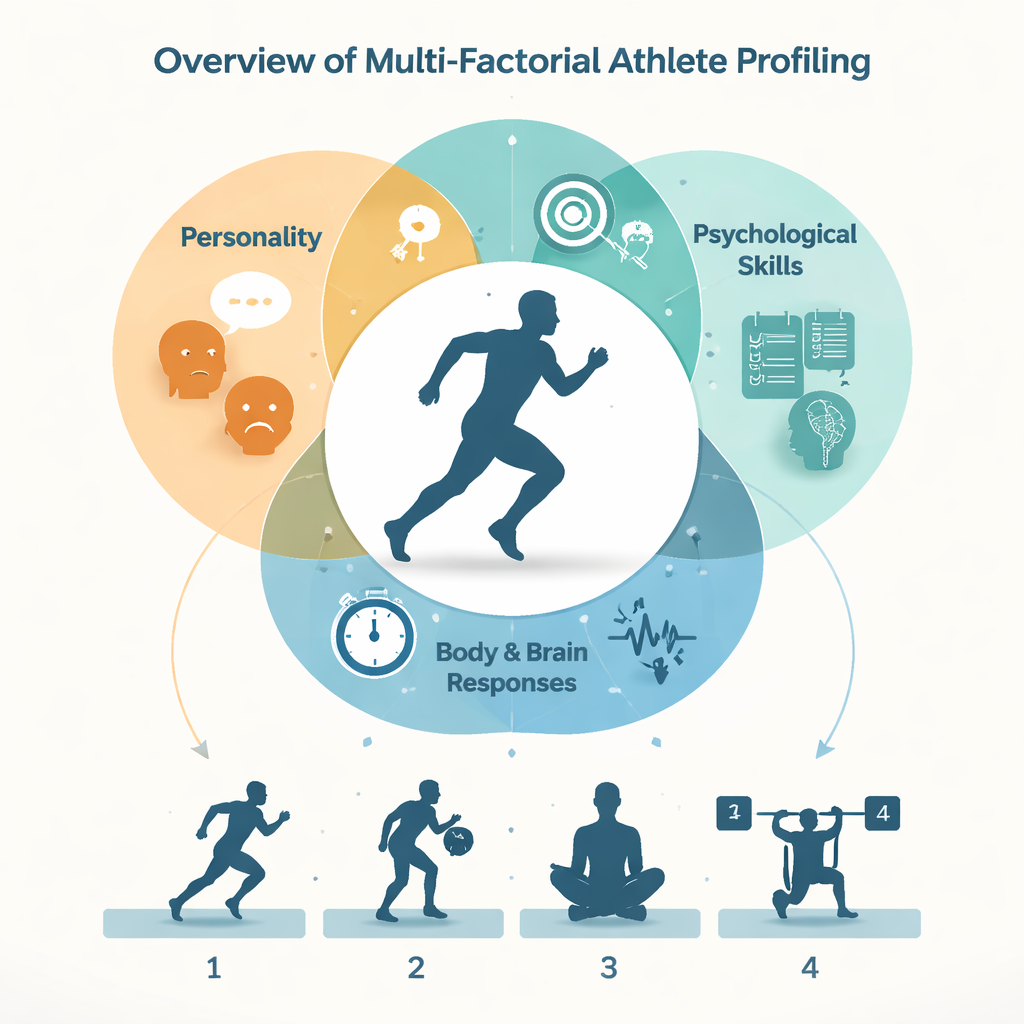
Looking at the whole athlete, not just one side
Sports science has often studied athletes in slices: one project focuses on personality, another on motivation, another on reaction time or fitness. That has produced mixed and sometimes contradictory findings. This study instead treats athletes as complex systems. The team tested 304 young Latvian competitors from many sports—team and individual, elite, rising, and amateur. Each athlete completed personality questionnaires, a survey of mental skills such as confidence, motivation, teamwork, and visualization, and a series of computerized lab tasks that measure real-time performance under pressure: reaction speed, accuracy, error control, stress tolerance, and how consistently they can perform when demands change rapidly.
What was measured inside and outside the lab
On the psychological side, the researchers focused on broad traits like emotional stability, sociability, curiosity, self-discipline, and modesty, along with sport-specific skills such as self-belief, drive, and comfort working with teammates. On the psychophysiological side, athletes took standardized tests used in high-stakes settings like aviation. These tasks probed how quickly and accurately they respond to flashing lights and sounds, how well they stay precise when time pressure rises, how impulsive or cautious they are, and how much their performance drops—or does not—after mistakes or frustration. All these results were turned into comparable scores so that patterns across dozens of measures could be viewed “in one picture.”
Team players, solo performers, and four distinct profiles
The data showed that sport context matters. Team-sport athletes were generally more motivated, more focused on cooperation, and faster in their physical responses. Individual-sport athletes tended to be more open to new experiences and reported slightly higher confidence, but not always greater drive. Elite competitors, compared with pre-elite and amateur peers, most clearly stood out in their mindset: they were more confident, more decisive, and aimed higher, even though their raw reaction speeds were not always faster. When the researchers grouped athletes by their combined scores, four clear profiles emerged. One group, called “Stable High-Performance Athletes,” combined emotional steadiness with strong stress tolerance and fast, decisive action. A second, “Controlled Precision Athletes,” favored careful, accurate execution and strict self-control but could struggle when situations changed suddenly. A third, “Low-Regulation Reactive Athletes,” showed more mood swings, lower stress tolerance, and slower, less consistent responses. The fourth, “Reactive High-Speed Athletes,” were strikingly fast and resilient but relied heavily on instinct, leaving room for decision errors under long or chaotic pressure.
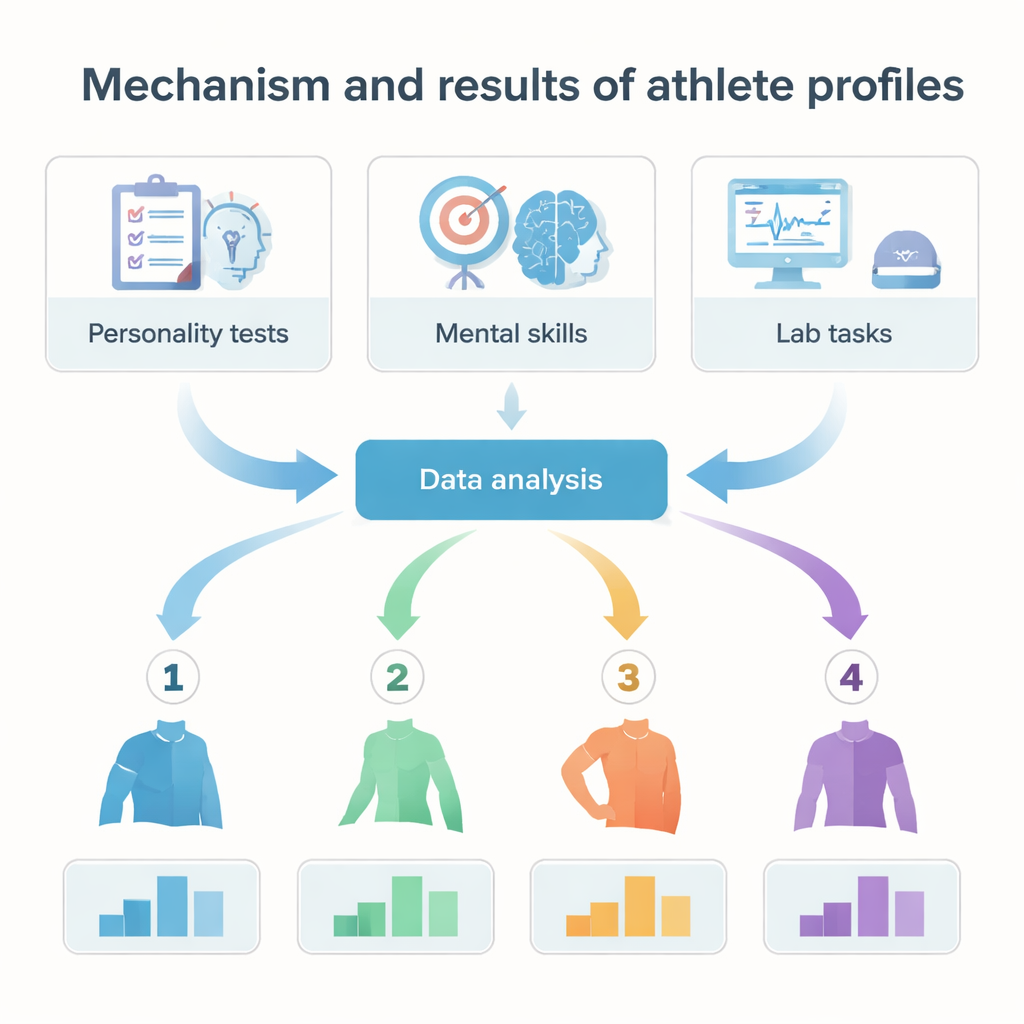
Checking the profiles against real-world experience
To see if these four types were more than statistical curiosities, the researchers asked nine experienced sport psychologists and psychological preparation coaches to review narrative descriptions of each profile. Most experts immediately recognized all four as types they regularly encounter in training halls, locker rooms, and competitions. They linked the “stable high-performers” to team leaders who stay calm in crunch time, the “controlled precision” athletes to hard-working planners who dislike surprises, the “low-regulation” group to younger or less experienced competitors whose performance swings with their emotions, and the “high-speed reactors” to explosive, energetic players whose strengths can turn into impulsive mistakes. Experts also outlined profile-specific mental training suggestions, from building emotional regulation and self-talk routines to teaching over-controlled athletes to let go and trust their skills.
What this means for athletes and coaches
For non-specialists, the key message is that there is no single “champion personality.” High performance can emerge from different mixes of traits, mental habits, and bodily responses. By mapping these together, this study offers a practical framework: coaches and support staff can identify an athlete’s profile, then choose fitting approaches—such as stress-management training for emotionally reactive competitors, adaptability drills for cautious perfectionists, or impulse control work for ultra-fast responders. Rather than labeling athletes as simply “mentally strong” or “weak,” the findings encourage viewing each person as a unique pattern of strengths and risks that can be developed over time.
Citation: Volgemute, K., Ulme, G., Abele, A. et al. Multi-factorial profiling of athletes integrating personality, psychological skills, and Psychophysiological performance indicators. Sci Rep 16, 4949 (2026). https://doi.org/10.1038/s41598-026-35809-7
Keywords: athlete profiling, sports psychology, mental skills training, stress and performance, elite athletes