Clear Sky Science · en
Significant efficiency of Ti-MOF and Ag-NPs in antiviral effect in PVY-tobacco pathosystem
Why tiny particles could protect future harvests
Farmers worldwide lose huge portions of their crops to plant viruses that are almost impossible to control once they take hold. This study explores a cutting‑edge idea: using ultra‑small particles of metals—nanoparticles—to help tobacco plants fend off Potato virus Y, a major pathogen of potatoes, peppers, and tobacco. By comparing titanium‑based and silver nanoparticles, the researchers show how the right kind of nano‑treatment can sharply reduce virus levels without harming the plants, hinting at a new generation of virus‑smart crop protectants.
Invisible enemies in the field
Plant viruses spread silently, carried by insects, tools, or infected seed, and current control methods mostly rely on avoiding infection altogether. Breeding resistant crop varieties helps, but viruses evolve quickly. Over the past decade, scientists have begun testing nanoparticles—extremely small particles measured in billionths of a meter—as tools to detect, block, or weaken plant diseases. Metal nanoparticles such as silver and titanium dioxide can interact closely with cells and microbes, and early work suggested they might either damage viruses directly or switch on the plant’s own immune system. Yet, how they behave inside real plants, and which types work best, has remained unclear.
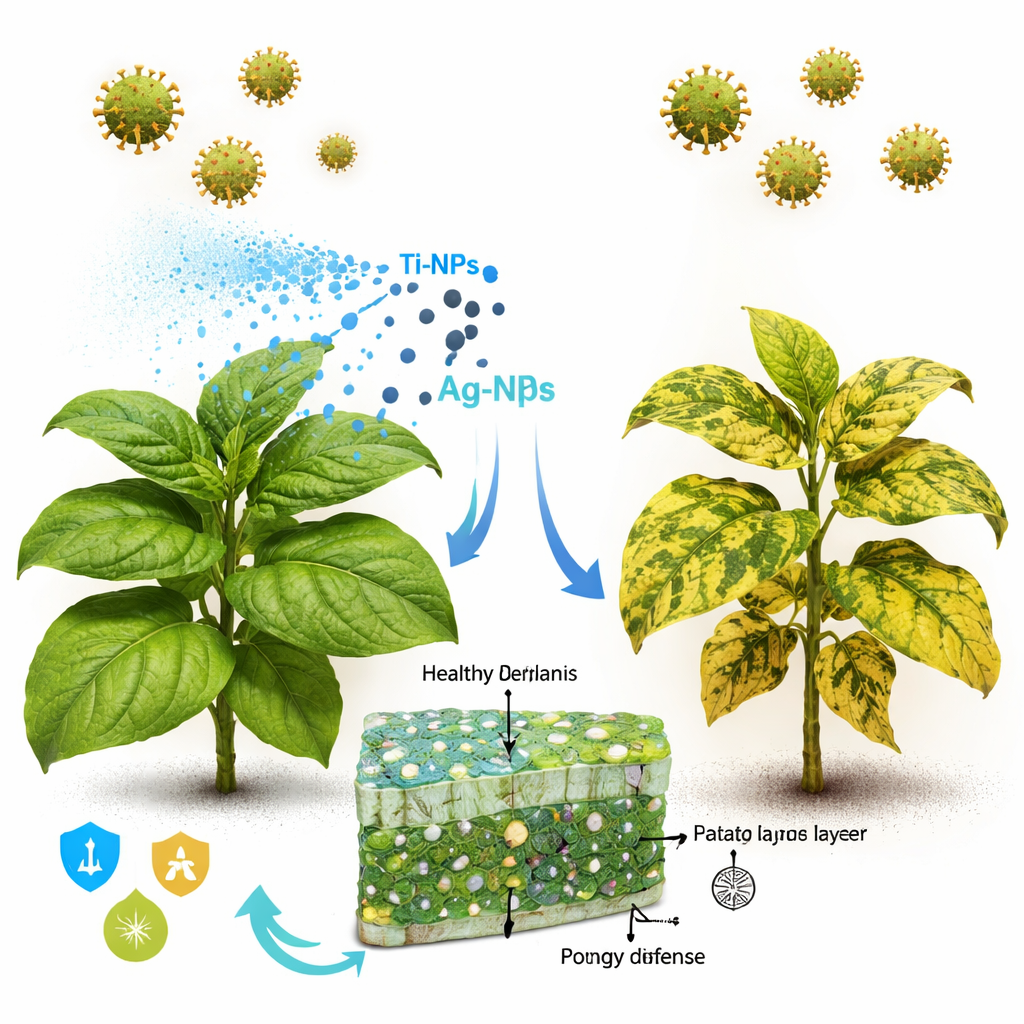
Spraying leaves with smart metal particles
The team worked with tobacco plants that are highly vulnerable to a severe strain of Potato virus Y (PVYNTN). They sprayed the leaves with two kinds of nanoparticles: conventional silver particles and much smaller titanium particles released from a special porous material called a metal–organic framework (Ti‑MOF). Plants were treated twice, several days before being rubbed with virus‑carrying sap. First, the researchers checked safety. High doses (100 parts per million) of either material damaged leaves, but lower doses (25 and 50 parts per million) did not and even reduced signs of stress. These safe doses were then used to test antiviral power.
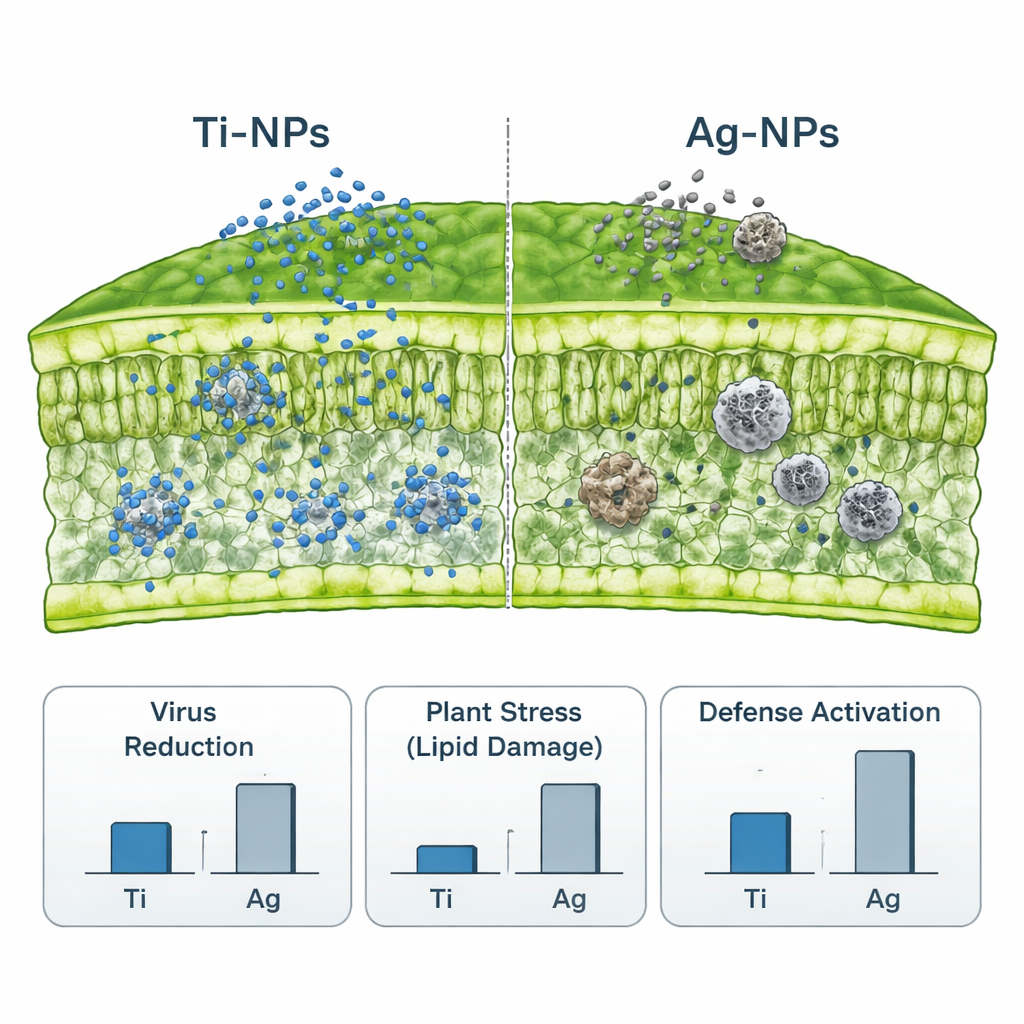
When the plants were later analyzed, both silver and titanium treatments greatly lowered the amount of virus compared with untreated plants, and visible disease symptoms were essentially absent. The 50‑part‑per‑million titanium treatment was the standout: it cut the virus’s genetic signal far more than silver did at the same dose. Microscopy and laser‑based measurements revealed why. Silver particles tended to remain near the leaf surface, while the smaller titanium particles moved more deeply into the inner leaf tissues, where the virus normally multiplies and travels.
How titanium outperformed silver
To see how closely the nanoparticles and virus interacted, the scientists mixed purified PVY particles with each material in the lab and examined them under an electron microscope. Only the titanium nanoparticles were seen clinging directly to virus particles, often breaking them into fragments; silver did not produce this shattering effect. Inside treated leaves, detailed imaging showed that untreated plants were packed with virus particles and characteristic viral inclusion structures. In contrast, silver‑treated plants contained only occasional virus particles, mostly sequestered in cell storage compartments, and titanium‑treated plants showed no detectable virus structures at all, despite clear traces of titanium particles distributed through their cells.
Turning on the plant’s internal defenses
The nanoparticles did more than physically hinder the virus. They also acted as powerful triggers for the plant’s own defense chemistry. Treated plants accumulated higher levels of salicylic acid—a key immune signal also involved in aspirin’s action in humans—as well as protective molecules such as proline and phenolic compounds. Enzymes that help control damaging oxygen by‑products and build defensive barriers (SOD, PAL, PPO) became more active, especially after titanium treatment. At the genetic level, key defense genes that usually get suppressed by PVY were switched back on by both types of nanoparticles, while a gene linked to vulnerability was turned down. Overall, titanium nanoparticles from Ti‑MOF produced the strongest combination of virus reduction, stress relief, and immune activation.
What this means for crops and food security
To a non‑specialist, the message is straightforward: carefully designed metal nanoparticles can act like tiny bodyguards for plants. In this tobacco–PVY system, spraying leaves with moderate doses of titanium‑based nanoparticles before infection not only blocked the virus from spreading but also primed the plant’s built‑in alarm and repair systems, all without obvious toxicity. While much work remains—especially to confirm safety in the field, understand long‑term environmental effects, and adapt the approach to food crops—the study suggests that nano‑enabled sprays could one day help farmers protect yields from destructive plant viruses, adding a new tool alongside resistant varieties and good farming practices.
Citation: Otulak-Kozieł, K., Nasiłowska, B., Gohari, G. et al. Significant efficiency of Ti-MOF and Ag-NPs in antiviral effect in PVY-tobacco pathosystem. Sci Rep 16, 5162 (2026). https://doi.org/10.1038/s41598-026-35808-8
Keywords: plant virus control, nanoparticles, titanium MOF, Potato virus Y, tobacco immunity