Clear Sky Science · en
Demographic differences are associated with temporal variation in cardiac and electrodermal interpersonal synchrony
Why Our Bodies React to Who We Sit With
Imagine sitting down with two strangers. Before anyone speaks, your heart and skin are already responding to who is in the room. This study asks a deceptively simple question: when small groups include people who differ in gender, religion, or nationality, do their bodies still “move in sync” as easily—and does that change as they begin to work together? The answers reveal how hidden biological rhythms may help or hinder our ability to feel like a cohesive team in diverse settings such as classrooms, workplaces, and community groups.
How Our Bodies Fall Into Step
When people interact, their bodies often start to line up in subtle ways. Heartbeats speed up and slow down together, and tiny changes in skin sweat mirror one another. Scientists call this physiological synchrony, and it has been tied to feelings of connection, cooperation, and trust. But most past research looked at close pairs—romantic partners, parents and children, or long-time friends—who usually share many similarities. Much less is known about what happens in newly formed groups of near-strangers who differ in visible ways, such as gender or religious background, especially in the very first minutes of contact.
Putting New Groups to the Test
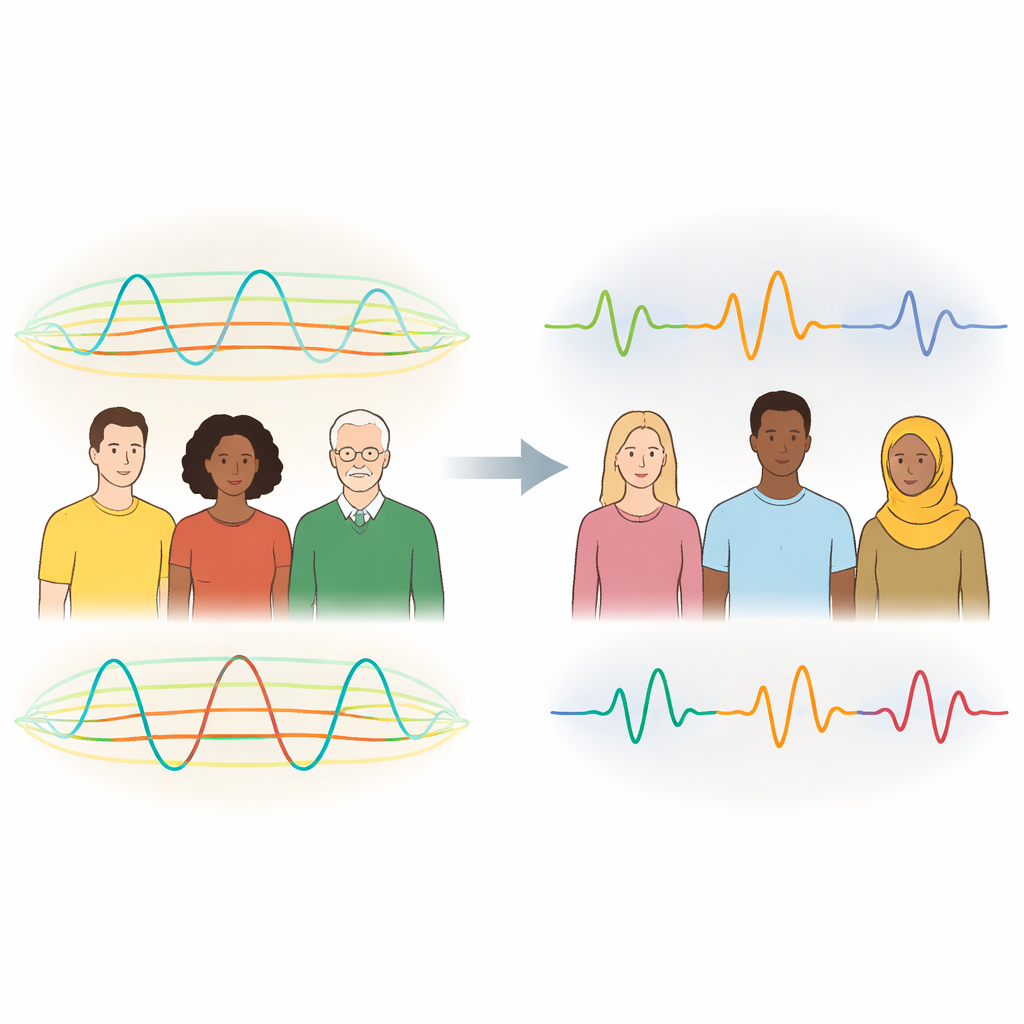
The researchers pooled data from three laboratory studies, bringing together 438 young adults into 146 three-person groups. These trios had varying mixes of men and women, religious and secular participants, and people from different national backgrounds within Israel. First, each group sat quietly together for five minutes without talking—just sharing the same space. Then they completed one of three short tasks: drumming along to a beat, working through a survival-themed decision-making game, or assembling words from shared letters. Throughout both the quiet and active phases, sensors recorded two signals: the time between heartbeats and changes in skin conductance, which reflect arousal or alertness. The scientists then calculated how tightly these signals rose and fell together across the three group members.
Hidden Tension Before Anyone Speaks
The findings show that differences between people shape their shared biology right from the start, before any real interaction begins. During the silent baseline phase, groups with more demographic differences had higher overall skin conductance, suggesting greater arousal or tension, but less alignment in those skin responses across members. In other words, mixed groups tended to be more “on edge,” yet their bodies were not reacting in unison. This pattern fits with the idea of intergroup anxiety—unease that arises simply from being near people seen as out-group members. At this early stage, that unease appears to be felt individually, not as a shared experience.
Heart Rhythms During Real Collaboration
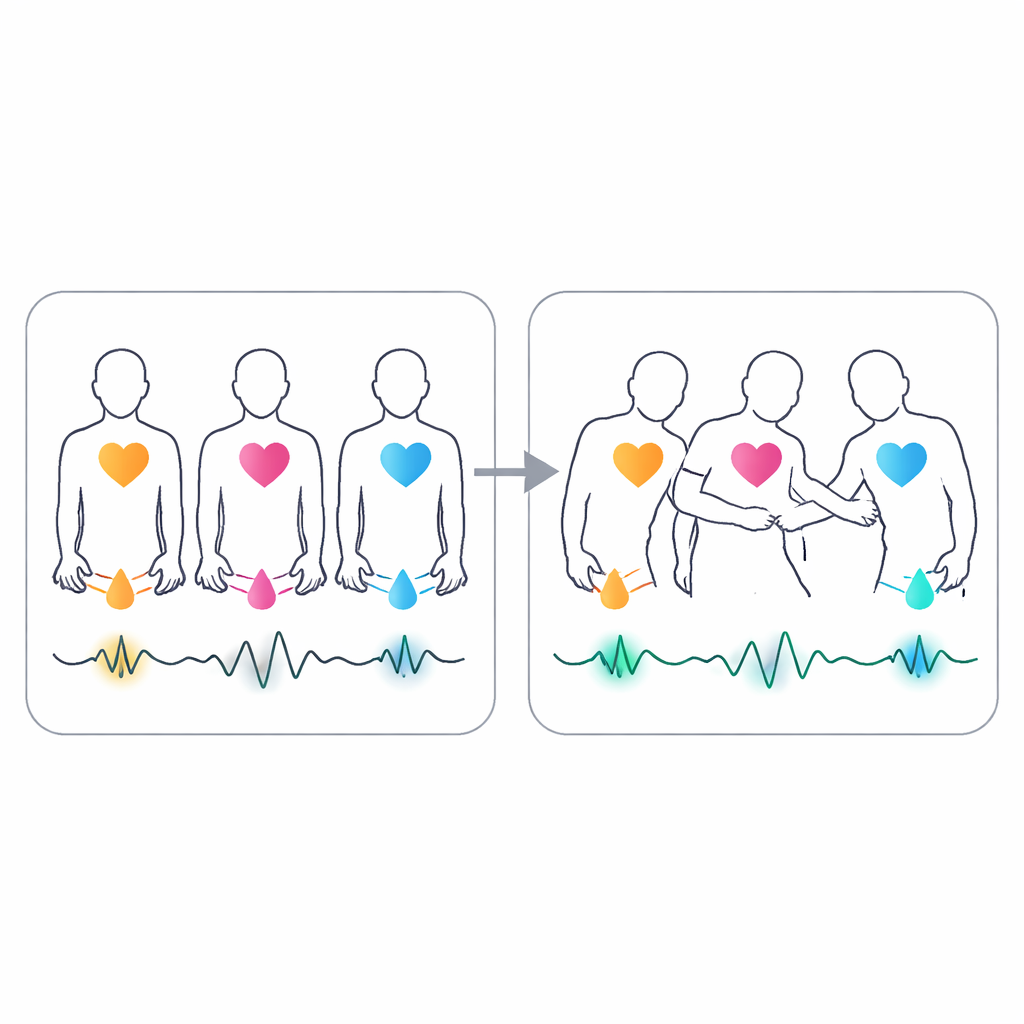
Once groups began working together, the picture shifted. Skin-based synchrony was no longer clearly tied to demographic differences. Instead, the key signal became the heart. Groups with more differences between members showed lower synchrony in the timing of their heartbeats while collaborating, even though, on average, real groups were still more synchronized than artificial “random” groupings of participants. Importantly, higher heart synchrony during the task was linked to stronger feelings of social inclusion afterward, while more demographic differences were linked to feeling less included. This suggests that, as soon as people must coordinate actions and decisions, the heart’s ability to fall into step across group members may serve as a biological marker of whether the group manages to overcome initial divides.
What This Means for Real-World Groups
The study shows that diversity does not simply “lower synchrony” in a uniform way. Instead, who we are shapes when and how our bodies line up with others. Visible differences seem to spark higher, but uncoordinated, arousal before conversation begins, while later, during active collaboration, those same differences are tied to less flexible alignment in heart rhythms and weaker feelings of belonging. These results highlight physiological synchrony as a sensitive window into the unfolding life of a group: from private tension in the first moments of contact to the coordinated engagement needed for effective teamwork. Understanding these subtle body-to-body dynamics may help educators, managers, and community leaders design settings and activities that support cohesion in diverse groups, allowing differences to become a strength rather than a barrier.
Citation: Ohayon, S., Erez, C. & Gordon, I. Demographic differences are associated with temporal variation in cardiac and electrodermal interpersonal synchrony. Sci Rep 16, 8824 (2026). https://doi.org/10.1038/s41598-026-35806-w
Keywords: physiological synchrony, group diversity, intergroup relations, heart rate and skin conductance, social cohesion