Clear Sky Science · en
Visual control of walking using terrain reconstructions
Why Watching Your Steps Matters
Anyone who has hiked a rocky trail knows that a single misplaced step can send you stumbling. Yet most of the time, we move over uneven ground without thinking about each footfall. This article explores how our eyes and brain quietly team up to guide every step we take on rough terrain, using new 3D imaging tools to reveal where we look and how that shapes where we land our feet.
Looking Ahead to Stay Upright
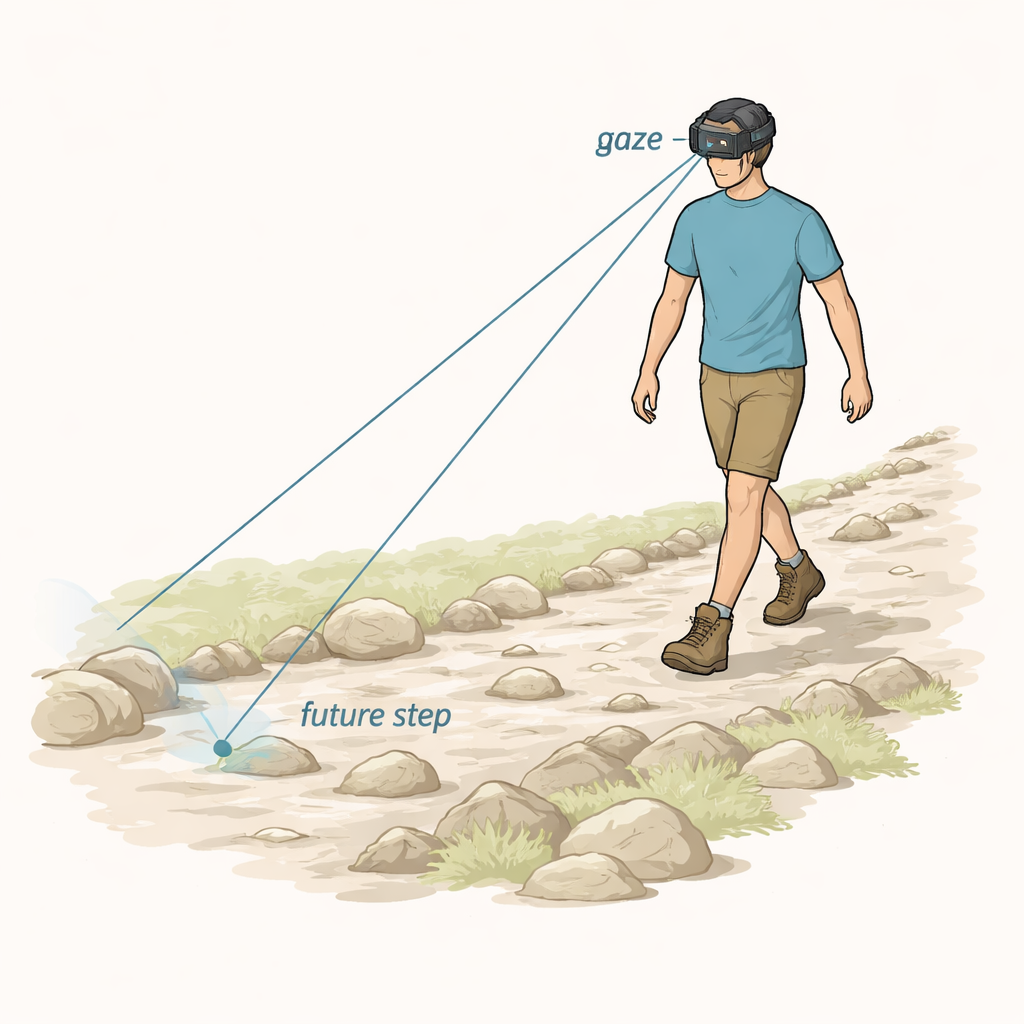
Walking in a lab on flat floors is relatively easy for scientists to study, but it hides the real challenge of everyday movement: outdoor paths full of rocks, dips, and bumps. In that kind of landscape, vision becomes crucial. Earlier studies showed that people tend to look a few steps ahead and adjust their speed and stride when the ground gets tricky. But because researchers had assumed the ground was flat, they could only roughly estimate where a person was actually looking relative to the real 3D surface. The new work tackles this gap by measuring not just eye and body movements, but also the detailed shape of the terrain itself.
Building a 3D Map From a Walker’s View
The researchers asked volunteers to walk along a hiking trail with sections labeled “medium” and “rough,” while wearing a head-mounted eye tracker and a motion-capture suit. The eye tracker recorded both where the eyes were pointing and a video of the scene ahead. Using a computer vision technique called photogrammetry, they turned these video frames into a textured 3D model of the ground, much like stitching many photos into a detailed digital landscape. They then aligned the walkers’ body positions, foot placements, and gaze directions with this reconstructed terrain, greatly reducing errors that come from assuming a flat surface or from drifting sensors.
Where We Look Relative to Our Next Steps
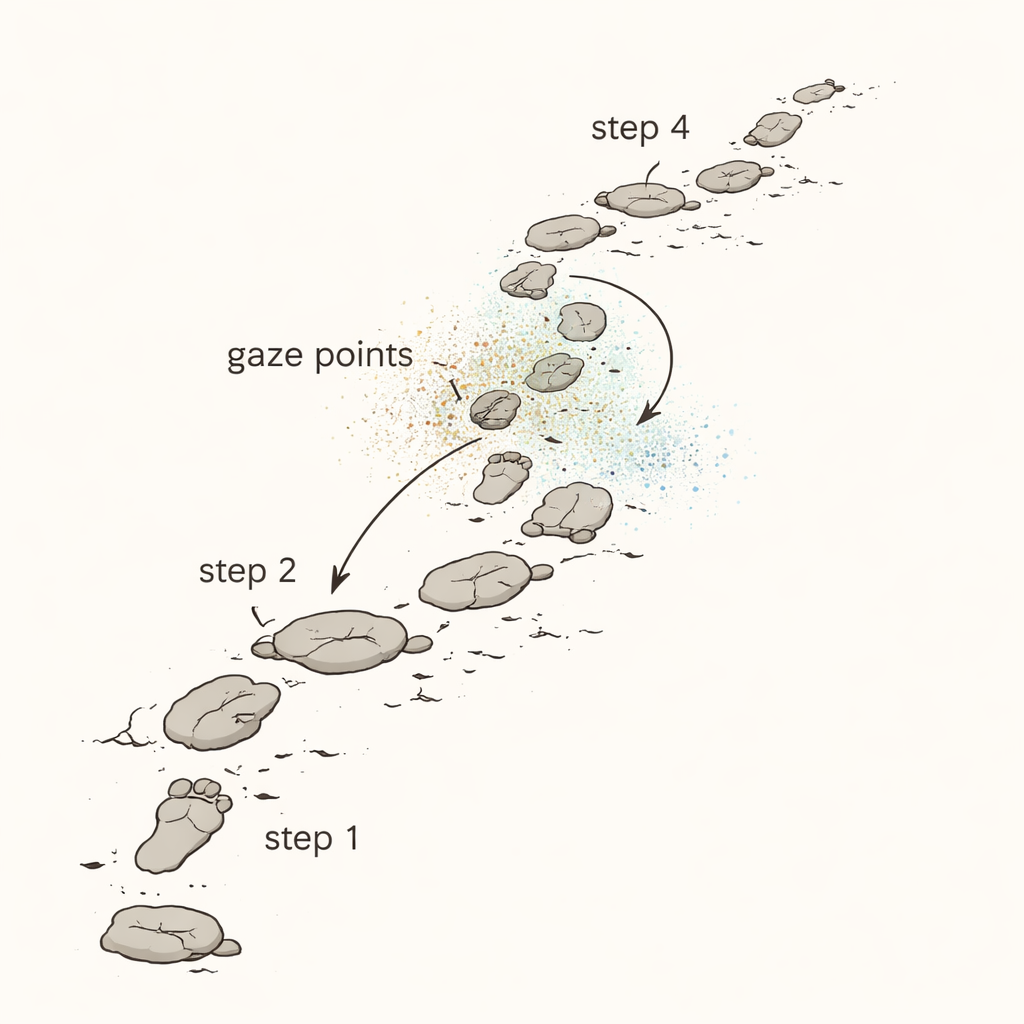
With this combined data set, the team could ask a simple but previously hard-to-answer question: how close does gaze fall to the spots where people actually step? For each fixation—that is, each short period when the eyes are held steady—they found the nearest foothold within the next five steps. Across both medium and rough terrain, gaze clustered around specific future steps, especially those two and three steps ahead. The typical spread of gaze around a foothold was about a quarter of a meter. In visual terms, that means people often do not look exactly at the precise point where their foot will land; instead, their gaze falls somewhere nearby, and they still manage stable steps.
Planning Several Steps and Using “Good Enough” Vision
These patterns suggest that high‑resolution, pinpoint vision is not always necessary for safe walking, even on irregular ground. Instead, information from slightly off-center regions of the retina—the parafovea—often suffices to judge whether a patch of ground is large and flat enough to be safe. People also tend to shift their gaze distribution as the trail gets rougher, looking a bit closer to their bodies and focusing more on steps two and three ahead, while spending less time inspecting steps four or five steps away. Yet the time between looking at a spot and stepping on or near it stays surprisingly stable, around 1.5 to 2 seconds, suggesting that each person maintains a preferred “look-ahead window” and uses visual working memory to plan several steps at once.
What This Means for Everyday Walking
To a layperson, the takeaway is that walking over rough ground is a finely tuned, flexible planning process. Your eyes do not march neatly from one rock to the next; they scout clusters of upcoming footholds a few steps in advance, using “good enough” detail rather than perfect focus. At the same time, your brain juggles information from current and remembered views of the path to choose safe, efficient routes. By combining eye tracking, body motion, and 3D terrain reconstructions, this study shows that staying upright on a rocky trail depends on a subtle balance between where you look, how far ahead you plan, and how precisely you need to see each foothold.
Citation: Panfili, D.P., Muller, K., Bonnen, K. et al. Visual control of walking using terrain reconstructions. Sci Rep 16, 5750 (2026). https://doi.org/10.1038/s41598-026-35803-z
Keywords: locomotion, eye movements, rough terrain, gait planning, visual control