Clear Sky Science · en
Enhanced terahertz radiation generation by phase-controlled two-color laser pulses interacting with an under-dense plasma
Light Waves that Reveal a Hidden Part of the Spectrum
Terahertz waves occupy a little-known slice of the electromagnetic spectrum between microwaves and infrared light. They can peer beneath clothing for security, probe the motions of molecules, and potentially carry ultra-fast wireless data. Yet making strong, tunable terahertz pulses in a compact setup has been a long-standing challenge. This paper explores how cleverly shaped laser flashes striking a thin layer of plasma can dramatically boost terahertz output, pointing toward more powerful tabletop sources.
Why Terahertz Waves Matter
Terahertz radiation spans roughly 0.1 to 10 trillion cycles per second. In this range, many molecules rotate, vibrate, or rearrange their internal electric charges, so terahertz light can act like a stethoscope for matter. It already underpins experiments in chemistry and biology, and it is being explored for high-speed communication links, crop monitoring, and noninvasive security scanners. However, commercially available sources tend to be weak and cover only a narrow frequency band, leaving much of the terahertz range underused. Physicists therefore look to extreme interactions of lasers with matter, especially plasmas—gases whose atoms have been stripped of electrons—to generate brighter and broader terahertz pulses.
Turning Laser Pulses into Terahertz Radiation
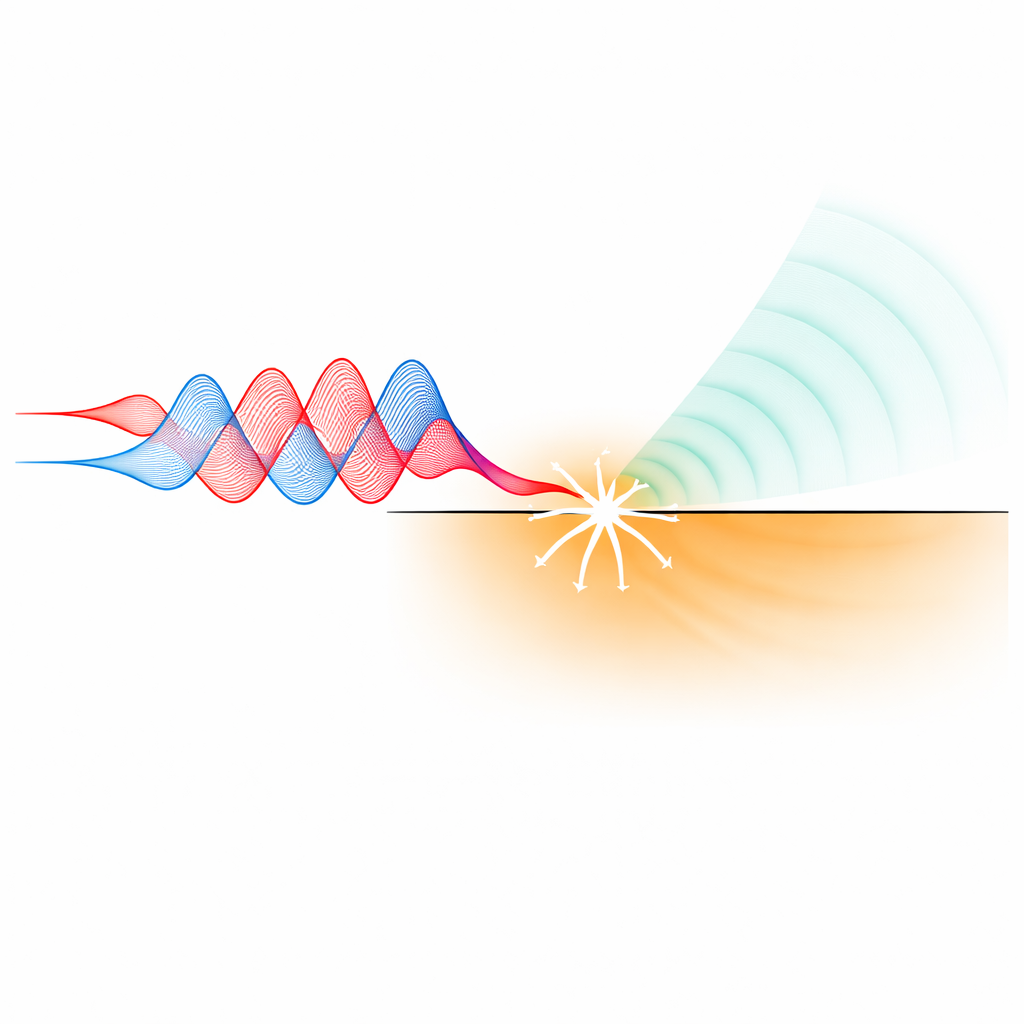
One promising route relies on directing an intense laser pulse at the sharp boundary where vacuum meets an under-dense plasma. When the light hits at an angle, its rapidly oscillating electric field pushes electrons around near the surface. Although the light itself oscillates far faster than terahertz frequencies, its overall push can contain slower variations. These slower variations act like a hammer on the electron layer, causing it to emit much lower-frequency radiation into the terahertz band, a process related to what physicists call transition radiation. The central control knob is the so-called ponderomotive force—the effective, cycle-averaged push that the light exerts on the electrons. Make that push stronger or more asymmetric and the emitted terahertz wave can grow dramatically.
Mixing Two Colors of Light for a Stronger Push
The authors show that using two laser colors together, rather than a single-color pulse, can greatly amplify this effective push. They consider a pair of synchronized laser waves with different frequencies but similar envelopes, whose relative strengths and internal phases can be tuned. When combined, these two colors can produce a mixed waveform whose positive and negative swings are no longer mirror images from cycle to cycle. Even though the overall flash may still contain equal positive and negative areas, locally in time the electron layer can feel a net shove in one direction. The researchers derive a new expression that connects this subtle cycle-to-cycle asymmetry to the strength of the ponderomotive force at the plasma surface. Crucially, this strength depends sensitively on the phase difference between the two colors and on their frequency ratio.
Phase Control as a Power Dial
By exploring different choices of frequency ratio and phase, the team identifies combinations in which the two-color pulse produces a ponderomotive force many times larger than a traditional single-color pulse with the same total energy. When the lower-frequency component is much smaller than the higher one, and the phases are aligned just right, the effective force at the boundary can be hundreds of times stronger. This, in turn, translates into terahertz pulses whose energy can be tens of thousands of times higher than in the single-color case. Shortening the duration of the driving pulse further broadens the terahertz spectrum and nudges its peak toward higher frequencies, offering a way to tune both the strength and the color of the emitted radiation.
Checking the Theory with Virtual Experiments
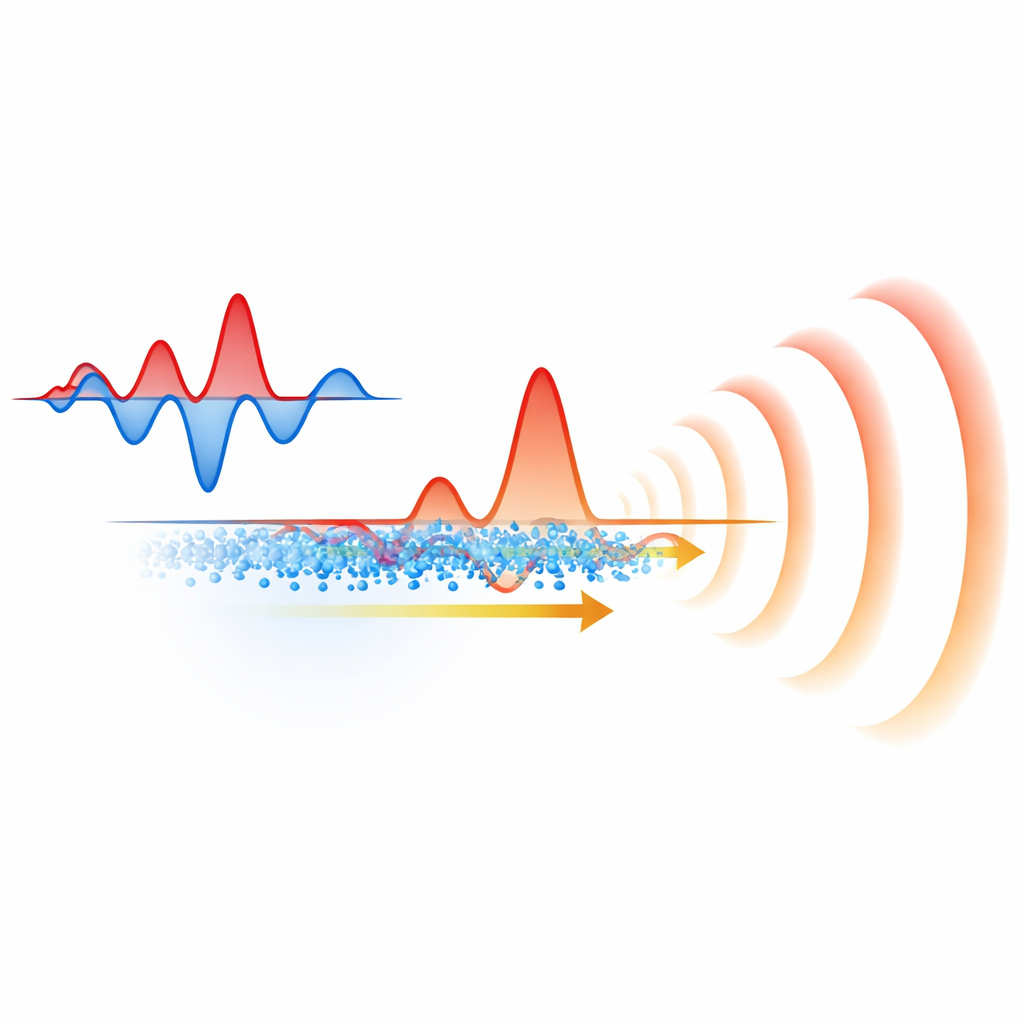
To test whether these analytical results hold up in more realistic conditions, the authors run detailed particle-in-cell simulations. These computer experiments track many charged particles and electromagnetic fields self-consistently in a finite plasma slab. The simulations confirm that two-color pulses with carefully chosen phases produce terahertz fields enhanced by roughly one to two orders of magnitude in the reflected direction, in line with or even exceeding the theoretical predictions. They also reveal that the finite thickness of the plasma can provide additional amplification or suppression by allowing terahertz waves to reflect internally and interfere as they exit.
What This Means for Future Terahertz Sources
In simple terms, the study shows that how you mix and time two laser colors can matter more than just how much laser energy you have. By using phase-controlled two-color pulses, experimenters can engineer a stronger and more directional shove on electrons at a plasma surface, turning an under-dense plasma into an efficient, tunable terahertz emitter. This strategy could help bridge today’s “terahertz gap,” enabling brighter, broadband sources for spectroscopy, imaging, and communication, and it may also benefit other plasma-based technologies that rely on precise control of charged particle motion.
Citation: Anjana, K.P., Srivastav, R.K. & Kundu, M. Enhanced terahertz radiation generation by phase-controlled two-color laser pulses interacting with an under-dense plasma. Sci Rep 16, 9116 (2026). https://doi.org/10.1038/s41598-026-35800-2
Keywords: terahertz radiation, two-color lasers, laser-plasma interaction, ponderomotive force, transition radiation