Clear Sky Science · en
Applicability limits of time-domain impedance spectroscopy for comprehensive thermoelectric characterization under heat leakage conditions
Turning Waste Heat into Useful Power
Every time a car engine runs or a computer chip works hard, heat is produced and mostly wasted. Thermoelectric materials offer a way to turn some of that waste heat directly into electrical power, with no moving parts. This article explores a new way to measure how good such materials really are at this job, under realistic conditions where some heat inevitably “leaks” away. The work matters because accurate, fast testing can speed up the discovery of better materials for cooling electronics, powering sensors, and recovering industrial waste heat.
Why Measuring Thermoelectrics Is So Tricky
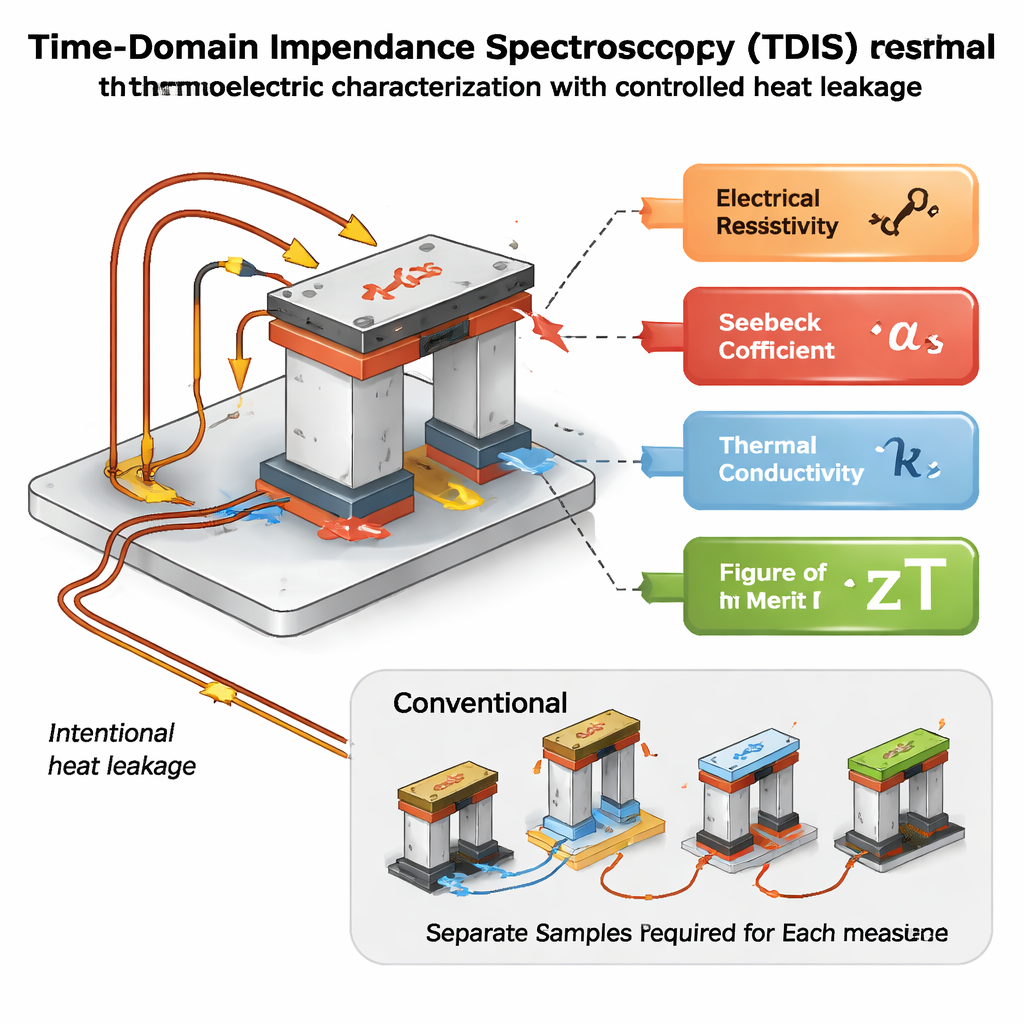
To judge a thermoelectric material, researchers use a score called the dimensionless figure of merit, or zT. A higher zT means better ability to turn heat into electricity. But zT is not measured directly; it combines three separate properties: how well the material conducts electricity (resistivity), how strongly it generates voltage from a temperature difference (Seebeck coefficient), and how easily heat flows through it (thermal conductivity). Traditionally, scientists have to prepare different-shaped samples and use different instruments to measure these three pieces. That process is slow, delicate, and prone to error, especially when tiny heat leaks or contact losses distort the results.
A Single-Test Approach Using Tiny Heat Pulses
The authors build on a recently developed technique called time-domain impedance spectroscopy (TDIS). Instead of heating one side with a heater, they send a carefully controlled electrical current through a thermoelectric module. This current generates a small burst of heat inside the material itself (the Peltier effect), which creates a temperature difference between its two ends. By watching how the electrical resistance of the module changes over time and how it behaves at rapidly alternating current, TDIS can extract the figure of merit zT and the basic electrical resistance using only electrical signals. The clever twist in this study is to intentionally add extra thin wires that act as controlled heat-leak paths. By knowing how much heat these wires can carry away, the method can back out not only zT and resistivity but also the thermal conductivity and Seebeck coefficient from the same sample.
Putting the Method to the Test
To check how far this approach can be pushed, the team studied a commercial module made of bismuth–telluride, a standard thermoelectric material widely used near room temperature. They cooled and warmed the device between 100 and 300 kelvins (about -173 °C to 27 °C), all inside a high-vacuum chamber with temperature stability better than one thousandth of a degree. At each temperature, they measured the response of the module both with and without extra heat-leak wires attached. From these data, they determined resistivity values, zT ranging from about 0.11 at 100 K to 0.86 at 300 K, thermal conductivity values that decreased with temperature, and Seebeck coefficients that increased from around 80 to 190 microvolts per kelvin. These numbers agree well with earlier reports, suggesting that the TDIS approach can give trustworthy results when carefully applied.
Finding the Safe Operating Window
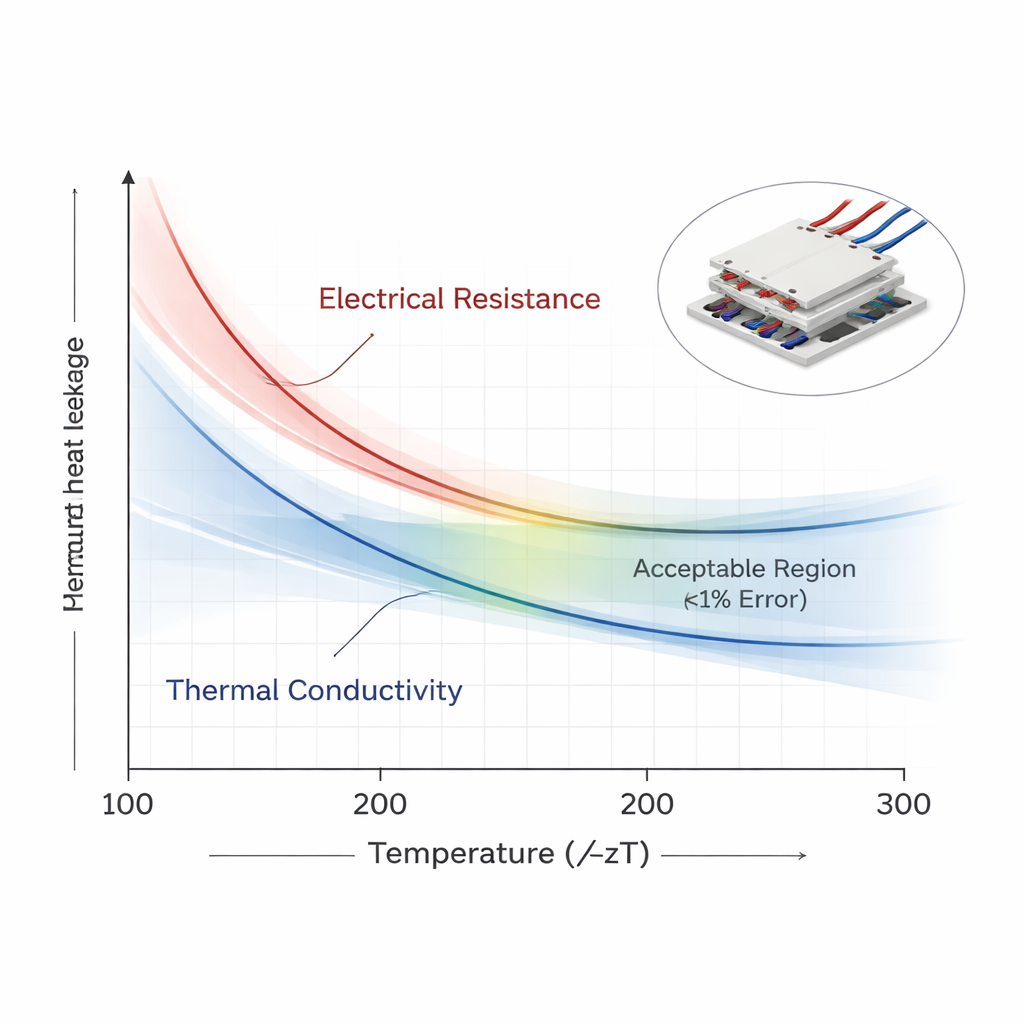
Beyond simply reporting numbers, the study asks a practical question: under what conditions can this method deliver measurements accurate to within about one percent, which is the level needed to compare new materials reliably? The researchers show that two factors dominate. First, the uncertainty in the measured zT must be extremely small—about one part in a thousand or better. This mainly depends on how precisely the final resistance values are extracted from noisy signals, and they demonstrate that digital filtering can reduce this noise to acceptable levels. Second, the ratio between the heat carried away through the added wires and the natural heat flow through the material must be tuned. If the heat leak is too small, the method becomes insensitive; if it is too large, the measured thermal conductivity and Seebeck coefficient become “effective” values that are influenced by hidden heat paths and interfaces rather than the material alone.
What This Means for Future Devices
The authors conclude that, with suitable control of heat leakage and careful noise reduction, the TDIS method can fully characterize a thermoelectric material—electric, thermal, and conversion efficiency properties—from a single sample using only electrical measurements. For a wide range of materials with different zT values, they provide simple, quantitative rules: keep the relative error in zT below about one part in a thousand, and adjust the heat-leak ratio into a specific range depending on whether one wants intrinsic or effective values. In practical terms, this work offers a roadmap for laboratories to test candidate thermoelectric materials more quickly and consistently, which in turn can accelerate the development of solid-state coolers and generators that turn everyday waste heat into useful energy.
Citation: Hasegawa, Y., Kodama, K. Applicability limits of time-domain impedance spectroscopy for comprehensive thermoelectric characterization under heat leakage conditions. Sci Rep 16, 6910 (2026). https://doi.org/10.1038/s41598-026-35799-6
Keywords: thermoelectric materials, waste heat recovery, time-domain impedance spectroscopy, thermal conductivity measurement, Seebeck coefficient