Clear Sky Science · en
A comprehensive study integrating bioinformatics analysis and experimental results on HROB as a potential biomarker for the prognosis of lung adenocarcinoma
Why this lung cancer protein matters
Lung cancer remains one of the deadliest cancers worldwide, and doctors still struggle to predict which patients will do poorly and who might respond best to treatment. This study zooms in on a little-known protein called HROB, found inside our cells where DNA is copied and repaired. By mining large genetic databases and running lab experiments, the researchers show that HROB may help drive an aggressive form of lung cancer called lung adenocarcinoma and could become a new marker for prognosis and a future drug target.
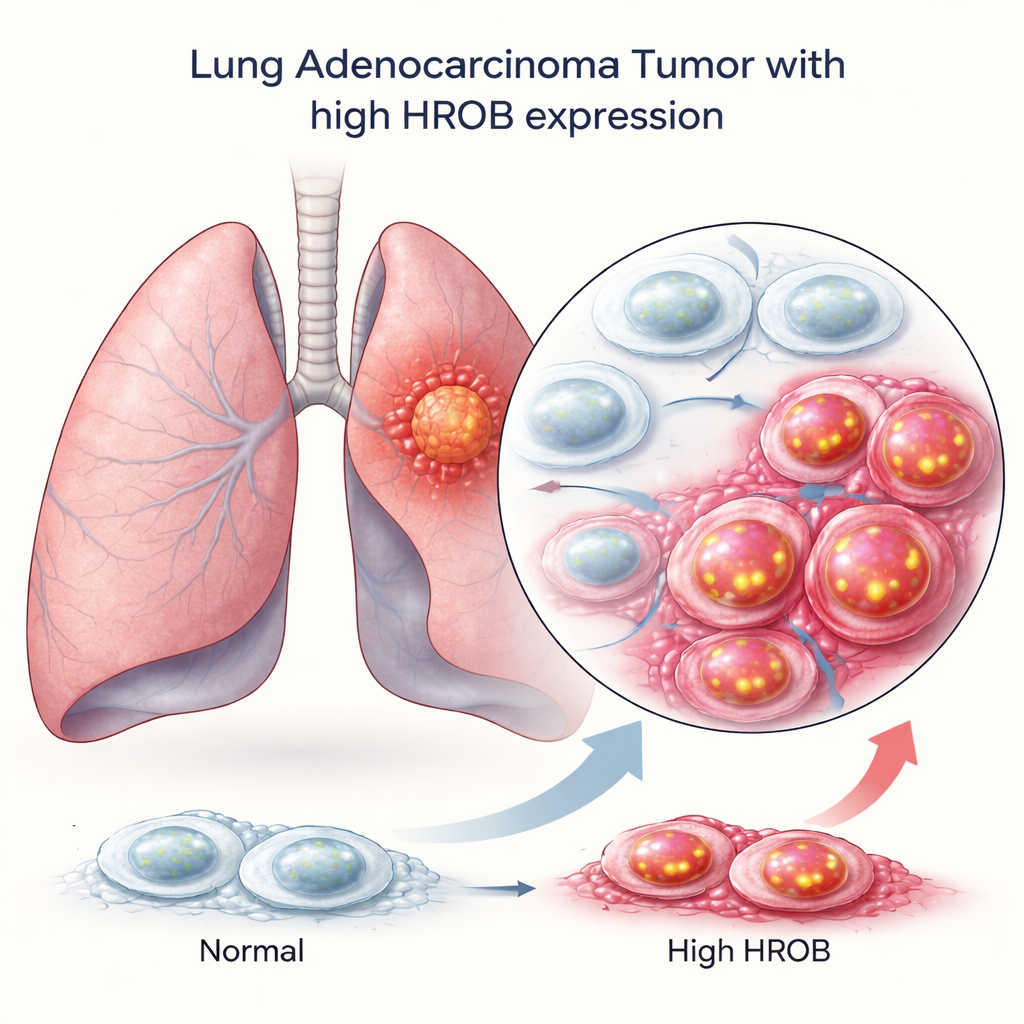
A hidden player in lung tumors
The team began by asking a basic question: is HROB more active in tumors than in healthy tissue? Using thousands of RNA measurements from two major cancer resources, The Cancer Genome Atlas (TCGA) and the Gene Expression Omnibus (GEO), they compared HROB levels across many cancer types. They found that HROB activity was noticeably higher in several cancers, and especially in lung adenocarcinoma, compared with normal lung tissue. This pattern held up even when they restricted the analysis to patients who had both tumor and nearby noncancerous samples, suggesting the rise in HROB is a consistent feature of the disease rather than a quirk of a single dataset.
Linking HROB levels to patient outcomes
Next, the researchers asked whether HROB tells us anything about a patient’s future. They divided lung adenocarcinoma patients into high and low HROB groups and followed how long they lived and how long they remained free of disease progression. Patients with higher HROB levels had shorter overall survival and more cancer-related deaths. Even after accounting for traditional clinical factors such as tumor size, spread to lymph nodes, and treatment response, high HROB remained an independent warning sign of poor prognosis. In statistical terms, patients with elevated HROB had about an 80% higher risk of death. The study also found that smokers with lung adenocarcinoma tended to have higher HROB levels and worse outcomes, tying this molecule to a well-known environmental risk.
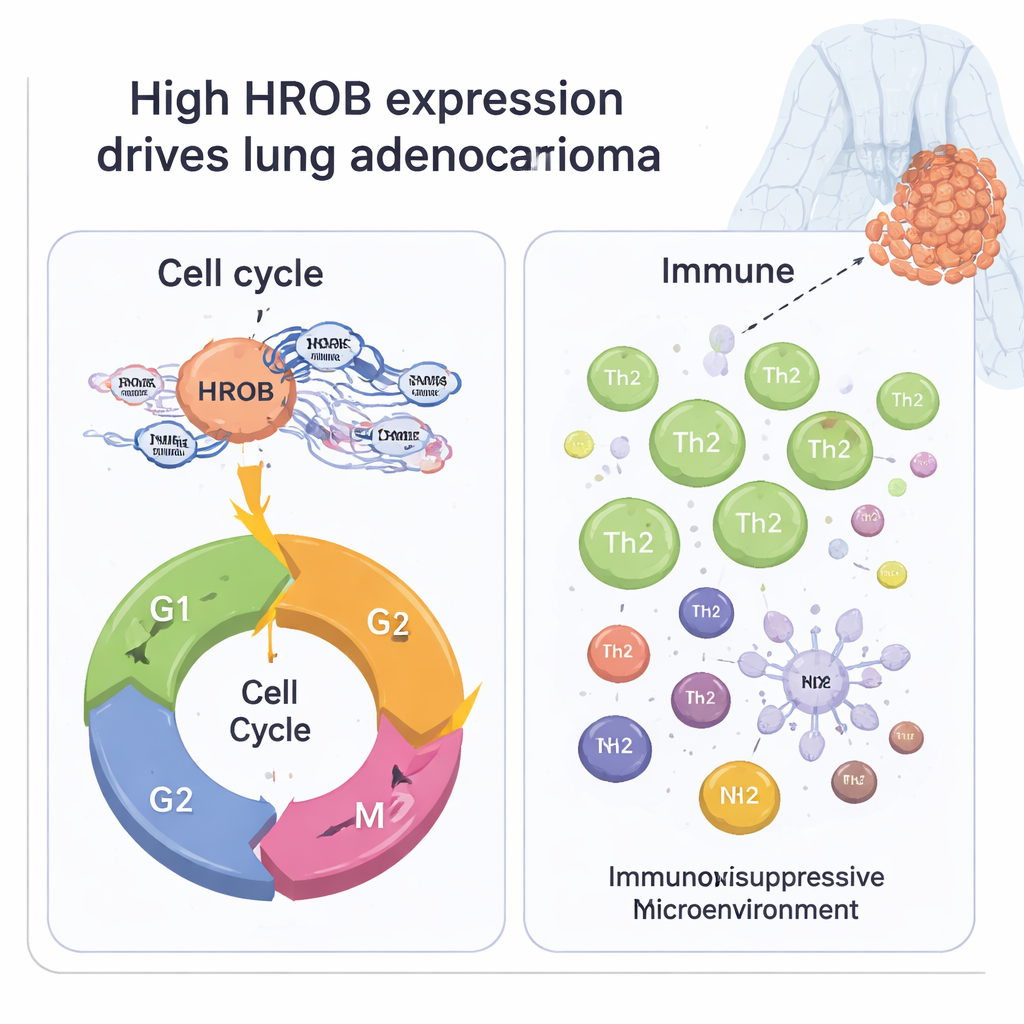
How HROB may help cancer cells grow
To understand what HROB might be doing inside tumor cells, the team compared gene activity patterns between tumors with high and low HROB. Thousands of genes differed, but the strongest signals pointed to the cell cycle—the tightly controlled process by which cells grow and divide. Genes involved in splitting chromosomes, organizing the cell’s internal scaffolding, and passing through key checkpoints were all more active alongside HROB. Network analysis highlighted a set of partner genes that are classic drivers of cell division. In the lab, when the researchers silenced HROB in a lung cancer cell line, the cells grew more slowly, invaded less through artificial membranes, and piled up in the resting (G1) phase of the cell cycle instead of advancing toward division. Together, these findings suggest that HROB acts as a kind of accelerator pedal for lung cancer cell proliferation.
Shaping the tumor’s immune neighborhood
Cancer does not grow in isolation; it interacts constantly with surrounding immune cells. The study therefore examined how HROB levels relate to the “immune microenvironment” of lung tumors. Tumors with high HROB had fewer supportive stromal and immune cells overall and appeared “purer,” meaning more dominated by cancer cells. A closer look at the types of immune cells revealed that high-HROB tumors were rich in a subset of helper T cells called Th2 cells, which tend to favor tumor-friendly conditions, and poorer in other immune cells such as dendritic cells, mast cells, B cells, and certain macrophages that can participate in anti-tumor responses. This pattern points to HROB as a possible influencer of an immunosuppressive environment that helps tumors evade the body’s defenses.
Toward new treatments and what comes next
Beyond describing HROB’s role, the researchers used public drug-matching resources to propose six existing small-molecule compounds that might counteract the gene activity pattern linked to HROB. Some of these drugs already target cancer-related signaling pathways. While this is an early, computer-guided step and not direct proof that these drugs hit HROB itself, it offers leads for future testing. The combination of big-data analysis and cell experiments paints a coherent picture: HROB is overactive in lung adenocarcinoma, helps tumor cells divide and invade, and is associated with an immune environment that favors tumor survival. For patients and clinicians, the message is that HROB could become a useful blood or tissue marker to better gauge risk and, eventually, a molecular handle for more precise therapies—once further clinical and animal studies confirm its value.
Citation: Zhang, F., Liu, X. & Zhou, S. A comprehensive study integrating bioinformatics analysis and experimental results on HROB as a potential biomarker for the prognosis of lung adenocarcinoma. Sci Rep 16, 5056 (2026). https://doi.org/10.1038/s41598-026-35798-7
Keywords: lung adenocarcinoma, HROB protein, cancer biomarker, cell cycle, tumor immune microenvironment