Clear Sky Science · en
Influence of ageing time on the microstructural and mechanical behaviour of Al-Si-Mg/coconut shell ash metal matrix composite
Turning Waste Shells into Strong Metals
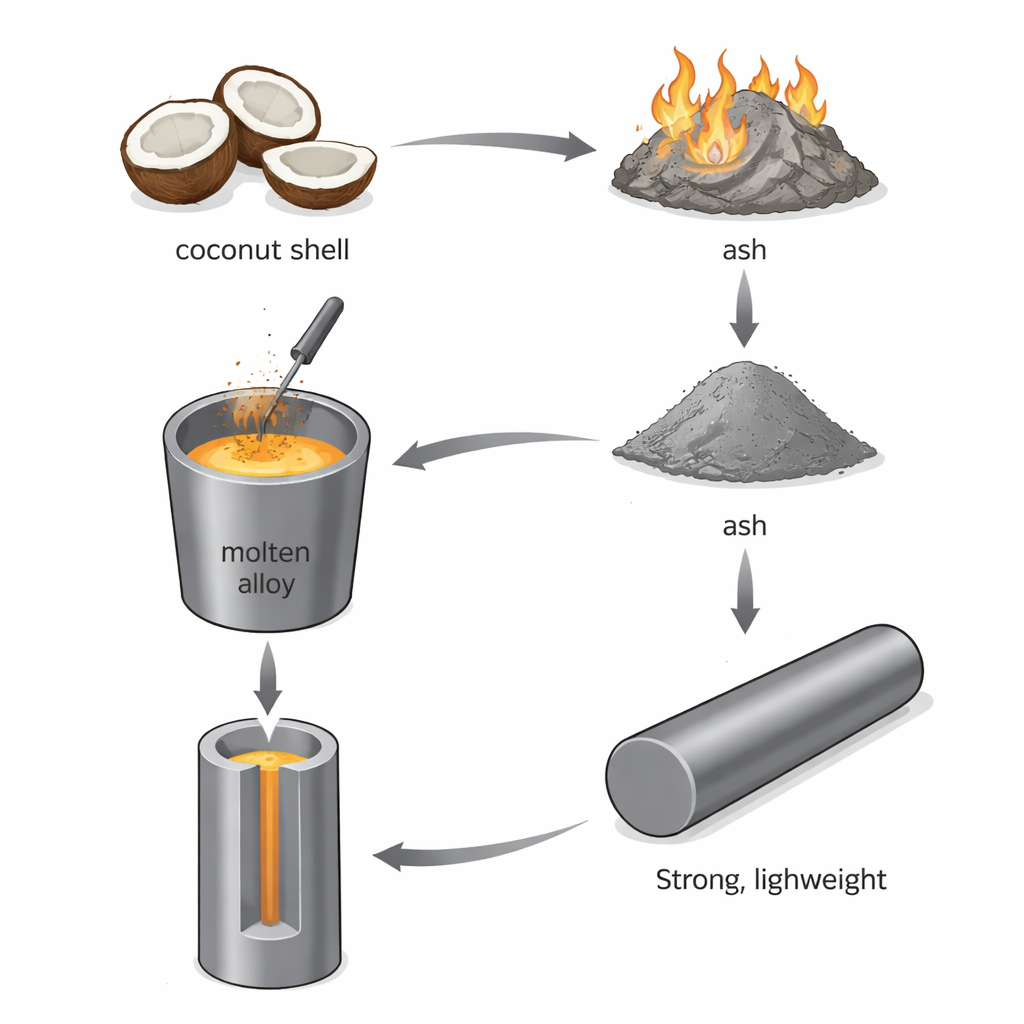
Modern cars, planes and gadgets all need materials that are both strong and light. At the same time, the world is looking for ways to reuse agricultural waste instead of simply burning or dumping it. This study brings those two goals together by showing how ash made from discarded coconut shells can be blended into a common aluminum alloy to create a lighter, tougher metal while putting an abundant waste product to work.
Why Lighter Metals Matter
Aluminum alloys that contain silicon and magnesium are already widely used in the aerospace and automotive industries because they are light, resist rust and can be cast into complex shapes. Silicon helps the molten metal flow and solidify cleanly, while magnesium boosts strength when the metal is heat treated. Even so, engineers are always searching for ways to increase strength and reduce weight further, ideally at low cost and with less environmental impact. Metal matrix composites, where tiny hard particles are locked inside a metal, are one promising route—but many traditional ceramic particles are expensive and energy-intensive to produce.
From Coconut Shell to Engineering Filler
The researchers focused on coconut shell ash, a fine, dark powder rich in silica and carbon that is normally a by-product of burning coconut shells. They carefully cleaned, dried and burned the shells, then reheated the ash in a furnace to remove leftover carbon pieces and ground it down to particles only a few micrometers across. This ash was then mixed into a molten aluminum–silicon–magnesium alloy using a stir-casting setup, which vigorously stirs the melt so that the particles spread out evenly before the metal is poured into cylindrical molds. The resulting composite contained about 7.5 percent coconut shell ash by weight—enough to affect the metal’s behavior without making it too brittle or porous.
Fine-Tuning with Heat and Time
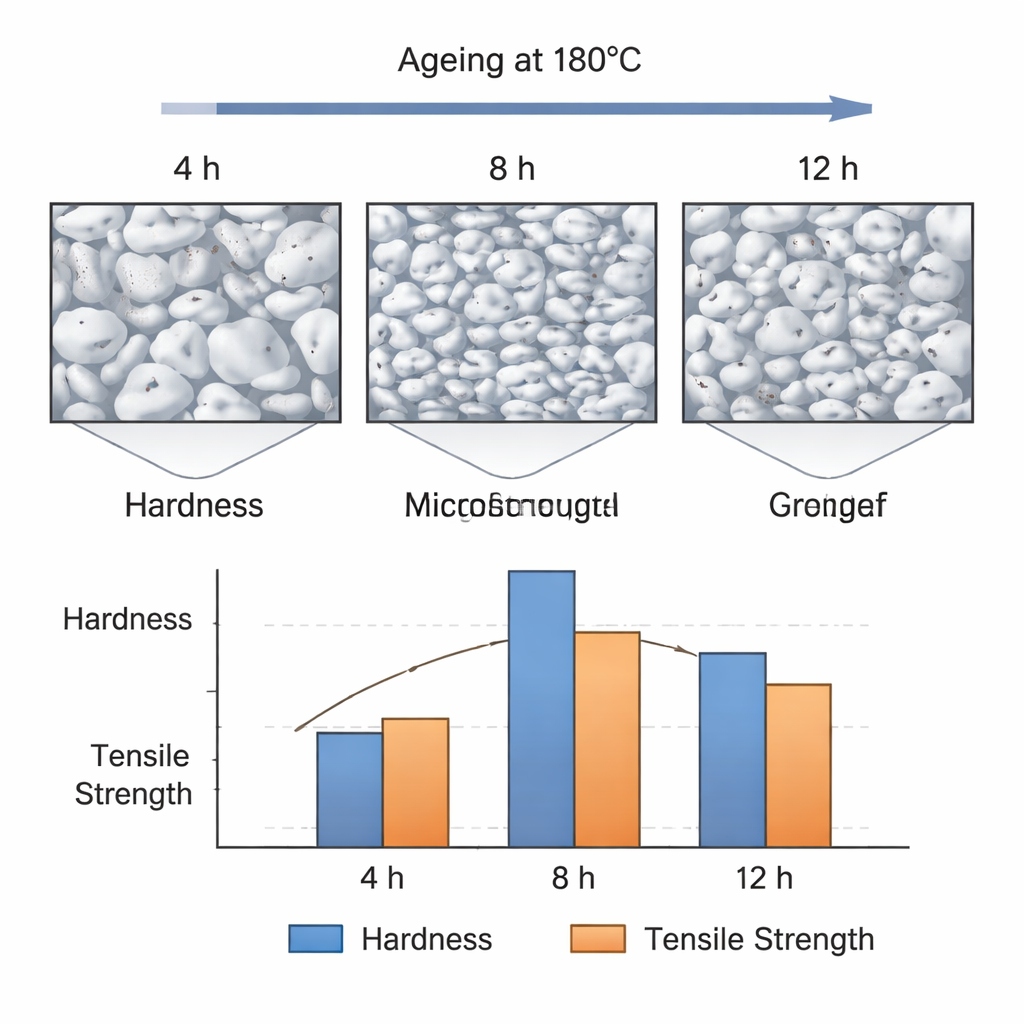
Simply casting the composite is not enough; how long it is aged—held at a moderate temperature after quenching—strongly shapes its internal structure. The team used a T6-type heat treatment: first heating the composite to dissolve alloying elements, rapidly cooling it in water, and then aging it at 180 °C for 4, 8 or 12 hours. Using optical and electron microscopes, as well as X-ray diffraction, they watched how the microscopic arrangement of aluminum grains, silicon-rich regions and hard particles changed with time. Up to 8 hours, the silicon structures and reinforcing particles broke up and became more rounded and evenly spaced, while tiny strengthening compounds containing magnesium formed and pinned the grain boundaries in place. After 12 hours, however, these features began to coarsen and clump, signaling that the material had been aged for too long.
What Happens to Strength and Toughness
Mechanical tests told a clear story that matched the microscopic observations. Adding coconut shell ash alone significantly increased hardness compared with the plain alloy, because the hard particles resist indentation and help spread loads through the metal. After heat treatment, hardness and tensile strength rose further, peaking for samples aged 8 hours. At this point, the composite reached about 130 on the Vickers hardness scale and an ultimate tensile strength around 165 megapascals—roughly 45 percent stronger than the original alloy—while still retaining moderate stretch before fracture. Shorter, 4-hour aging also improved properties, but not as much. By 12 hours, both hardness and strength declined as the over-aged microstructure became less effective at blocking deformation, and the metal’s fracture surface revealed a mix of ductile and brittle features.
What This Means in Everyday Terms
In simple terms, the study shows that waste coconut shells can be turned into a useful ingredient for making lighter, stronger aluminum parts—provided the metal is heat treated for just the right amount of time. Ageing the coconut-ash-reinforced alloy for about eight hours at a moderate temperature gives the best balance of strength and toughness. Go shorter, and the metal has not fully developed its reinforcing structures; go longer, and those structures grow too large and the metal begins to lose its advantage. This insight could help designers create more efficient engine components, automotive parts and other products that use less metal, reduce fuel consumption and make smarter use of agricultural waste.
Citation: Murali, A.P., Kannan, K.R., Shankar, K.V. et al. Influence of ageing time on the microstructural and mechanical behaviour of Al-Si-Mg/coconut shell ash metal matrix composite. Sci Rep 16, 6629 (2026). https://doi.org/10.1038/s41598-026-35796-9
Keywords: aluminum composites, coconut shell ash, lightweight alloys, heat treatment ageing, sustainable materials