Clear Sky Science · en
Artificial neural network as a strategy to predict rheological properties in emulgel formulations
Smarter Creams and Gels for Your Skin
From pain-relief creams to cosmetic moisturizers, many everyday products are actually sophisticated mixtures of oil, water, and thickening agents. Getting their texture “just right” – not too runny, not too stiff – normally takes a lot of trial and error in the lab. This article explores how researchers used artificial intelligence to predict and fine‑tune the thickness of a popular type of topical product called an emulgel, potentially making development faster, cheaper, and more reliable.
Why Texture Matters in Everyday Medicines
Emulgels combine the smooth spread of a cream with the structure of a gel. They are widely used in over‑the‑counter pain treatments and dermatology products because they can hold oily drug ingredients while still feeling pleasant on the skin. Their performance depends strongly on “rheological” properties – in simple terms, how easily they flow and how firm they feel. If a gel is too thin, it may run off the skin or fail to keep the drug where it is needed. If it is too thick, it can be hard to spread and may not release the medicine properly. Traditionally, formulators change one ingredient or processing step at a time and then measure the texture, a slow process that can miss important interactions between variables.
Designing Better Gels with a Plan
The team adopted a strategy known in drug manufacturing as Quality by Design, which starts by asking: which features of the product matter most to patients and safety, and which materials and processing steps control those features? Using a risk‑analysis tool, they identified three key factors for their carbopol‑based emulgels: the amount of carbopol polymer (the main thickener), how long the mixture is stirred, and how fast it is stirred. They then prepared eleven different test gels that systematically varied these three factors, and carefully measured the resulting thickness and other physical properties. This structured approach created a compact but informative data set that captures how recipe and process conditions shape the final feel of the gel.
Teaching a Neural Network to Read the Mixture
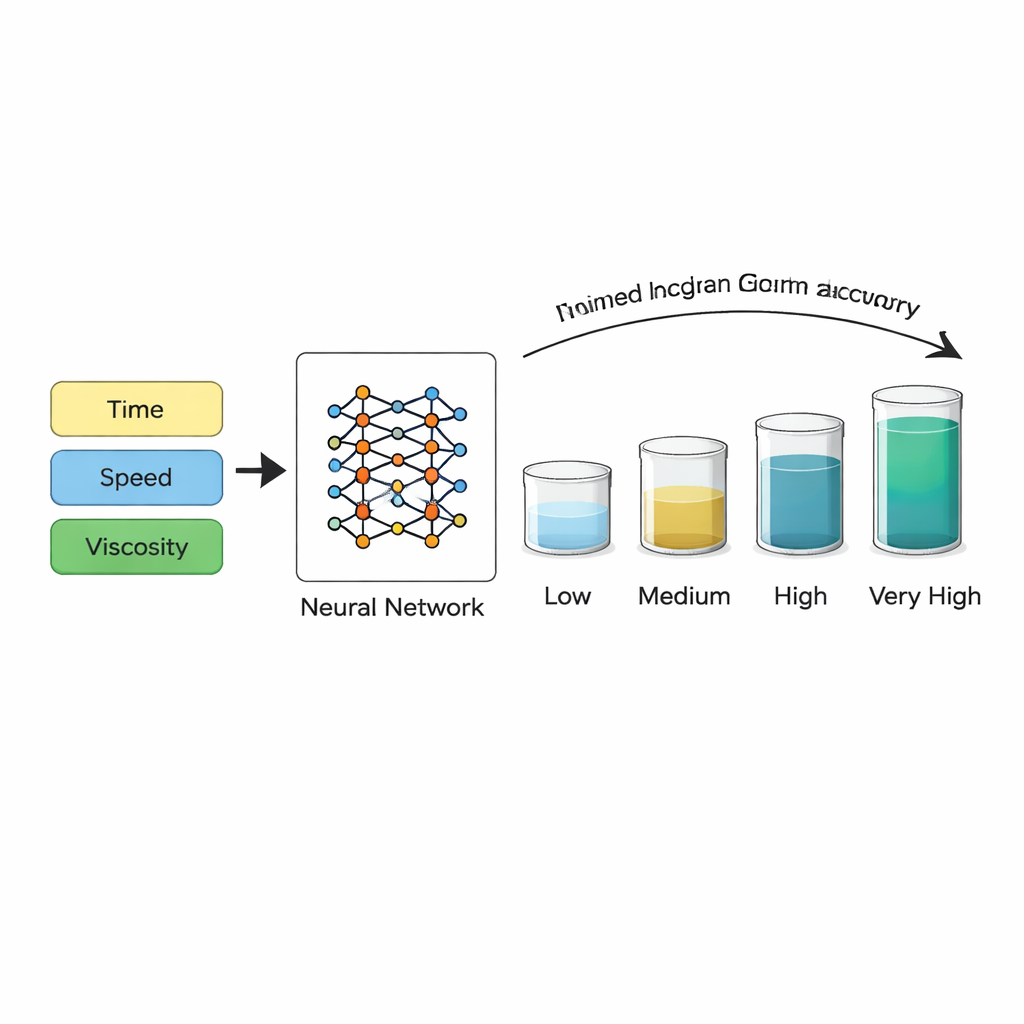
With these experimental data in hand, the researchers turned to artificial neural networks, a type of machine learning inspired by brain‑like layers of connected nodes. Instead of using the network to predict texture directly, they found that the most powerful setup did the reverse: it took easily measured values – mixing time, mixing speed, and gel thickness – as inputs and predicted the carbopol concentration that must have produced them. By testing different network sizes, they identified models that closely matched reality, with correlation values indicating that predicted and actual carbopol levels agreed more than 90 percent of the time in cross‑checks. This meant the system could reliably “infer the recipe from the behavior” of the gel.
Putting the Digital Recipe to the Test
To see whether their virtual formulator worked beyond the initial lab set, the authors challenged it with commercial products, including well‑known pain‑relief emulgels. They measured the thickness of these store‑bought gels, fed that information and chosen mixing times and speeds into their best network, and obtained a predicted carbopol content. When they made new gels using those predicted values, the measured thicknesses matched the originals with agreement above 94 percent, and in some cases almost perfectly. The model performed especially well for thicker, high‑viscosity products, which are common in pharmaceutical gels and particularly sensitive to small changes in composition and processing.
What This Means for Future Medicines
For non‑specialists, the main takeaway is that computers can now learn enough from a relatively small set of carefully planned experiments to act as smart assistants in the lab. Instead of repeatedly guessing and checking, developers of creams and gels can use such neural‑network tools to jump directly to promising recipes that deliver the desired feel and performance. While there are still challenges – especially for very thin products and for explaining the inner workings of these “black box” models to regulators – the study shows that data‑driven design can make everyday medicines more consistent and easier to develop. In the long run, this kind of approach could help bring better topical treatments to market faster, with textures that are optimized for both comfort and effectiveness.
Citation: Duarte, L.S., Molano, L., Jiménez, R.A. et al. Artificial neural network as a strategy to predict rheological properties in emulgel formulations. Sci Rep 16, 5025 (2026). https://doi.org/10.1038/s41598-026-35795-w
Keywords: topical gels, artificial neural networks, drug formulation, emulgels, pharmaceutical rheology