Clear Sky Science · en
The impact of new quality productive forces on urban carbon emission performance in the Yangtze river economic belt of China
Why this matters for cities and the climate
China’s Yangtze River Economic Belt (YREB) is one of the country’s main engines of growth—and also one of its biggest sources of carbon dioxide. This study asks a pressing question for anyone concerned about climate change and sustainable cities: can a new kind of high-tech, green, and skills‑driven economy help cities grow while cutting emissions? By examining over a decade of data from 108 cities, the authors show how “new quality productive forces” – a package of digital technology, green innovation, and advanced industry – can make urban development cleaner and more efficient, with benefits that spill over from one city to its neighbors. 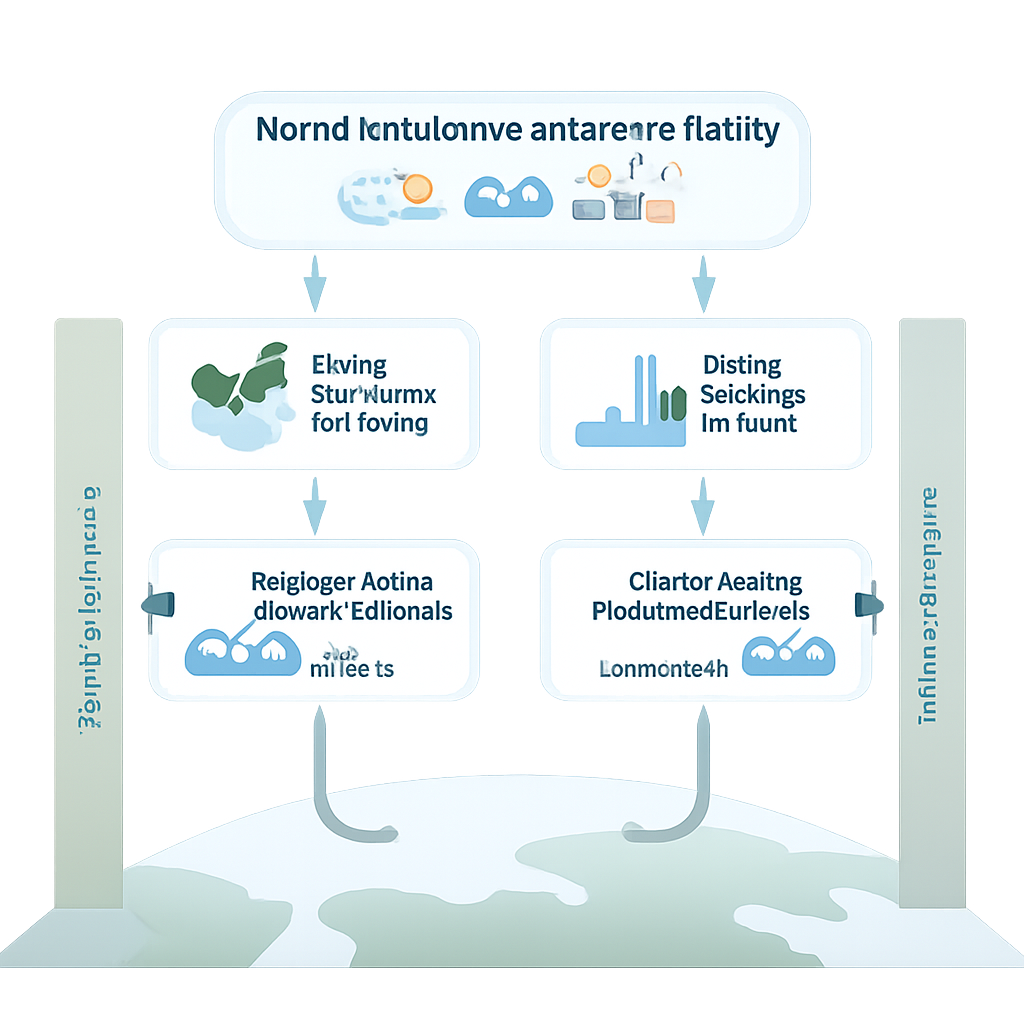
A new kind of economic strength
The paper focuses on “new quality productive forces,” a policy term that captures how modern economies are shifting away from cheap labor and heavy industry toward knowledge, digital tools, and cleaner technologies. In practical terms, this means more skilled workers, smarter factories, better data systems, and equipment such as industrial robots and artificial intelligence. In the YREB, which produces nearly half of China’s total economic output but also a large share of its emissions, these new forces are seen as a key lever for hitting national “dual carbon” goals—peaking emissions and then reaching carbon neutrality—without sacrificing growth.
Measuring how clean and efficient cities really are
To see whether this new growth model is really greener, the authors track two sides of city carbon performance from 2010 to 2022. The first is carbon emission intensity: how much carbon dioxide a city emits for each unit of economic output. The second is carbon emission efficiency: how much economic value a city can create for each unit of carbon it emits. Using satellite‑based carbon data, city statistics, and an efficiency model that treats emissions as an unwanted by‑product, they build detailed indicators for all 108 cities. At the same time, they construct a multi‑indicator index of new quality productive forces, including digital infrastructure, high‑tech firms, green investment, and advanced equipment, to see how strongly each city has embraced this new development path.
How innovation and industry upgrades cut carbon
The analysis shows a clear pattern: cities that score higher on new quality productive forces tend to emit less carbon per unit of GDP and to generate more output from each ton of emissions. In other words, the new growth model both lowers intensity and raises efficiency. The study digs deeper into why this happens. Two main channels emerge. First, cities with stronger new productive forces produce and adopt more green technologies, often captured through higher rates of green patents. These help firms use less energy and cleaner processes, pushing emissions down at the source. Second, these forces accelerate a shift in the local economy away from heavy, energy‑hungry industries toward more advanced manufacturing and services. This more balanced industrial mix uses resources better and raises the value created for each unit of energy and carbon. Environmental regulations—such as stricter language on pollution and climate in city government reports—amplify both channels by nudging firms to adopt green solutions faster. 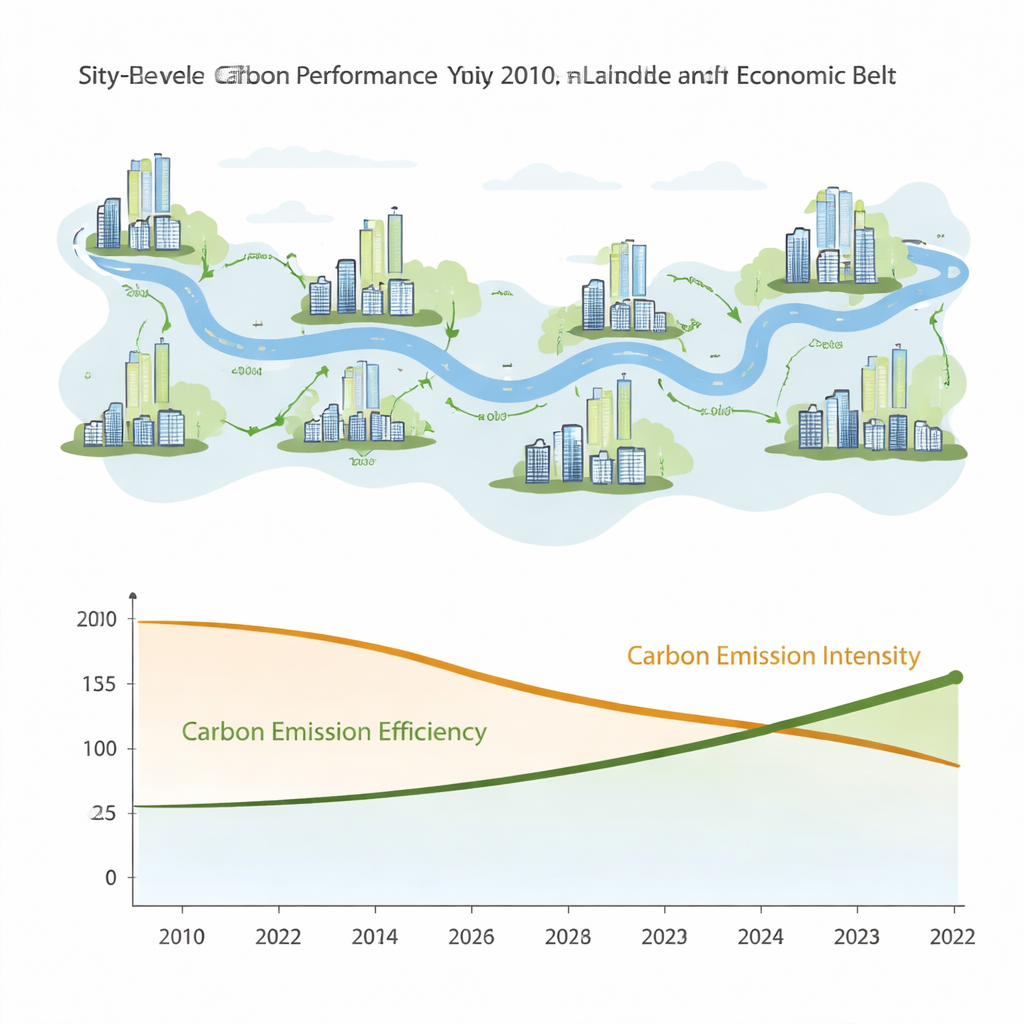
Not all cities benefit in the same way
The story is not uniform across the region. In cities that are poorer or already relatively low‑carbon, new quality productive forces are especially effective at pushing down carbon intensity, mainly by replacing outdated technologies and cleaning up traditional industries. In wealthier or more carbon‑intensive cities, the same forces do more to boost efficiency—getting more economic output from each ton of carbon—than to slash intensity further. Policy pilots also matter: cities officially designated as low‑carbon pilots reap larger gains in both intensity and efficiency, suggesting that supportive policies and finance make it easier to turn abstract ideas about green growth into real‑world change.
Green progress that spreads across city borders
Because the Yangtze River Economic Belt is a tightly connected corridor of cities, the authors test whether progress in one place helps—or hurts—its neighbors. Using a spatial model, they find that improvements do in fact spread. When a city strengthens its new quality productive forces, it not only improves its own carbon performance but also tends to lower carbon intensity and raise efficiency in nearby cities. This happens through shared supply chains, technology diffusion, talent flows, and policy imitation. In effect, early‑moving cities can pull the whole region toward cleaner growth, especially when regional planning and infrastructure encourage integration.
What this means for the path to cleaner growth
For a lay reader, the core message is straightforward: cities do not have to choose between economic dynamism and climate responsibility. In China’s Yangtze River Economic Belt, a shift toward a more innovative, digital, and skills‑rich economy is already helping cities produce more with less carbon, particularly when it is backed by smart environmental rules and industrial policies. Because these gains spill over across city borders, investing in new quality productive forces is not just a local choice but a regional strategy. Strengthening green technology, upgrading industry, and fine‑tuning environmental regulation can together move large urban regions onto a path where cleaner air and strong growth reinforce each other rather than conflict.
Citation: Liu, X., Sun, F. & Li, Y. The impact of new quality productive forces on urban carbon emission performance in the Yangtze river economic belt of China. Sci Rep 16, 5131 (2026). https://doi.org/10.1038/s41598-026-35794-x
Keywords: urban carbon emissions, green innovation, industrial transformation, Yangtze River Economic Belt, low-carbon development