Clear Sky Science · en
Quantum kernel methods for marketing analytics with convergence theory and separation bounds
Why smarter customer predictions matter
Companies increasingly rely on data to decide which customers to target with offers, support, or retention campaigns. But as data grows more complex, traditional tools can struggle to spot subtle patterns, especially when every missed high-value customer is costly. This paper explores whether emerging quantum computers—machines that use the rules of quantum physics—could sharpen these predictions for marketing-style problems, and does so with a clear eye on today’s imperfect, “noisy” hardware.
From customer records to quantum circuits
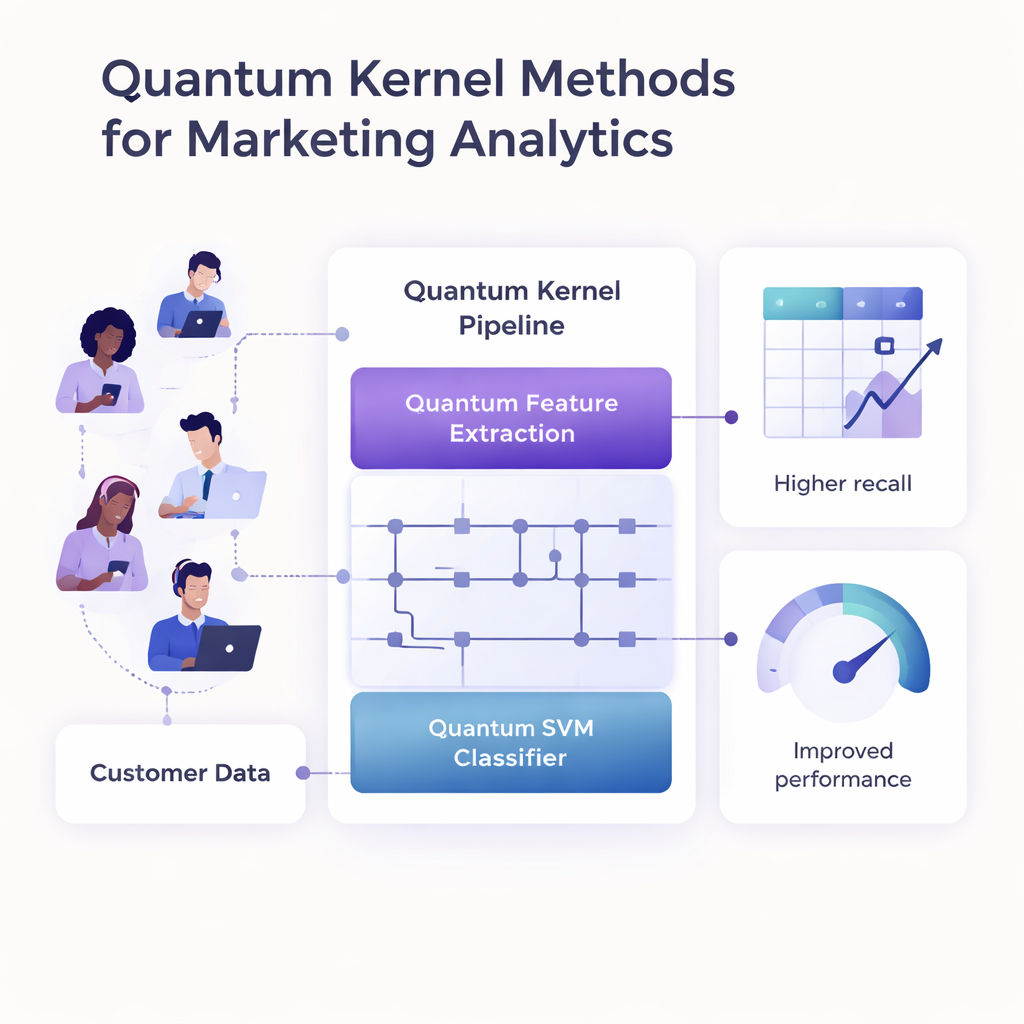
The authors focus on a practical task they call consumer classification: predicting which users will engage with or adopt a digital service. Each user is described by a small set of numerical features, such as demographics and behavior on a platform. Instead of feeding this data directly into a standard algorithm, they first encode it into the states of a few quantum bits (qubits) using a compact quantum circuit. This circuit acts as a feature transformation, reshaping the data into a form that may be easier to separate into two groups—“likely to engage” and “unlikely to engage.” On top of this quantum transformation, they use a well-known classification method, the support vector machine, in a quantum-flavored version called a quantum-kernel SVM (Q-SVM).
Testing quantum ideas in realistic conditions
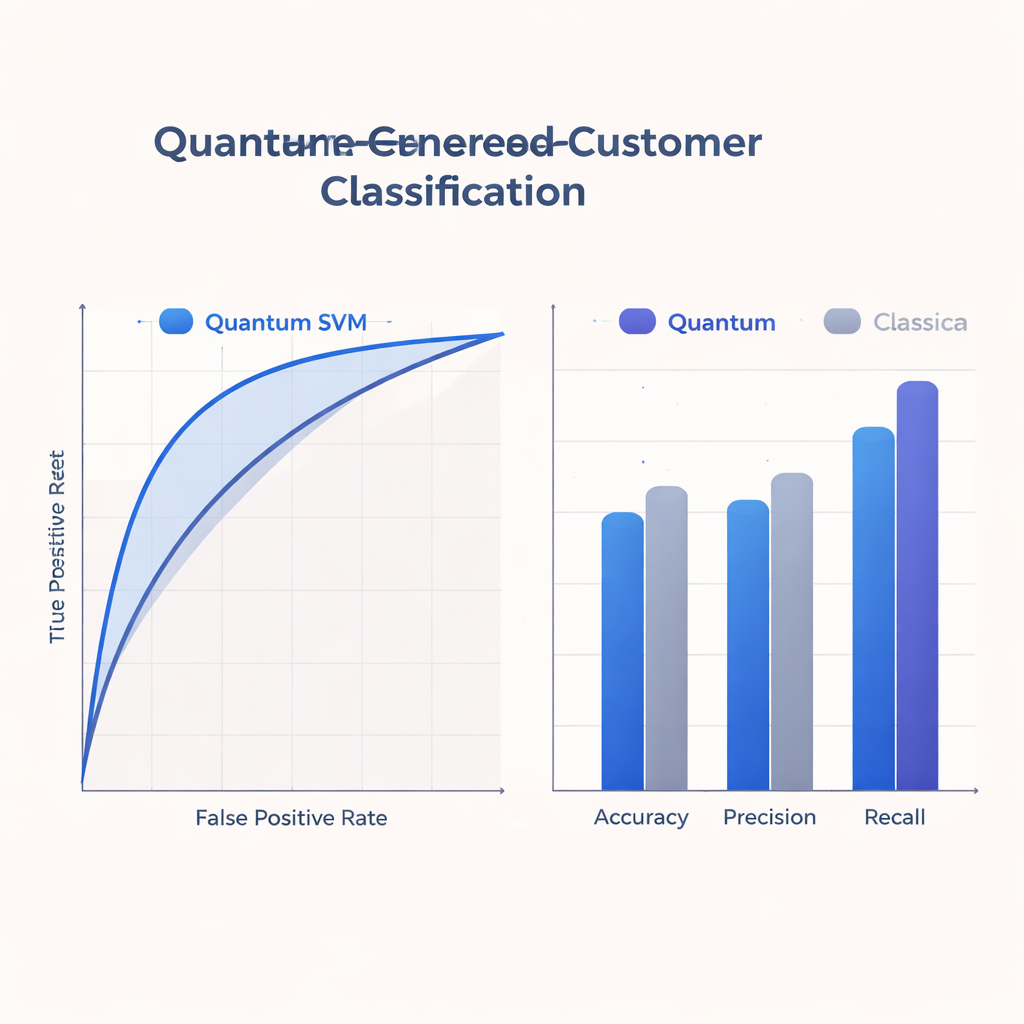
Because today’s quantum devices are small and error-prone, the study sticks to shallow circuits that match what near-term hardware can handle. The team trains and evaluates their Q-SVM on a real, anonymized dataset of about 500 training and 125 test cases with eight features per user, simulating both ideal and noisy quantum behavior. They compare the quantum approach to strong classical baselines that use popular kernel tricks on standard computers. Across accuracy, precision, recall, and the area under the ROC curve (a summary of trade-offs between catching positives and avoiding false alarms), the Q-SVM delivers competitive or better performance, with especially strong recall: it correctly identifies a higher fraction of truly interested users than the classical models do.
Theoretical guarantees behind the scenes
Beyond raw performance, the paper asks a deeper question: when should quantum methods be expected to help at all? The authors develop three main theoretical results. First, they show that if the learning problem satisfies certain smoothness conditions and the quantum circuits remain shallow, the training process for quantum kernels should converge reliably in a reasonable number of steps. Second, they provide separation bounds suggesting that their quantum feature extraction can, under specific assumptions, enlarge the gap between the two customer classes compared with classical transformations—essentially making the problem easier to solve. Third, they analyze how approximate methods can dramatically reduce the cost of working with large quantum-derived feature spaces, so that the approach remains computationally feasible.
What this could mean for marketers
For marketing and customer analytics teams, the most concrete payoff lies in how the quantum model balances missed opportunities versus wasted outreach. The Q-SVM’s higher recall means it is less likely to overlook users who would respond positively to an offer, a key advantage in retention or proactive service campaigns. At the same time, its precision and overall accuracy stay in a range comparable to strong classical baselines, supported by a robust ROC curve. Because the method works well across a range of decision thresholds, teams could adjust how aggressive or cautious they are—favoring either recall or precision—without needing to retrain the model each time.
A promising start, not a quantum revolution (yet)
The authors stress that their findings are early steps, not proof of sweeping quantum superiority. Results come from simulations on one dataset, not from large-scale hardware runs or many different markets. Their mathematical guarantees also rely on idealized assumptions that may not fully hold on noisy devices. Still, the work shows that carefully designed quantum kernels can already match or slightly outperform good classical methods on a realistic consumer task, while offering a clear path to larger advantages as quantum hardware scales. For readers, the takeaway is that quantum machine learning is moving from abstract promise toward tools that could one day make customer predictions more accurate and flexible in real-world business settings.
Citation: Sáez Ortuño, L., Forgas Coll, S. & Ferrara, M. Quantum kernel methods for marketing analytics with convergence theory and separation bounds. Sci Rep 16, 6645 (2026). https://doi.org/10.1038/s41598-026-35793-y
Keywords: quantum machine learning, marketing analytics, customer classification, support vector machines, quantum kernels