Clear Sky Science · en
Factors influencing the progression of post-mortem changes between scene and autopsy
Why the pace of decay matters
When someone dies, their body does not simply “freeze in time” once it reaches a cold room. Subtle changes continue, and those changes can erase clues about how and when the person died. This study asks a deceptively simple question with big practical consequences: between the moment a body is found and the later autopsy, what really drives the speed of decomposition – and how can we slow it down to protect vital forensic evidence?
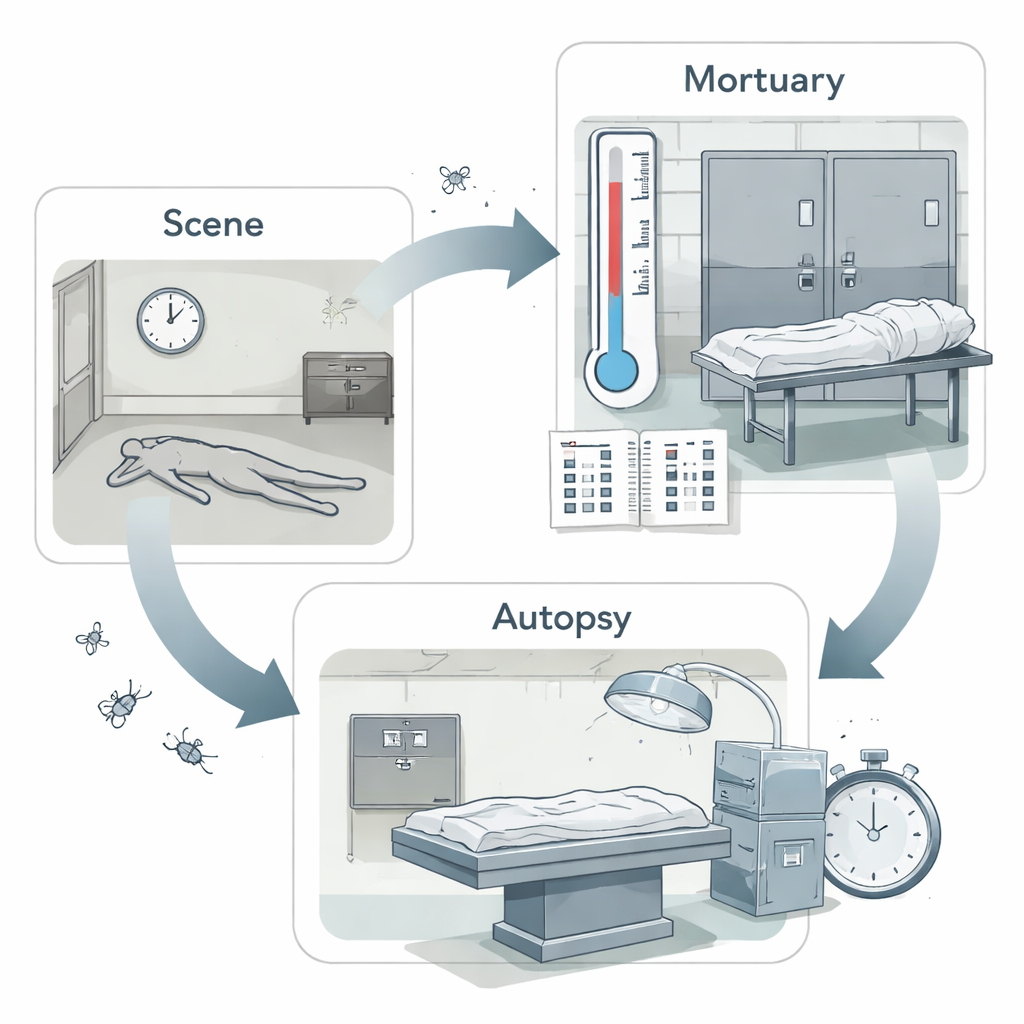
Following bodies from discovery to autopsy
The research team in Frankfurt tracked 135 deaths that became forensic cases. For each one, the same specialists examined the body twice: first at the place it was found (a home, outdoors, or elsewhere) and later in the autopsy room. Between those points, bodies were placed in plastic body bags, taken to a mortuary, stored in cold rooms, and then moved on to the Institute of Legal Medicine, where they were cooled again until autopsy. This whole journey typically took almost a week. To see how decay progressed, the team used two scoring systems that rate visible changes – such as discoloration, bloating, or drying of tissues – into numerical “decomposition scores.” They also attached small temperature loggers to the wrist inside each body bag to record the cooling process hour by hour.
What happens to body temperature in cold storage
The temperature data showed that refrigeration does not immediately stop decomposition. On average, bodies started at about room temperature and took several days to cool. Many did not reach 10 °C for more than two days, and only a minority ever fell to around 6 °C, a level often assumed to be “safe” in forensic calculations. Storage time in the first mortuary made up about 60% of the total cooling period, and the quality of cooling there varied. Bodies generally cooled quickly during the first 40 hours, warmed slightly during transport, and then cooled again in the specialized facility. Importantly, bodies discovered in summer or those heavily colonized by insects began with higher internal temperatures and cooled from a warmer starting point, keeping them in a “decomposition-friendly” range for longer.
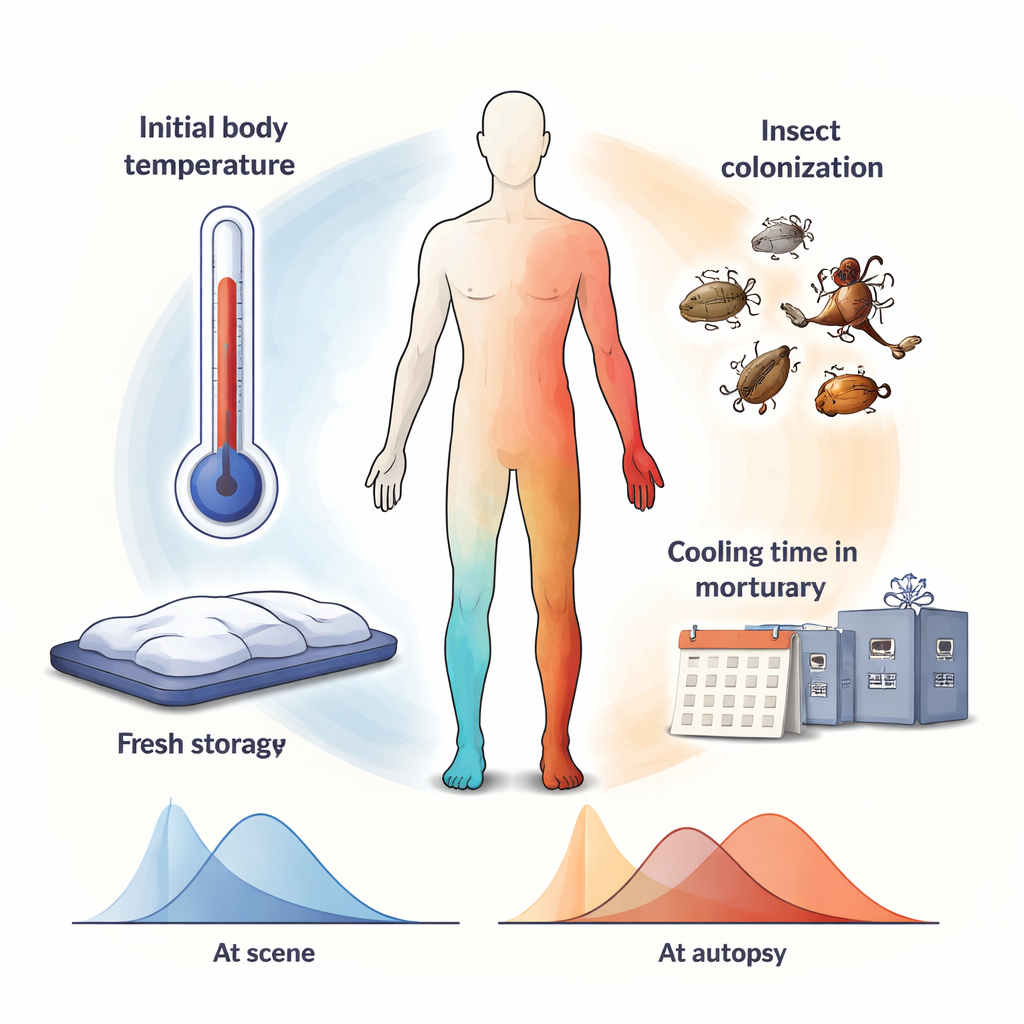
Key factors that speed up visible decay
By comparing the decomposition scores at the scene and at autopsy, the researchers found that more than half of the bodies showed clear progression of decay during storage. Three factors stood out as especially important, regardless of which scoring method was used. First, bodies that were still in very early stages of decay when discovered tended to change the most during refrigeration; they had more “room to advance” along the decomposition process. Second, higher initial body temperature was strongly linked to greater later change, because warmth fuels bacterial activity, chemical breakdown, and insect growth. Third, long storage times in the mortuary – especially more than five days – were associated with noticeably greater progression of decomposition. In addition, bodies colonized by insects decomposed faster even in the cooler, as maggot activity can raise local temperatures and consume soft tissues.
Why climate, clothing, and location are not the whole story
Some influences that might seem obvious turned out to matter less than expected. The estimated time since death before discovery, as well as the general outdoor temperature at the scene, did not show a strong, direct link with how much decomposition advanced during storage. Indoor versus outdoor discovery locations produced only minor differences in cooling behavior. Clothing showed a complex picture: in this study, unclothed bodies often appeared to change a bit less between scene and autopsy, but the authors note that this may partly reflect better photographic documentation rather than a real biological effect. Overall, the findings highlight that decomposition is shaped by many interacting variables rather than by single simple factors.
Practical steps to protect forensic evidence
For investigators, the message is straightforward. Bodies that are warm when discovered, in the early stages of decomposition, or clearly infested with insects are at highest risk of rapid change while waiting in cold storage. If these bodies are stored for many days in mortuary coolers that are not cold enough or are opened frequently, crucial signs like bruises or small wounds can be lost, making it harder or even impossible to determine the cause or manner of death. The authors recommend clear nationwide rules: mortuaries should cool bodies to around 4 °C, prioritize quick autopsies for warm or insect-colonized remains, and avoid storage periods longer than five days. Better temperature control and case triage, they argue, would not only improve time-of-death estimates but also safeguard justice by preserving fragile evidence.
Citation: Lanzinger, N., Verhoff, M.A., Birngruber, C.G. et al. Factors influencing the progression of post-mortem changes between scene and autopsy. Sci Rep 16, 1950 (2026). https://doi.org/10.1038/s41598-026-35786-x
Keywords: forensic pathology, body decomposition, postmortem interval, mortuary cooling, insect colonization